









































Author: Mycond Technical Department
The air we breathe is not just a mixture of nitrogen, oxygen, and other gases. It is a complex thermodynamic system that contains water vapor, whose state determines our comfort, the energy efficiency of buildings, and the durability of structures. For an HVAC engineer (heating, ventilation, and air conditioning), understanding humid air parameters is not just theoretical knowledge but the foundation of everyday professional activity—essential for correct system design, problem diagnosis, and ensuring an optimal indoor environment.
Water vapor in the air affects people’s health, the preservation of property, energy consumption, and the cost-effectiveness of engineering systems. That is why we will consider seven key parameters of humid air that must be taken into account in the design and operation of HVAC systems.
1. Dry-bulb temperature
Dry-bulb temperature (T) is the ordinary air temperature indicated by a thermometer that is not affected by moisture or radiation. It is measured in degrees Celsius (°C) and is the most common and intuitive parameter.
The term “dry-bulb” distinguishes it from “wet-bulb” temperature in a psychrometer. On the psychrometric chart, dry-bulb temperature is the horizontal axis that forms the basis for all other parameters.
Recommended values for thermal comfort:
- Residential spaces: 20–22 °C in winter and 23–25 °C in summer
- Offices: 21–23 °C regardless of season
2. Relative humidity
Relative humidity (RH or φ) is the ratio of the actual amount of water vapor in the air to the maximum possible amount at a given temperature, expressed as a percentage (%). It is one of the most common humidity parameters, yet also one of the most frequently misinterpreted.
A key feature of relative humidity is its dependence on temperature. Even if the absolute amount of water vapor in the air remains unchanged, relative humidity varies with temperature. For example, winter air at -5 °C and 80% RH, when heated to +21 °C, will have a relative humidity of only about 20%, although the absolute amount of water vapor remains the same.
For human comfort, the optimal relative humidity is considered to be 40–60%. Below 30% the air becomes too dry, leading to dryness of mucous membranes and discomfort, while above 70% it creates conditions for mold and fungi growth and a “sticky” sensation.
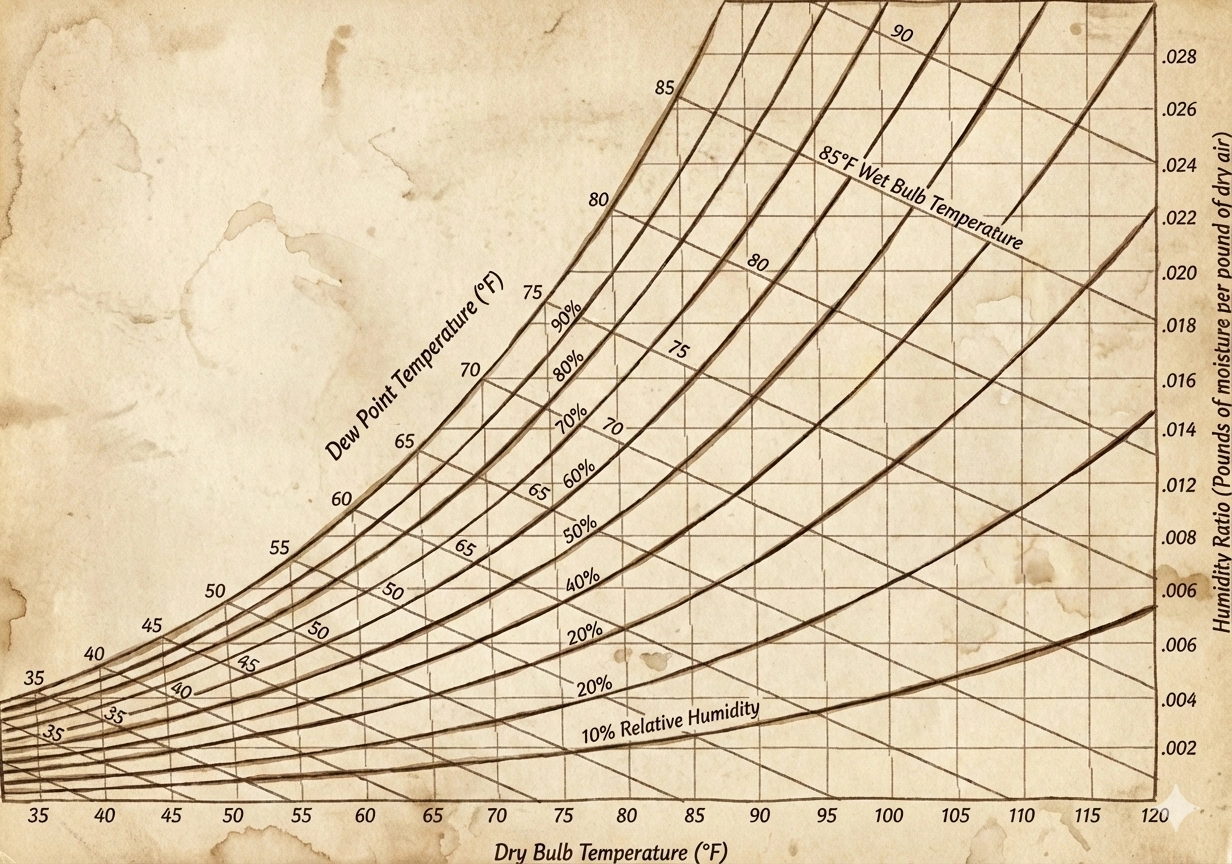
On the psychrometric chart, relative humidity lines are curved.
3. Humidity ratio (moisture content)
Humidity ratio (d, w, or x) is the actual physical amount of water vapor contained in air, expressed in grams per kilogram of dry air (g/kg). The main advantage of this parameter is that it does not depend on temperature and remains constant during heating or cooling (provided there is no condensation or additional humidification).
Typical humidity ratio values:
- Dry winter day: 2–4 g/kg
- Comfortable indoor conditions: 6–9 g/kg
- Humid summer day: 12–18 g/kg
- Tropical climate: over 20 g/kg
To calculate the amount of moisture that needs to be removed from a space, use the formula:
W = G × (din - dout), where:
- W — amount of moisture removed, kg/h
- G — air flow rate, kg/h
- din, dout — humidity ratio of indoor and outdoor air, g/kg
On the psychrometric chart, the humidity ratio is shown as horizontal lines with the scale on the right.
4. Dew point temperature
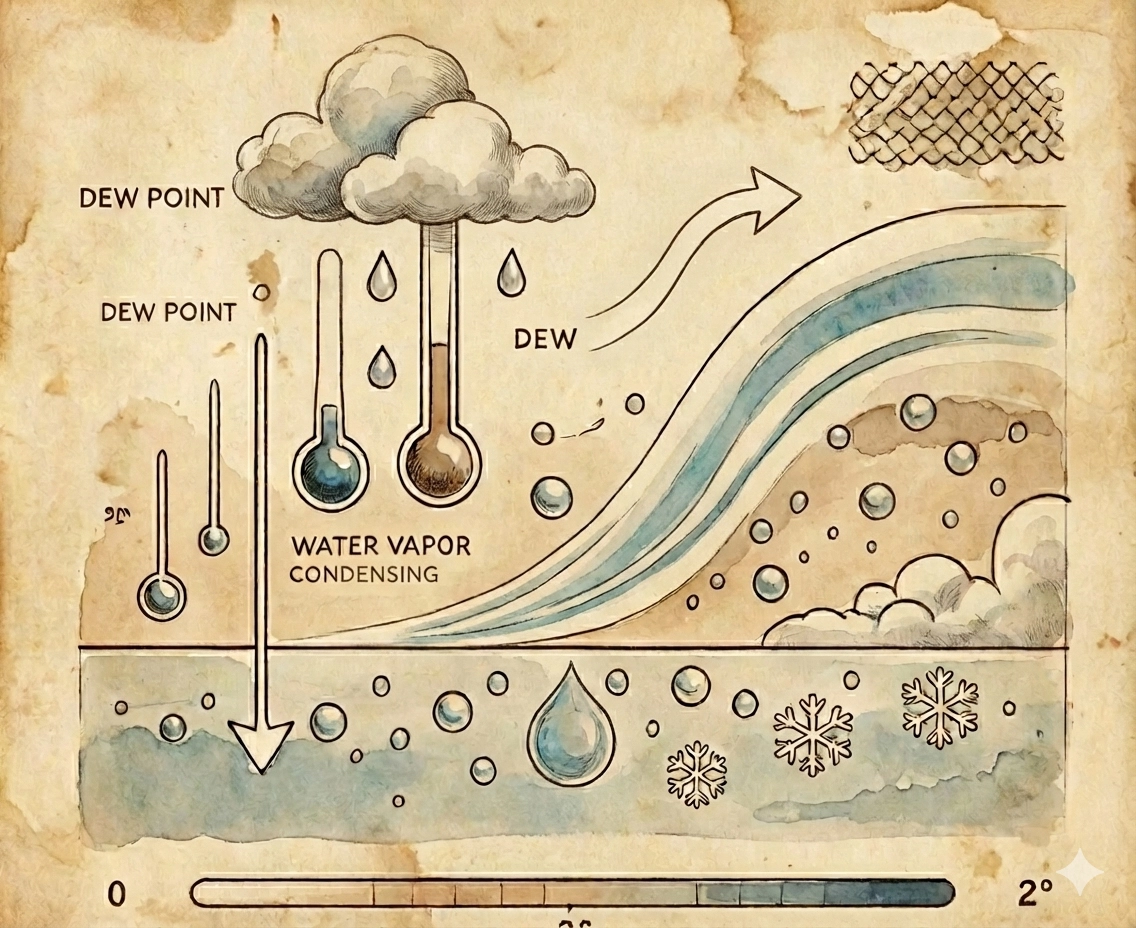
Dew point temperature (Td) is the temperature to which air must be cooled at constant pressure to reach saturation and begin condensation of water vapor. It is measured in degrees Celsius (°C).
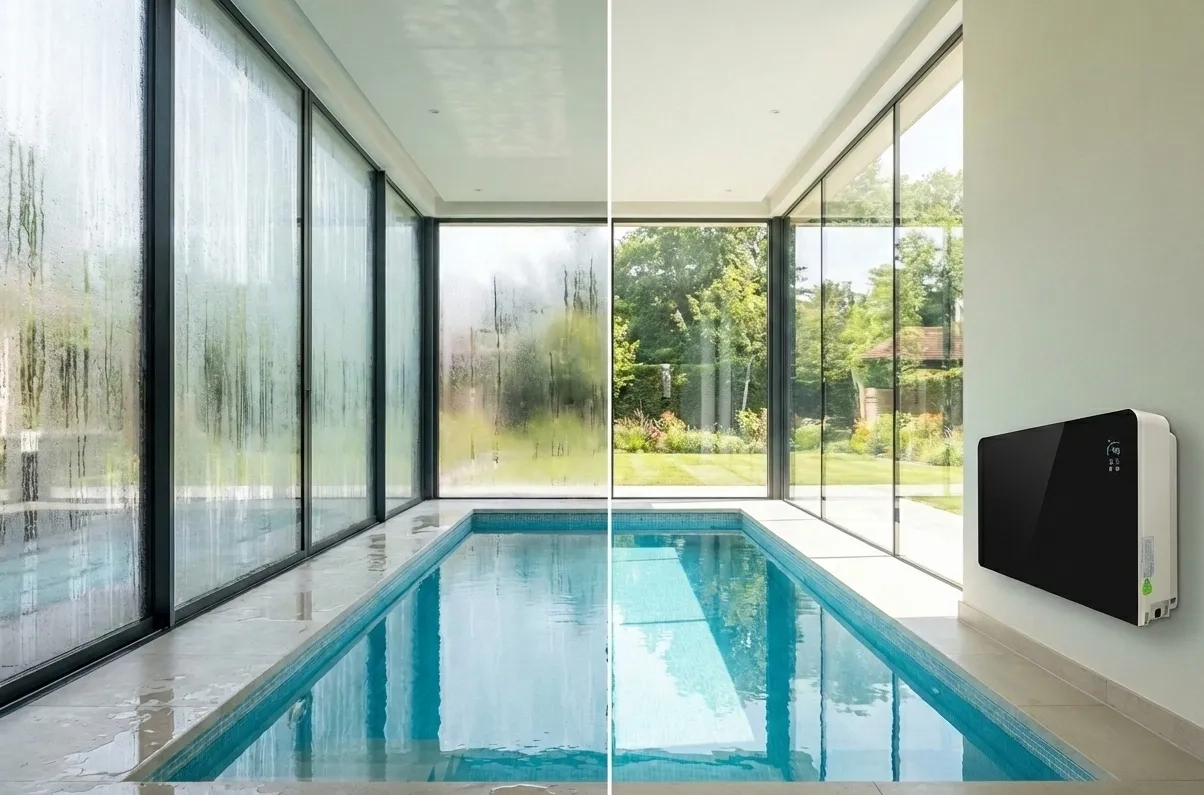
The physical meaning is simple: if the temperature of any surface is below the dew point, condensation will form on it. This is why a glass with cold water “sweats”—its surface is cooled below the dew point of the surrounding air.
For a typical room at 21 °C and 50% RH, the dew point is about 10 °C. This means any surface with a temperature below 10 °C will collect condensate. This is especially critical for windows in winter and for the surfaces of cold pipes.
A practical recommendation is to keep surface temperatures at least 2–3 °C above the dew point to prevent condensation.
5. Partial pressure of water vapor
The partial pressure of water vapor (pv) is the pressure exerted by water vapor molecules in the air. It is measured in pascals (Pa) or kilopascals (kPa).
The physical meaning is that each water vapor molecule “pushes” on its surroundings, creating pressure. This parameter is critical for understanding moisture transport through building assemblies.
Moisture moves from zones of higher partial vapor pressure to zones of lower pressure. For example, in winter the partial pressure of water vapor in a warm room (about 1.2 kPa at 21 °C and 50% RH) significantly exceeds the vapor pressure outdoors (about 0.4 kPa at -5 °C and 80% RH). This difference “drives” moisture through walls, which can lead to condensation within the assembly if proper vapor control is not provided.
On the psychrometric chart, the partial pressure scale is on the right, parallel to the humidity ratio scale.
6. Enthalpy of moist air
Enthalpy (h or i) is the total heat content of moist air, including sensible heat (associated with temperature) and latent heat (energy stored in water vapor). It is measured in kilojoules per kilogram of air (kJ/kg).
Consider an example: for air at 21 °C with a humidity ratio of 7.8 g/kg, the total enthalpy is approximately 41 kJ/kg, of which:
- Sensible heat: about 21 kJ/kg
- Latent heat: about 20 kJ/kg
It is important to know that evaporating 1 kg of water requires about 2500 kJ of energy. That is why humidifying air requires significant energy input, while dehumidification (condensation) is accompanied by the release of large amounts of heat.
To calculate the cooling or heating capacity for air treatment, use the formula:
Q = G × (h1 - h2), where:
- Q — capacity, kW
- G — air mass flow, kg/s
- h1, h2 — air enthalpy before and after treatment, kJ/kg
On the psychrometric chart, enthalpy is represented by diagonal lines at an angle, with the scale in the upper-left area.
7. Wet-bulb temperature
Wet-bulb temperature (Tw) is the reading of a thermometer wrapped with a wet wick through which air flows. It is measured in degrees Celsius (°C).
The physical principle is that as water evaporates from the wick, it absorbs heat, cooling the thermometer. The drier the air, the more intense the evaporation and the lower the wet-bulb temperature compared to the dry-bulb temperature.
For air at 21 °C and 50% RH, the wet-bulb temperature is approximately 15 °C. In the limiting case where relative humidity is 100%, evaporation is impossible and the wet-bulb temperature equals the dry-bulb temperature.
This parameter is especially important for assessing evaporative cooling potential. For example, for air at 35 °C and 30% RH, the wet-bulb temperature is approximately 22 °C, which means a potential cooling of 10–11 °C without mechanical refrigeration, only through water evaporation.
Psychrometric chart — an HVAC engineer’s tool
The is a graphical tool that relates all seven humid air parameters. Knowing any two parameters allows you to determine all the others, which makes the chart indispensable in engineering practice.
The most useful parameter combinations for practical application:
- Dry-bulb temperature + relative humidity — the easiest to measure
- Dry-bulb temperature + dew point — for condensation control
- Dry-bulb temperature + humidity ratio — for dehumidification calculations
Consider a practical example: cooling outdoor air with parameters of 32 °C and 70% RH down to 22 °C.
Calculation sequence:
- From the psychrometric chart, determine the initial parameters: humidity ratio d1 ≈ 22 g/kg, enthalpy h1 ≈ 89 kJ/kg
- When cooling to 22 °C, the air crosses the saturation line at a temperature of about 25 °C (dew point), after which condensation begins
- The final humidity ratio at 22 °C is d2 ≈ 16 g/kg (at 100% RH)
- Amount of condensed moisture: Δd = d1 - d2 = 22 - 16 = 6 g/kg
- Final enthalpy h2 ≈ 63 kJ/kg
- Specific cooling capacity: Δh = h1 - h2 = 89 - 63 = 26 kJ/kg
With an air flow of, for example, 1 kg/s, the air conditioner capacity should be 26 kW, and the amount of condensate — 6 g/s or 21.6 kg/h.
Common mistakes and their consequences
Engineers often make the following mistakes when working with humid air parameters:
- Equating relative humidity with the absolute amount of water in the air
- Ignoring the drop in relative humidity when heating air
- Underestimating partial pressure differences when designing vapor control layers
- Failing to account for latent heat in energy calculations
These mistakes lead to serious operational issues:
- Condensation on windows, pipes, and other cold surfaces
- Moisture accumulation within walls and insulation
- Incorrect equipment capacity selection
- Occupant discomfort due to improper indoor conditions
Frequently asked questions about humid air parameters
Why is it dry indoors in winter, even though outdoor relative humidity is high?
Cold winter air with high relative humidity contains little water vapor in absolute terms. When this air is heated indoors, its capacity to hold moisture increases significantly, and the relative humidity drops. For example, air at -10 °C with 90% RH, when heated to 22 °C, will have an RH of only about 15%.
How can I quickly estimate the dew point without instruments?
You can roughly estimate the dew point using: Td ≈ T - ((100 - RH)/5), where T is temperature in °C and RH is relative humidity in %. For example, for T = 25 °C and RH = 60%, the dew point Td ≈ 25 - ((100 - 60)/5) = 25 - 8 = 17 °C.
What is latent heat and why is it important?
Latent heat is the energy required for the phase change of water from liquid to vapor without a change in temperature. During dehumidification this heat is released, and during humidification it is absorbed. Neglecting latent heat can lead to errors of 30–50% in air conditioner capacity calculations, especially in high-humidity conditions.
How does humidity ratio differ from relative humidity?
Humidity ratio (g/kg) shows the actual amount of water vapor in air and does not depend on temperature. Relative humidity (%) shows the degree of saturation of air with water vapor and strongly depends on temperature. When air is heated, the humidity ratio remains unchanged, while relative humidity decreases.
Why use humidity ratio instead of relative humidity for dehumidification calculations?
The humidity ratio allows you to directly calculate the amount of moisture to be removed because it is expressed in absolute units (g/kg). Relative humidity depends on temperature, so it does not provide direct information about how much moisture must be removed from the air.
Conclusions
Understanding the seven key parameters of humid air enables an HVAC engineer to select equipment correctly, design efficient systems, and diagnose problems:
- Dry-bulb temperature — the primary parameter for ensuring thermal comfort
- Relative humidity — a critical parameter for preserving materials and preventing microbial growth
- Humidity ratio — the key parameter for dehumidification and humidification calculations
- Dew point temperature — the main tool for preventing surface condensation
- Partial pressure of water vapor — the basis for designing effective vapor control
- Enthalpy — a fundamental parameter for energy calculations and assessing equipment load
- Wet-bulb temperature — an indicator of evaporative cooling potential
Proper use of these parameters, combined with the psychrometric chart, allows engineers to create energy-efficient, comfortable, and durable HVAC systems that meet modern requirements.


