









































Author: Mycond Technical Department
Among various air dehumidification technologies, adsorption dehumidifiers with rotating Honeycombe®-type desiccant wheels have proven to be the most effective solutions for applications requiring low dew points. This technology has evolved over decades and today dominates the market for industrial air dehumidification at atmospheric pressure. But what makes this technology so special from an engineering point of view?
Evolution of desiccant dehumidifiers: why did the rotating wheel become the standard?
Historically, the development of adsorption dehumidifiers went through several configurations: packed towers with granular silica gel, horizontally rotating trays, and vertical multi-tier beds with a ratchet drive. However, the rotating wheel with a corrugated semi-ceramic structure (also known as DEW - Desiccant Wheel) became the dominant solution thanks to its unique combination of the advantages of all previous types.
Key advantages of a desiccant rotor over other configurations:
- Continuity of the dehumidification process (as in tray systems)
- The ability to achieve extremely low dew points (as in packed towers)
- High energy efficiency due to the low mass of the adsorbent
- Uniform performance without humidity pulsations in the outlet air
Honeycombe® wheel design: an engineering marvel of adsorption
The Honeycombe® technology is based on a semi-ceramic structure using a fiberglass matrix that visually resembles corrugated cardboard rolled into the shape of a wheel. This innovative structure provides an optimal balance of strength, weight, and functionality.
The key elements of the design are the corrugated grooves (flutes) that form individual air channels. The inner surface of these channels is coated with a finely dispersed adsorbent—predominantly silica gel (over 82% in a typical design). The engineering feature of this solution is that the internal surface area of silica gel reaches an impressive 21,000–22,700 m² per ounce (228,864–244,121 sq ft/oz), ensuring an extremely low partial water vapor pressure at the surface.
The physical operating principle is based on the diffusion of water vapor from areas of higher partial pressure (moist air) to areas of lower pressure (adsorbent surface) according to fundamental thermodynamic laws. Thanks to straight channels, the airflow through the wheel is laminar rather than turbulent as in packed beds. This means the aerodynamic resistance increases only in proportion to the wheel depth and not with the square of the velocity, which significantly improves system energy efficiency.
Adsorption–desorption cycle: a thermodynamic process in action
The desiccant wheel is divided into two functional zones: a dehumidification zone (270°, three-quarters of the area) and a regeneration zone (90°, one quarter), which are hermetically isolated from each other by special seals. The wheel slowly rotates between these zones at a typical speed of 5–30 rev/h for active adsorption (notably much slower than 20–60 RPM for passive enthalpy wheels).
The full adsorption–desorption cycle consists of three main phases:
- Adsorption phase (1→2): A dry, cool desiccant with low surface vapor pressure adsorbs moisture from the process air, gradually becoming saturated and heating up due to the heat of sorption.
- Regeneration phase (2→3): The saturated desiccant enters the regeneration zone, where it is heated by hot air (typically up to 120°C / 248°F from a PTC heater). As a result, the surface vapor pressure rises sharply and the moisture is released into the regeneration stream.
- Cooling phase (3→1): The hot, dry desiccant returns to the dehumidification zone, where it is cooled by a portion of the process air, restoring low surface vapor pressure for a new adsorption cycle.
It is important to note that the regeneration airflow usually amounts to roughly 1/3 of the process airflow and moves countercurrent, which increases efficiency. Moisture removal releases the heat of sorption (latent heat of condensation plus the chemical binding heat), amounting to 2510–3050 kJ/kg (1080–1312 BTU per pound) of removed moisture. This heats the process air proportionally to the amount of moisture removed. For example, air at 21°C and 50% RH, after deep drying to a 7°C dew point, can heat up to 49°C, so additional cooling is often required in the process.
Types of desiccants and their sorption characteristics
The efficiency of an adsorption dehumidifier is largely determined by the type of desiccant used. Modern systems use four main types of adsorbents, each with its own sorption capacity at different humidity levels.
At a temperature of 25°C (77°F) and 20% RH, different desiccants show the following sorption capacities:
- Silica gel Type 5 — 2.5% (mass of water to mass of dry material)
- Silica gel Type 1 — 15%
- Molecular sieves — 20%
- Lithium chloride — 35%
These figures have direct practical significance. For example, to remove 22.7 kg (50 lb) of water vapor from air at 20% RH, one would theoretically need: 907 kg (2000 lb) of Type 5 silica gel, or 151 kg (333 lb) of Type 1 silica gel, or 113 kg (250 lb) of molecular sieves, or 65 kg (143 lb) of lithium chloride. In practice, actual quantities are significantly higher due to process dynamics.
An engineeringly sound strategy is to combine desiccants: Type 1 provides capacity at lower humidity ranges, while Type 5 adsorbs large amounts of water at humidity above 90% RH. This combination allows for achieving seemingly conflicting goals: low dew point and high throughput simultaneously.
Molecular sieves occupy a special place when drying to extremely low dew points (below 10% RH or −40°C dew point), where they have the greatest capacity among all adsorbents thanks to their unique crystalline structure with precisely defined pore sizes.
Advantages of the Honeycombe® design compared to alternatives
An engineering analysis of the Honeycombe® design allows its advantages to be systematized compared to alternative adsorption dehumidifier configurations:
- Low rotating mass with high moisture removal capacity. Since the energy for heating and cooling is directly proportional to the mass of the desiccant, the lightweight design delivers significant energy efficiency.
- Low aerodynamic resistance. Due to laminar flow through straight channels, unlike the turbulent flow in packed beds where resistance grows with the square of the velocity.
- Ability to achieve ultra-low dew points. Depending on the desiccant type, dew points down to −68°C (−90°F) are achievable.
- Simplicity of design. A minimum of moving parts (only the wheel and drive) reduces maintenance costs.
- Flexibility to load different desiccants for specific applications.
- No “sawtooth” effect in outlet humidity, which is typical for packed towers with periodic regeneration.
The only significant drawback can be considered the higher manufacturing cost of the wheel compared to dry desiccant granules. However, this difference is offset by operational advantages over a typical service life of 15–30 years.

Factors affecting wheel performance
The efficiency of a desiccant wheel is determined by several key factors, each introducing its own engineering trade-offs:
1. Wheel depth. Increasing depth raises the contact area of the desiccant with air and the amount of removed moisture, but aerodynamic resistance increases proportionally, raising fan energy consumption.
2. Rotation speed (5–30 rev/h). Faster rotation increases the amount of desiccant cyclically contacting the air, boosting capacity. But it also increases heat carryover from the regeneration zone to the dehumidification zone (heat is directly proportional to the mass of desiccant and the temperature difference), which often requires additional cooling of the process air.
3. Regeneration temperature. A typical reactivation temperature of 120°C provides deep desorption of moisture. However, removing the last portions of strongly bound water requires high energy, so some manufacturers apply two-stage regeneration—70–80% of moisture is removed by low-grade heat, and the final drying by high-temperature heat.
4. Tightness between zones. Any leakage of moist regeneration air into the dry process stream significantly degrades performance. For example, a leakage of 20 cfm of air at 120 grains/lb into a 500 cfm stream at 1 grain/lb will raise the outlet humidity to 5.5 grains/lb.
5. Impact of air stream contaminants. Dust gradually clogs the adsorbent pores, reducing capacity over the years. Organic vapors can polymerize at high regeneration temperatures. Sulfur trioxide over several years can convert lithium chloride to lithium sulfate, which is not an effective desiccant.
Practical recommendation: always install filters at the dehumidifier inlet and consider outlet filtration if particles are undesirable in the supply air.
Application areas of desiccant rotors
Thanks to their ability to deliver low dew points, adsorption dehumidifiers with desiccant wheels are widely used in many industries:
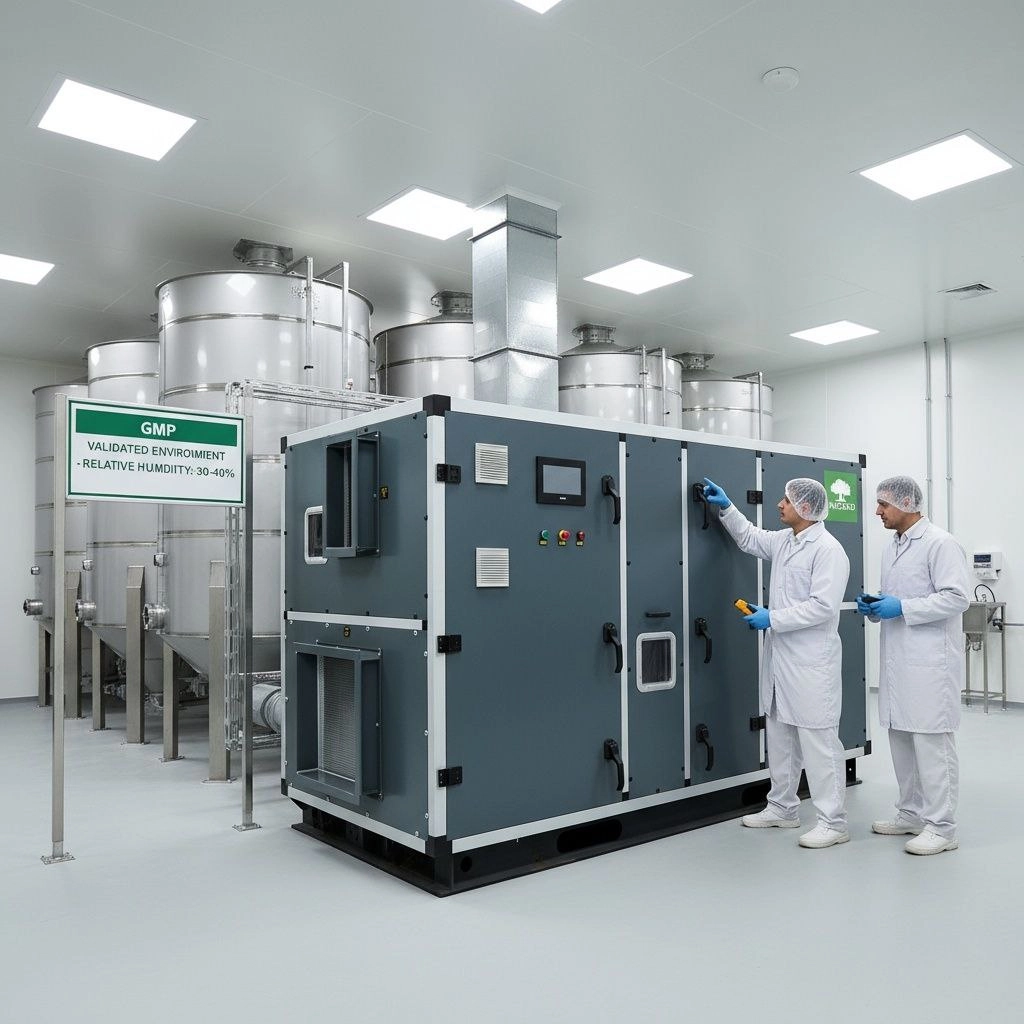
- Pharmaceutical manufacturing: cleanrooms for tableting and packaging with humidity control down to 10% RH and ±2% RH accuracy, typical dew point −11°C (13°F) at 21°C (70°F).
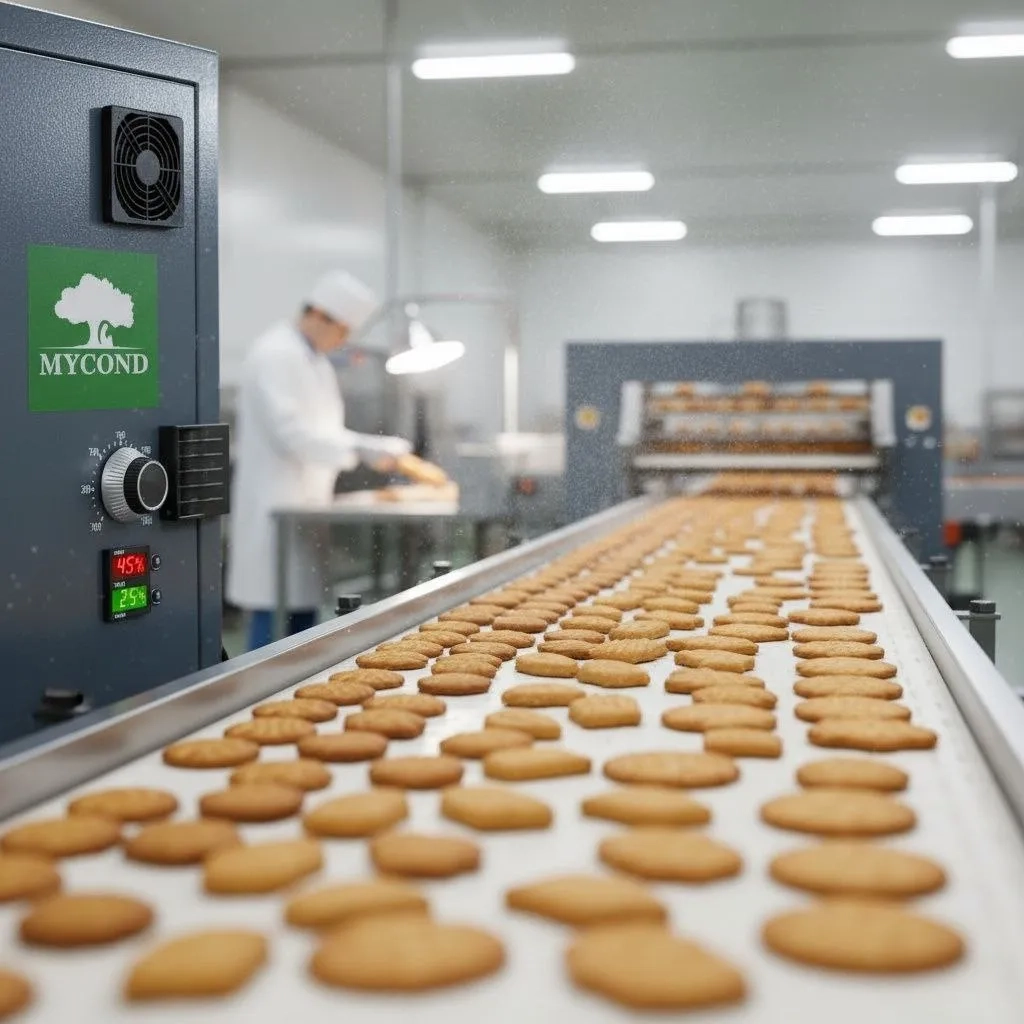
- Food industry: packaging of hygroscopic products (candies with corn syrup, instant coffee, dry beverages), where humidity critically affects quality and shelf life.
- Semiconductor manufacturing: humidity control for hygroscopic photoresists, where microscopic moisture uptake leads to chip defects.
- Archival storage: museums, libraries, document repositories with 35% RH control to prevent corrosion and mold.
- Protection of military and industrial equipment: storing electronics and precision instruments at 30–35% RH reduces corrosion of copper contacts to 10% of the normal level.
- Refrigerated warehouses and supermarkets: preventing icing of display cases and increasing refrigeration system efficiency.
- Industrial processes: laminating safety glass, composite manufacturing, investment casting.
FAQ: technical questions about desiccant wheels
1. What is the difference between passive and active adsorption?
Passive uses only the humidity difference between air streams without heat input (enthalpy wheels 20–60 RPM). Active applies heating of the regeneration air for deep drying (rotation speed 5–30 rev/h). Only active adsorption can dry air below the humidity level of the room.
2. Why is Honeycombe® more efficient than packed beds?
Thanks to laminar flow through straight channels, low mass with high contact surface area, continuous operation without sawtooth humidity fluctuations, and the ability to combine different desiccant types in one design.
3. What air dew point can be achieved?
With silica gel down to −68°C (−90°F), with molecular sieves even lower. For most industrial applications, −40°C is sufficient.
4. What is the service life of a desiccant wheel?
Typically 15–30 years with proper air filtration. There is gradual degradation due to pore contamination by dust and organic substances.
5. Can recovered heat be used for desiccant regeneration?
Yes, this is the most economical option: waste heat from boilers, cogeneration, chiller condensers, warm exhaust air. Two-stage regeneration allows 70–80% of moisture to be removed by low-grade heat.
6. When should molecular sieves be chosen instead of silica gel in dehumidifiers?
When dew points below −40°C or humidity below 10% RH are required, where molecular sieves have the highest sorption capacity thanks to their unique structure.
7. How does contamination affect rotor longevity?
Dust clogs pores and gradually reduces capacity over the years. Organic compounds polymerize when heated. Corrosive gases can chemically degrade some desiccants. Therefore, inlet air filtration is mandatory.

Conclusions
The Honeycombe® technology has become the standard for adsorption dehumidification thanks to its optimal balance of performance, energy efficiency, and reliability. Desiccant rotors deliver a unique combination of continuous operation, deep drying, and low operating costs.
For design engineers, three key recommendations can be formulated:
- Select the desiccant type according to the target dew point (silica gel for typical applications, molecular sieves for ultra-deep drying).
- Maximize the use of recovered heat for regeneration as the main factor in reducing operating costs.
- Ensure proper inlet air filtration to protect the wheel and extend its service life.
Desiccant wheels are optimal when dew points below 7–10°C are required, at high latent loads, low operating temperatures, or when low-cost heat is available. With proper design and operation, an adsorption wheel provides stable and reliable performance for decades, making this technology an ideal choice for critical processes with stringent humidity control requirements.


