









































Author: Mycond Technical Department
High indoor humidity is a problem faced by residents of various climate zones. It leads to condensation on windows, mold and mildew on walls, unpleasant odors, and damage to furniture and clothing. When it comes time to solve this issue, many people face a choice in the store: buy an inexpensive container with granules, known as a moisture absorber, or invest in an electric air dehumidifier.
At first glance, both devices are intended for the same thing — reducing humidity. However, in reality, they are fundamentally different devices designed to solve different tasks. A wrong choice can lead not only to wasted money but also to the persistence of the humidity problem, which will only worsen over time.
In this article, we will take a detailed look at the differences between a moisture absorber and a dehumidifier, their operating principles, real effectiveness, and usage scenarios. This will help you make the right choice and effectively solve the problem of excessive humidity in your home.

Moisture absorber: how it works
A moisture absorber is a passive device that does not require electricity to operate. Its operating principle is based on the use of salt granules, most often calcium chloride, which have hygroscopic properties. These granules actively attract water molecules from the surrounding air.
The typical design of a moisture absorber is simple: the upper chamber contains salt granules placed on a special grid. As the granules absorb moisture, they gradually dissolve, forming a saline solution that drips through the grid into the lower chamber. In this way, the device removes excess moisture from the air.
Moisture absorber performance
It is important to understand the real performance of moisture absorbers. On average, such a device can collect from 0.5 to 1 liter of water over a month, which is about 0.01–0.03 liters per day. This is extremely low compared to electric dehumidifiers.
Key point: a moisture absorber only works locally, in its immediate vicinity. It has no built-in fan to ensure air circulation, so it effectively dries only the air within a few dozen centimeters.
What a moisture absorber is suitable for
Moisture absorbers are best suited for tasks in limited, enclosed spaces:
- Closets with clothes and shoes
- Small storerooms or pantries
- Cars that sit unused for long periods
- Safes and other small enclosed spaces
Pros of moisture absorbers:
- Affordable price
- No electricity required
- Completely silent operation
- Compact size
- Easy to use
Cons of moisture absorbers:
- Extremely low performance (0.01–0.03 L/day)
- Work only locally
- Need for regular replacement of granule cartridges
- No ability to measure humidity levels
- Ineffective for solving room-wide humidity problems
Dehumidifier: operating principle and models
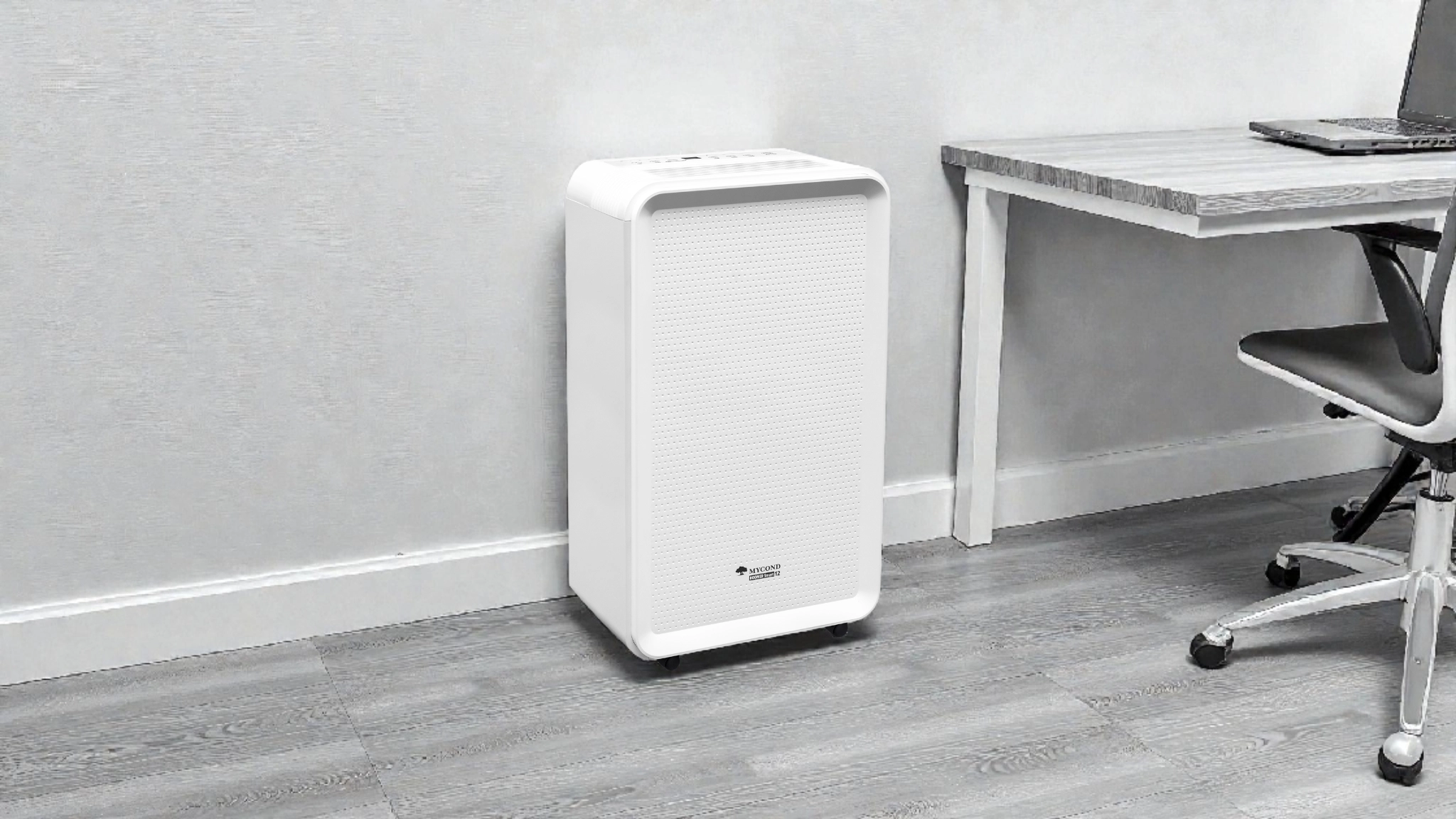
A dehumidifier is an active electric device that works on the principle of moisture condensation. Here’s how the dehumidification process takes place:
- A built-in fan draws humid air from the entire room
- The air passes through a cooled heat exchanger, where moisture condenses (similar to how condensation forms on a cold bottle on a hot day)
- Water droplets flow into a special tank
- The dried air is warmed and returned to the room
Modern dehumidifiers are high-tech devices with extensive functionality. They have built-in hygrometers to measure humidity levels, automatic operating modes, protection systems, and the option to connect to a continuous drainage system.
Dehumidifier specifications using Mycond models as examples
- Capacity: 12 L per day at 30°C and 80% humidity; 6.8 L per day at 27°C and 60% humidity
- Power consumption: 156–190 W
- Noise level: up to 36 dBA
- Refrigerant: R134a
- Airflow: 120 m³ per hour
- Tank capacity: 2 L
- Additional features: Wi‑Fi control via the MYCOND app for iOS and Android, air ionization
- Capacity: 12 L per day at 30°C and 80% humidity; 6.5 L per day at 27°C and 60% humidity
- Power consumption: 172–200 W
- Noise level: up to 38 dBA
- Refrigerant: eco‑friendly R290
- Airflow: 120 m³ per hour
- Tank capacity: 2 L
- Dimensions: 250 × 220 × 445 mm
- Weight: 11 kg
- Additional features: Wi‑Fi control
Comparison: dehumidifier vs moisture absorber
To understand the differences between a dehumidifier and a moisture absorber, let’s look at their comparative characteristics in the table:
| Criterion | Moisture absorber | Dehumidifier |
|---|---|---|
| Operating principle | Passive moisture absorption by salt granules | Active condensation of moisture on a cold heat exchanger |
| Capacity | 0.01–0.03 L per day | 6–12 L per day (depending on model) |
| Coverage area | Local only, within a 20–30 cm radius | A whole room or several rooms (20–35 m²) |
| Humidity measurement | None | Built-in hygrometer |
| Automation | None | Automatic maintenance of the set humidity level |
| Electricity | Not required | Consumes 156–200 W |
| Noise | Silent | 36–38 dBA (quieter than a normal conversation) |
| Intended use | Closets, pantries, small enclosed spaces | Rooms, apartments, houses |
| Effectiveness against mold | Low, only in immediate proximity | High, throughout the entire space |
Practical comparison examples
Example 1: A room with high humidity
In a 20 m² room there is elevated humidity: condensation on windows, a damp feeling, and a musty smell. Installing a moisture absorber does not produce a noticeable effect because its low performance (0.01–0.03 L/day) cannot cope with the volume of moisture in an entire room. In contrast, an electric dehumidifier capable of collecting 6–12 liters of water per day solves the problem within 1–2 days of operation, significantly reducing humidity.
Example 2: A clothes closet
There is a damp smell in a clothes closet. Installing a moisture absorber here is the ideal solution: it effectively reduces humidity in the enclosed space, requires no power, and operates silently. Using a dehumidifier for such a task would be excessive and not cost‑effective.
Example 3: Salt as a dehumidifier
A common question is whether regular salt works as a dehumidifier. The answer: yes, it works, but very slowly and only locally. Salt (as well as other home remedies — silica gel, rice, activated carbon) can be effective in small enclosed spaces, such as a closet, but it cannot solve a room-wide humidity problem.
Equipment selection recommendations
When to choose a moisture absorber:
- For closets with clothes and shoes
- For storerooms and pantries
- For a car
- When there is no access to electricity
- When absolute silence is required
- With a limited budget and no serious humidity problems
When to choose a dehumidifier:
- For a room or apartment from 10 m²
- If there is condensation on windows
- If mold or mildew appears on walls
- When a quick result is needed
- When automatic maintenance of optimal humidity is needed
- In spaces with a persistent high‑humidity problem (basements, bathrooms)
Comparison of Roomer Smart 12 and TIBO Eco 12
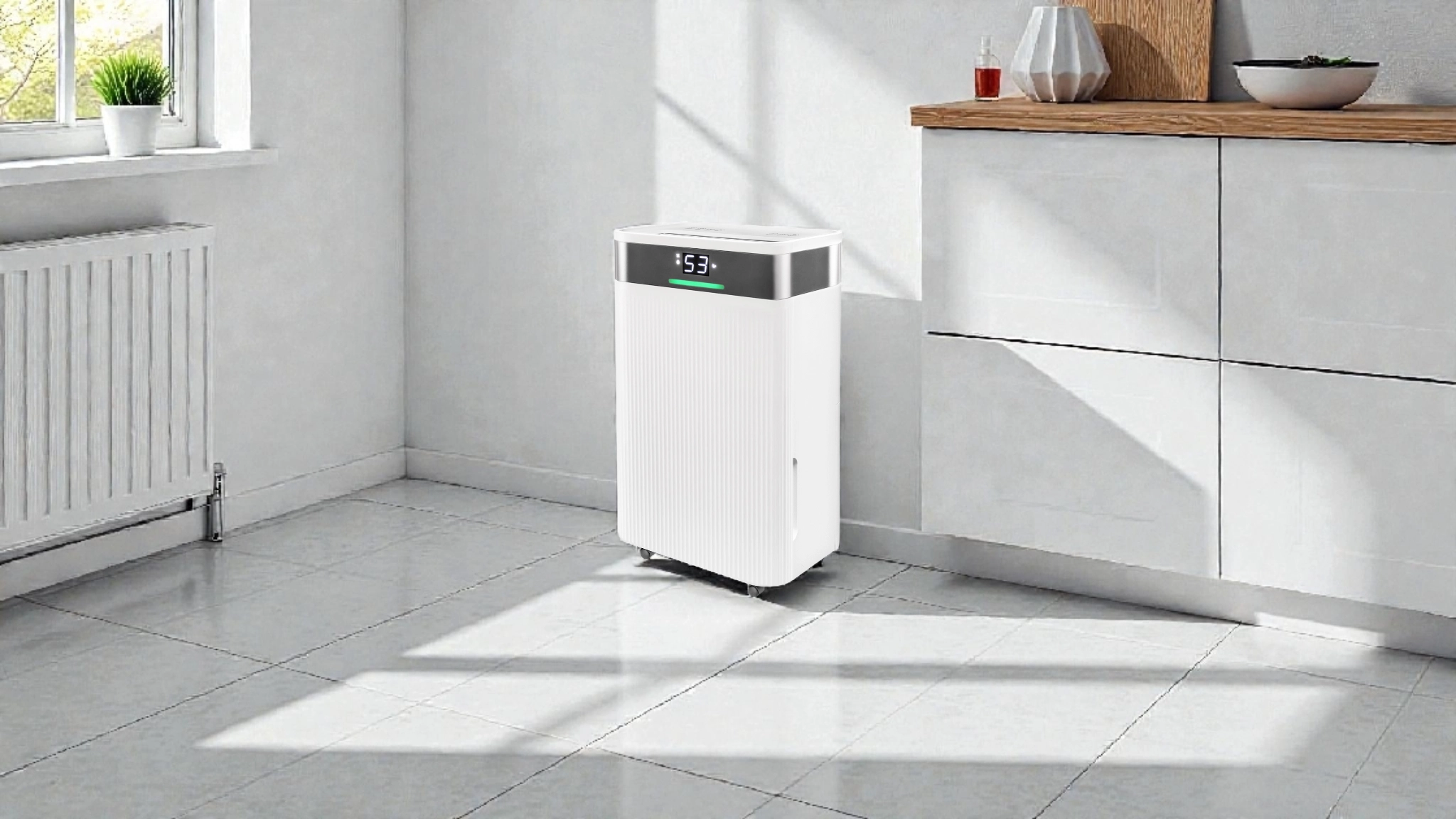
Both Mycond dehumidifier models have the same base capacity — 12 liters per day under optimal conditions (30°C and 80% humidity). However, there are several differences that are important to consider when choosing:
- Noise: Roomer Smart 12 runs quieter — up to 36 dBA, while TIBO Eco 12 can reach up to 38 dBA. The difference is small but may matter for bedroom use.
- Smart control: Roomer Smart 12 offers more advanced smart control via the proprietary MYCOND app, allowing you to control operating parameters from anywhere.
- Eco-friendliness: TIBO Eco 12 uses R290 refrigerant, considered more eco‑friendly than R134a used in the Roomer Smart 12.
- Price: TIBO Eco 12 is usually more affordable, making it an optimal choice for practical buyers.
The choice between these models depends on your priorities. If quieter operation and convenient smart control are more important — choose Roomer Smart 12. If eco‑friendliness and a more affordable price are decisive — TIBO Eco 12 is the optimal choice.
Combined approach and home dehumidifying methods
Combined approach
For maximum effectiveness in combating humidity at home, a combined approach is often optimal: using a dehumidifier for overall humidity control in the room and additionally using moisture absorbers in problematic enclosed spaces, such as clothes closets.
This approach allows you to effectively control humidity throughout the space, avoiding excessive electricity costs (the dehumidifier will not run constantly thanks to automation) and ensuring protection against moisture in places where a dehumidifier cannot be effective.
Home methods of air dehumidification
There are several home methods to combat excessive humidity:
- Salt: Regular table salt absorbs moisture, but very slowly. Works locally in small enclosed spaces.
- Rice: Uncooked rice also has some moisture-absorbing properties. You can place cups of rice in closets.
- Silica gel: The same packets often placed in boxes with shoes and electronics. Effective in small enclosed spaces.
- Activated carbon: Not only absorbs odors but also has moisture-absorbing properties.
- Ventilation: In winter, opening windows can help because cold winter air is usually dry. In summer, however, the situation is the opposite — outdoor air is often more humid than indoors.
It is important to understand: all home methods only work for minor humidity issues and mainly in small enclosed spaces. They cannot replace a dehumidifier for serious humidity problems in a room.
Debunking myths about dehumidifiers and moisture absorbers
Myth 1: "A moisture absorber is the more economical solution"
Indeed, the initial cost of a moisture absorber is lower. However, the regular replacement of granule cartridges over time makes this option quite costly, especially if the moisture absorber fails to cope with the task and the humidity problem remains, leading to more serious consequences (mold remediation).
Myth 2: "Dehumidifiers consume a lot of electricity"
Modern dehumidifiers consume from 156 to 200 W — roughly like two to three light bulbs. Moreover, they work cyclically: once the set humidity level is reached, the device automatically turns off and only turns on again when humidity rises.
Myth 3: "Salt can replace a room dehumidifier"
Salt does absorb moisture, but its effectiveness in the open space of a room is negligible. It can be useful for closets and similar enclosed spaces, but not for drying the air in an entire room.
Myth 4: "Dehumidifiers are dangerous to health"
Modern dehumidifiers from reliable manufacturers are certified and safe devices. They do not "remove all the oxygen" from the air, as is sometimes mistakenly believed. On the contrary, by maintaining optimal humidity, they create a healthier environment, preventing the development of fungi and bacteria.
FAQ
Which is better, a dehumidifier or a moisture absorber?
For rooms and apartments, a dehumidifier is definitely better — it is hundreds of times more effective. A moisture absorber is advisable only for small enclosed spaces: closets, pantries, cars.
What absorbs moisture best?
In terms of performance, an electric dehumidifier far outperforms any other means. Among passive moisture absorbers, the most effective are those using calcium chloride.
What removes moisture from the air best?
An electric dehumidifier removes moisture from the air best. Modern models can collect up to 12 L of water per day, while passive moisture absorbers collect only 0.01–0.03 L.
Can a moisture absorber replace a dehumidifier?
No, for rooms a moisture absorber cannot replace a dehumidifier due to fundamentally different performance. A moisture absorber can replace a dehumidifier only in very small enclosed spaces.
What can be used instead of a dehumidifier?
For small spaces you can use moisture absorbers. For rooms, alternatives include good ventilation and air conditioning, but they are less effective than a dedicated dehumidifier.
Does salt work as a dehumidifier?
Yes, regular salt absorbs moisture, but very slowly and is only effective in small enclosed spaces. For a room, salt as a dehumidifier is practically ineffective.
How to dehumidify air at home?
For minor dehumidification, you can use ventilation (in winter), salt, rice, or silica gel in open containers. For serious humidity problems, these methods are ineffective.
What is the best moisture absorber for home?
For home use, the best moisture absorbers are those with calcium chloride granules and a sufficiently large water collection chamber. But remember: they are only effective for local use.
What to choose for a small 15 m² room?
For a 15 m² room, you need a dehumidifier. The Roomer Smart 12 or TIBO Eco 12 models are ideal for such spaces, maintaining optimal humidity.
Is a dehumidifier noisy?
Modern dehumidifiers are quite quiet. For example, the Roomer Smart 12 operates at up to 36 dBA, which is quieter than a normal conversation and allows the device to be used even in a bedroom.
Can a moisture absorber be used in a bedroom?
Yes, it can, but remember that a moisture absorber is only effective locally. It will not control the humidity in the entire bedroom, only near itself.
What is better for a closet?
For a closet, a moisture absorber is the ideal solution. It is compact, requires no electricity, operates silently, and effectively handles humidity in the closet’s enclosed space.
Conclusion
A moisture absorber and a dehumidifier are fundamentally different devices designed to solve different tasks. The difference in their effectiveness is measured in hundreds of times.
Moisture absorbers are ideal for small enclosed spaces — closets, pantries, cars. They are affordable, require no electricity, and are completely silent, but have extremely low performance and work only locally.
For rooms, apartments, and houses, the only effective solution is a dehumidifier. Modern models such as the Roomer Smart 12 and TIBO Eco 12 provide high performance, energy efficiency, and ease of use.
If you value maximum technology, quieter operation, and full control via smartphone — we recommend Roomer Smart 12. If practicality, eco‑friendliness, and a more affordable price are more important — TIBO Eco 12 is the optimal choice.
For the best result, you can use a combined approach: a dehumidifier to maintain optimal humidity throughout the space and moisture absorbers for problematic enclosed areas.
Solve your humidity problem once and for all!
Mycond is a leader in the household dehumidifier segment, offering comprehensive, modern, and energy‑efficient solutions without overpaying for a globally known brand. Our Roomer Smart 12 and TIBO Eco 12 models are the perfect solution for drying small spaces up to 30–35 m².
Not sure which dehumidifier to choose? Call us or fill out the form at the bottom of the page for a free consultation. Our specialists will help you select the optimal solution for your specific case!


