









































Installing a private pool is a luxury and a pleasure, but without proper air dehumidification your pool will quickly turn into a source of problems. One of the most common mistakes owners make is building the pool first, doing luxurious finishes, and only then thinking about a dehumidifier. And suddenly it turns out: there is nowhere to install the equipment!
The consequences of this approach can be unpleasant: insufficient ceiling height for installing a duct dehumidifier, inability to run air ducts because everything is sealed with drywall, no space for drainage. You have to look for compromises that are more expensive and less effective.
The golden rule: the MSHA(C) X series duct dehumidifier must be planned at the DESIGN stage. If you are planning a renovation, it is also possible to plan the installation, but the main thing is to know exactly what to check before starting work.
In this article, we provide a simple checklist of what to consider for the future installation of a duct dehumidifier to ensure the perfect microclimate in your pool.
Placement options for the MSHA(C) duct dehumidifier
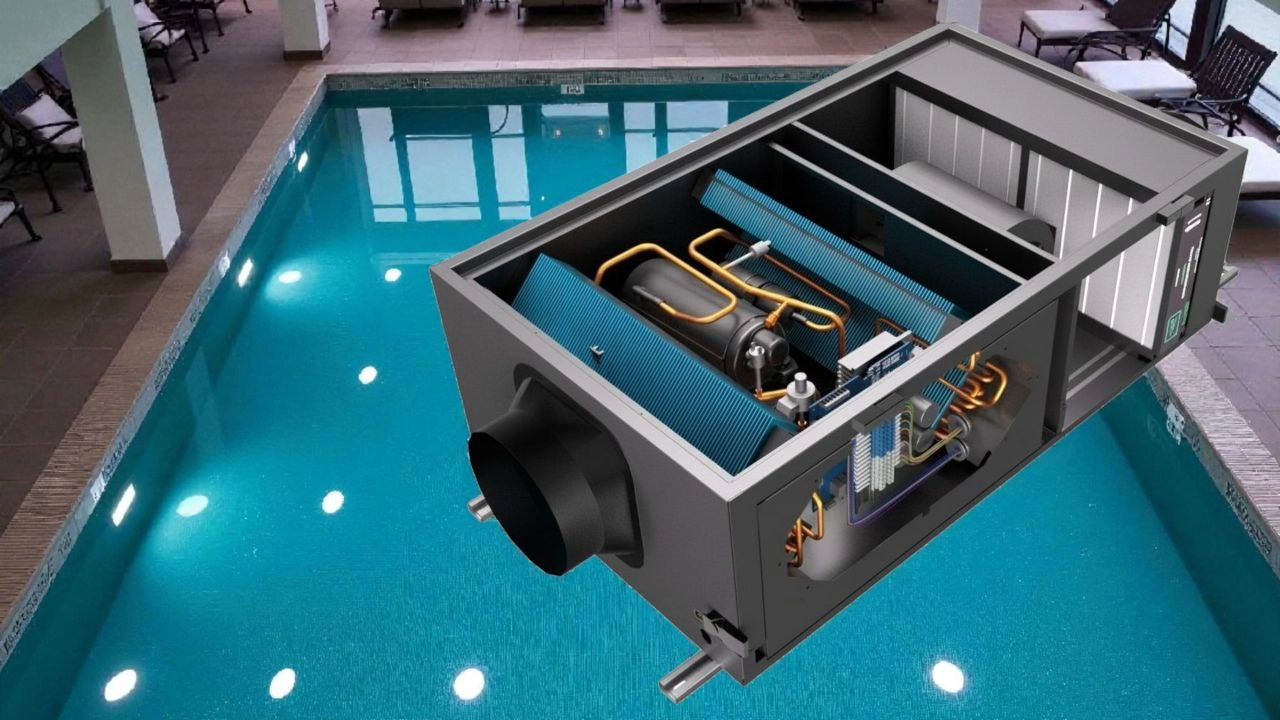
There are three main placement options for the Mycond MSHA X series duct dehumidifier. Let’s look at the advantages and disadvantages of each so you can choose the optimal solution for your situation.
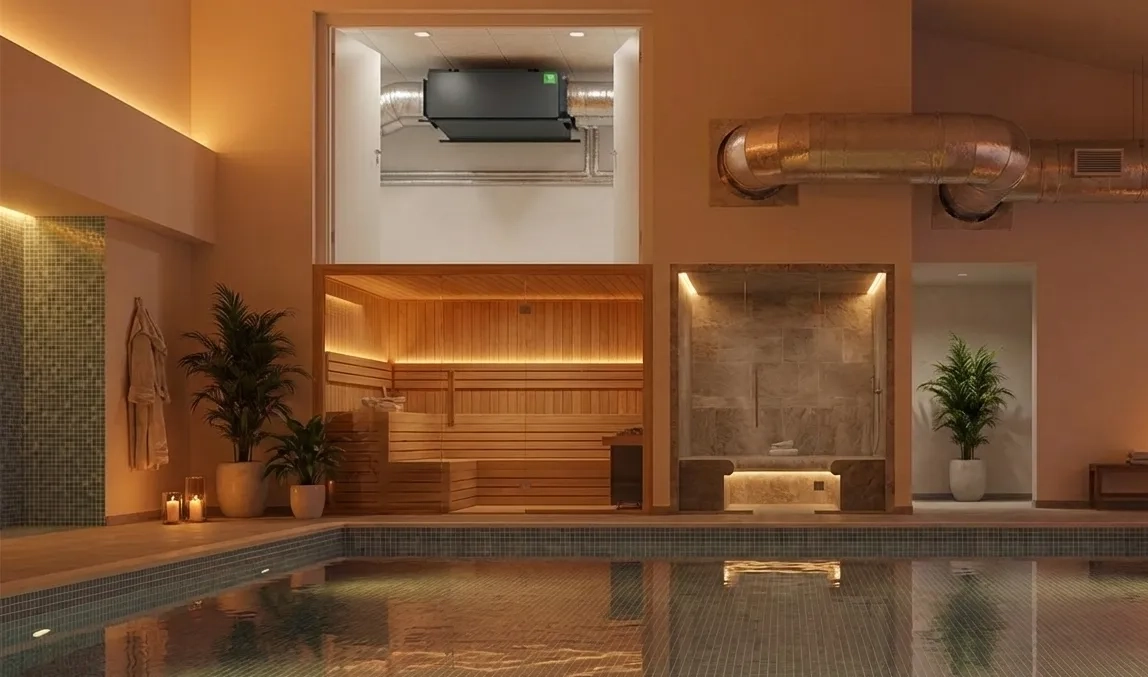
Option 1: Above the pool room’s suspended ceiling
What it looks like: the MSHA(C) dehumidifier is completely hidden between the main and suspended ceiling; only ventilation grilles for air intake and supply are visible in the pool room.
Main requirement: a room height of at least 3.2–4.0 meters depending on the model (the more powerful the dehumidifier, the greater the required height).
Advantages:
- No separate technical room needed
- Excellent aesthetics — the equipment is completely hidden
- Easy service access through removable ceiling panels
- Shorter air ducts = lower installation costs
Disadvantages:
- Requires sufficient ceiling height (if not available, this option is not suitable)
- Some equipment noise (35–55 dB) is present in the pool room
When suitable: new construction or renovation with full ceiling replacement when the room height is sufficient.
Option 2: In a separate technical room next to the pool
How it works: the dehumidifier stands in an adjacent room (boiler room, storage, utility room), and air goes through ducts from the pool to the dehumidifier and back.
Main requirement: an appropriate adjacent room with an area of 3 to 15 square meters depending on the dehumidifier model.
Advantages:
- Absolute silence in the pool (the equipment runs in another room)
- Does not depend on the pool ceiling height
- Simpler access for regular maintenance
- Other equipment can be placed nearby (pumps, filters)
Disadvantages:
- A separate room must be allocated
- More expensive installation (longer air ducts, more complex routing)
- Ventilation of the technical room is required
When suitable: the pool ceiling height is insufficient, there is a free room nearby, silence in the pool is critical, commercial facilities.
Option 3: In the attic or basement
Advantages:
- Maximum silence in the pool area
- Does not consume useful space
Disadvantages:
- The most complex and most expensive installation
- Special conditions required (attic insulation, basement waterproofing)
- More difficult service access
- Long air ducts, higher pressure losses
When suitable: rarely, when there are no other options or the building has very specific architecture.
| Criterion | Above ceiling | Technical room | Attic/basement |
|---|---|---|---|
| Required pool ceiling height | 3.2–4.0 m | Not important | Not important |
| Separate room required | No | Yes (3–15 m²) | Partly |
| Noise level in pool | 35–55 dB | Minimal | Minimal |
| Installation cost | Lowest | Medium | Highest |
| Service access | Through ceiling panels | Free access | Limited |
| Most commonly used for | New construction | Insufficient height | Special cases |
Conclusion: there is no universally correct option for everyone. The choice depends on specific conditions (ceiling height, availability of rooms) and your priorities (budget, silence, ease of maintenance). The key is to make the decision BEFORE starting finishing work.
The most important thing — ceiling height
Why is ceiling height so critical for installing an MSHA(C) duct dehumidifier? It’s simple: the dehumidifier needs to be placed between the main ceiling and the suspended ceiling. This requires a space of 60 to 120 centimeters depending on the model. If the ceiling is too low, the dehumidifier simply won’t fit physically.
| MSHA(C) model | Pool size (surface area) | Minimum room height (m) | Comfortable height (m) |
|---|---|---|---|
| 28, 40, 60 | Small pools (up to 25 m²) | 3.2–3.3 | 3.5 |
| 100, 140 | Medium pools (25–60 m²) | 3.5 | 3.7 |
| 180, 250, 380, 500, 750, 1000 | Large pools (60+ m²) | 3.7–4.0 | 4.0–4.5 |
How to check the height: measure the distance from floor to ceiling with a tape measure, then compare it with the table for your model. If the height is NOT sufficient, consider the technical room option.
What to do if the height is insufficient:
Option A: Increase the height (if you are at the design stage) — raise the roof by 30–50 centimeters or lower the pool floor.
Option B: Find or allocate a technical room nearby to place the dehumidifier.
Option C: If installing a duct dehumidifier is impossible, consider wall-mounted dehumidifiers (several MBA-G instead of one MSHA(C)).
If you choose a technical room — what’s needed
Room size is a very important parameter for placing the dehumidifier. Here is a simple guide:
- Small MSHA(C) 28–60: room 4–5 m² (like a small storage)
- Medium MSHA(C) 100–140: room 5–6 m²
- Large MSHA(C) 180 and above: room 10–15 m² (like a small boiler room)
Why so much? You need space for the dehumidifier itself, for access and maintenance (filter cleaning, inspection), as well as extra space for utilities.
The distance from the pool is preferably no more than 15–20 meters. The closer — the better, as shorter air ducts mean lower installation costs and lower pressure losses.
Mandatory conditions for the technical room:
- Ventilation: must be provided, since the dehumidifier releases heat. Simple grilles at the top and bottom of the wall or a small exhaust fan are sufficient.
- Winter temperature: not below +10°C. If the room is unheated, heating must be provided.
- Lighting: required for easy maintenance.
- Door: at least 80 cm wide to allow equipment to be brought in/out.
What to include in the design — a simple checklist
Before starting construction or renovation, check the following items:
Space and structures:
- ✓ Ceiling height matches the table for your model
- ✓ Suspended ceiling (if planning above-ceiling installation)
- ✓ Reinforced ceiling frame (the dehumidifier weighs 40–560 kg depending on the model — tell this to the builders)
- ✓ Technical room of the required size (if there isn’t enough height)
Utilities:
- ✓ Space for routing air ducts (installers will run them)
- ✓ Drainage — a pipe to discharge condensate into the sewer
- ✓ Power — a dedicated supply line (tell the electrician it’s needed for the dehumidifier)
Details such as air duct diameters, cable sizes, etc., will be selected by the installers themselves. The main thing is to include these routes in the design BEFORE finishing work.
Access for maintenance:
- ✓ Removable ceiling panels above the dehumidifier (for filter cleaning)
- ✓ Free access in the technical room (at least 50 cm on all sides)
Why this is needed: the dehumidifier filters must be cleaned every 2–4 weeks. Without proper access, maintenance becomes impossible or very difficult.
Continuous 24/7 operation — why it matters for planning
Yes, the MSHA(C) duct dehumidifier is designed for 24/7 operation. Why? Water evaporation from the pool occurs around the clock, even at night. To maintain an optimal humidity of 55%, the dehumidifier must run continuously with automation that turns it on and off based on the humidity sensor readings.
What this means for planning:
Reliable power: a dedicated power line is required, not just a power strip from a general outlet. Tell the electrician that a dedicated line is needed for a continuously operating dehumidifier — they will select the appropriate cable size and circuit breaker.
Continuous drainage: condensate (water) is produced 24/7, from 28 to 1000 liters per day depending on the model. A pipe to the sewer is required — the installers will run it; the main thing is to plan the possibility of routing this pipe in advance.
Access for maintenance: once a month, you need to check and clean the filters. If the dehumidifier is “sealed in” with no access, this becomes a serious problem.
Advantages of continuous operation: stable humidity of 55% at all times, without spikes (dry during the day, wet at night), no mold or mildew, long service life of both the dehumidifier and building structures.
Typical planning mistakes
Mistake 1: “We’ll build first, then think about the dehumidifier”
Consequence: It turns out there’s nowhere to install the equipment; expensive rework is needed.
Correct: Think about the dehumidifier at the DESIGN stage.
Mistake 2: Didn’t measure the ceiling height
Consequence: The ceiling is 3.0 meters, but 3.5 meters are needed for the desired model.
Correct: Check the height against the table NOW.
Mistake 3: Forgot to allocate space for utilities
Consequence: Tiles are already laid, everything is sealed, nowhere to run air ducts.
Correct: Tell the builders to leave space for the dehumidifier ducts — they’ll understand.
Mistake 4: Made the ceiling permanently sealed
Consequence: To clean the filter you have to dismantle half the ceiling.
Correct: Provide removable panels above the dehumidifier.
Mistake 5: Plugged into a general outlet
Consequence: Overload trips the breaker, the dehumidifier doesn’t work.
Correct: A dedicated line — tell the electrician.
Mistake 6: Chose the model after finishing
Consequence: Calculations require an MSHA(C)180 (height 3.7 m), but the ceiling is 3.3 m.
Correct: First calculate the model and check the height, THEN do the finishing.
Mistake 7: No ventilation in the technical room
Consequence: The dehumidifier overheats and operates inefficiently.
Correct: Provide simple ventilation grilles or a fan.
Simple checklist for the owner
DESIGN STAGE / START OF CONSTRUCTION:
- □ I know my pool’s surface area (length × width = ____ m²)
- □ I know which MSHA(C) model I need (based on capacity calculation)
- □ I have checked the pool room height (____ m)
- □ The height is sufficient for above-ceiling installation (see table)
- □ OR There is a suitable technical room nearby
- □ I have informed the architect/designer:
- □ A suspended ceiling with 60–120 cm inter-ceiling space is required
- □ OR A room for the dehumidifier (4–15 m²) next to the pool is required
- □ I have informed the builders:
- □ Leave routes for air ducts from the pool ceiling
- □ A pipe is needed to drain condensate into the sewer
- □ Reinforce the ceiling frame (there will be equipment of 40–560 kg)
- □ I have informed the electrician:
- □ A dedicated line is required for the dehumidifier that runs 24/7
- □ The electrician will select the cable and breaker
- □ I have provided access for maintenance:
- □ Removable ceiling panels above the dehumidifier
- □ OR Free access in the technical room
AFTER MAIN WORKS, BEFORE FINISHING:
- □ Air ducts laid by installers
- □ Drainage connected
- □ Power supplied
- □ Finishing work can begin
DEHUMIDIFIER INSTALLATION STAGE:
- □ Dehumidifier installed
- □ Everything connected
- □ Tested
- □ I know how to clean the filters (once every 2–4 weeks)
FAQ
Can a duct dehumidifier be installed if the renovation is already finished?
It’s difficult and expensive — the ceiling must be dismantled and utilities routed. It is possible, but it’s much better to plan BEFORE finishing. If it’s already too late, consider MBA-G models as an alternative.
What is the minimum ceiling height required for a duct dehumidifier?
It depends on the model: small MSHA(C) 28–60 require 3.2–3.3 meters, medium MSHA(C) 100–140 — 3.5 meters, large MSHA(C) 180+ — 3.7–4.0 meters. If the height is insufficient, consider the technical room option.
Is a separate technical room mandatory?
No, if the ceiling height is sufficient (3.2–3.8 m depending on the model) — the dehumidifier can be hidden above the suspended ceiling. A technical room is an alternative when height is insufficient.
Should a duct dehumidifier run around the clock?
Yes, to effectively maintain humidity the dehumidifier operates 24/7 with automatic on/off cycles. Therefore, it is important to provide a dedicated power line and reliable drainage at the construction stage.
What should I tell the builders about the duct dehumidifier?
Say that a suspended ceiling with 60–120 cm space is required or a 4–15 m² room nearby, leave routes for air ducts, a pipe to the sewer is needed for drainage, and the ceiling frame must be reinforced. The installers will select the necessary details themselves.
Do I need special knowledge to prepare for installation?
No, the main things are to check the ceiling height against the table, inform the builders that there will be a dehumidifier (they will leave space for utilities), and provide access for maintenance. Technical details are the installers’ job.
When should I choose the dehumidifier model — before or after finishing?
You need to know the specific model before starting finishing work, as the ceiling height requirements depend on it. The correct sequence: calculation → model selection → height check → inclusion in the design → finishing.
How much does it cost to prepare a room for a duct dehumidifier?
It depends on the option: a suspended ceiling with utility provisions is part of regular renovation with a small extra cost; building a separate technical room is more expensive, but these are one-time costs at the construction stage.
What happens if you don’t plan the dehumidifier in advance?
You will have to seek compromises: expensive rework, installation in a suboptimal place, or abandoning a duct system in favor of several wall-mounted units (less effective). It’s much easier and cheaper to plan everything from the start.
How do I know if my ceiling height is sufficient?
Measure the height from floor to ceiling with a tape measure and compare it with the table in the article for your future MSHA(C) model. If the figure is greater than or equal — excellent. If it’s less — you need to look for a technical room or increase the height (if you are at the design stage).
Conclusion
The MSHA(C) X series duct dehumidifier from Mycond is an excellent solution for maintaining the optimal microclimate in a pool, but successful installation requires advance planning.
Three key points to remember:
- Check the ceiling height against the table in the article
- Inform the builders that a dehumidifier will be installed — they will leave space for utilities
- Provide convenient access for regular maintenance
This isn’t difficult — you just need to think about these things NOW, at the design stage. Installers will help with technical details (diameters, cables, etc.).
If you are planning to build or renovate a pool, Mycond specialists are ready to provide a free consultation at the planning stage. We will check your project for compliance with the requirements for installing MSHA(C), help calculate the required model, answer all questions in simple language, and provide a checklist of what exactly to tell the builders.
Mycond is a leader in its segment for those looking for a comprehensive, modern, and energy-efficient solution for pool microclimate management without overpaying for a world-famous brand. The MSHA(C) X series duct dehumidifier is the ideal solution for creating the perfect microclimate in your pool.
To get a consultation, fill out the form at the bottom of the page or call us.


