









































Author: Mycond Technical Department
Effective humidity control in a warehouse is not just a technical matter but an important economic component of modern business. Excess humidity leads to serious problems: corrosion of metal products causes defects and returns, cardboard packaging loses strength at relative humidity above 65% and deforms, and condensate forms on cold surfaces, creating hazards for personnel and damaging goods. Analysis shows that annual losses from these issues often exceed the cost of a dehumidification system by 3–5 times.
When designing dehumidification systems for warehouse spaces, it is important to understand that there are two fundamentally different types of warehouses: passive and active. Passive warehouses are characterized by infrequent staff access and minimal goods movement. These include archive storage, museum repositories, and long-term storage of military equipment. Active warehouses have constant loading and unloading and frequent door openings — these are distribution centers, logistics hubs, production buffers, and cold stores. This classification dictates fundamentally different approaches to dehumidification system design.
Defining project goals and humidity control setpoints
When designing a dehumidification system, it is critical to formulate a specific goal rather than simply aiming to reduce humidity. For example, at one metal products warehouse they maintained 40% relative humidity according to the specification, but condensation still formed on the metal roof at night when its temperature dropped below the air’s dew point. This happened because the goal was framed as “maintain relative humidity,” not “prevent condensation on surfaces.”
Recommended relative humidity levels for different types of goods:
- Steel and cast iron products: maximum 40% at 18-22°C
- Aluminum and non-ferrous metals: up to 50%
- Cardboard packaging: 45-55% to retain 80% of strength
- Electronics and printed circuit boards: 30-45%
- Pharmaceutical warehouses: 30-40% depending on the product
For cold storage, control is based on dew point rather than relative humidity. The air dew point should be 2-3°C below the temperature of the coldest surface. The method includes measuring surface temperatures with an infrared thermometer and calculating the required dew point.
Comparing passive and active warehouses
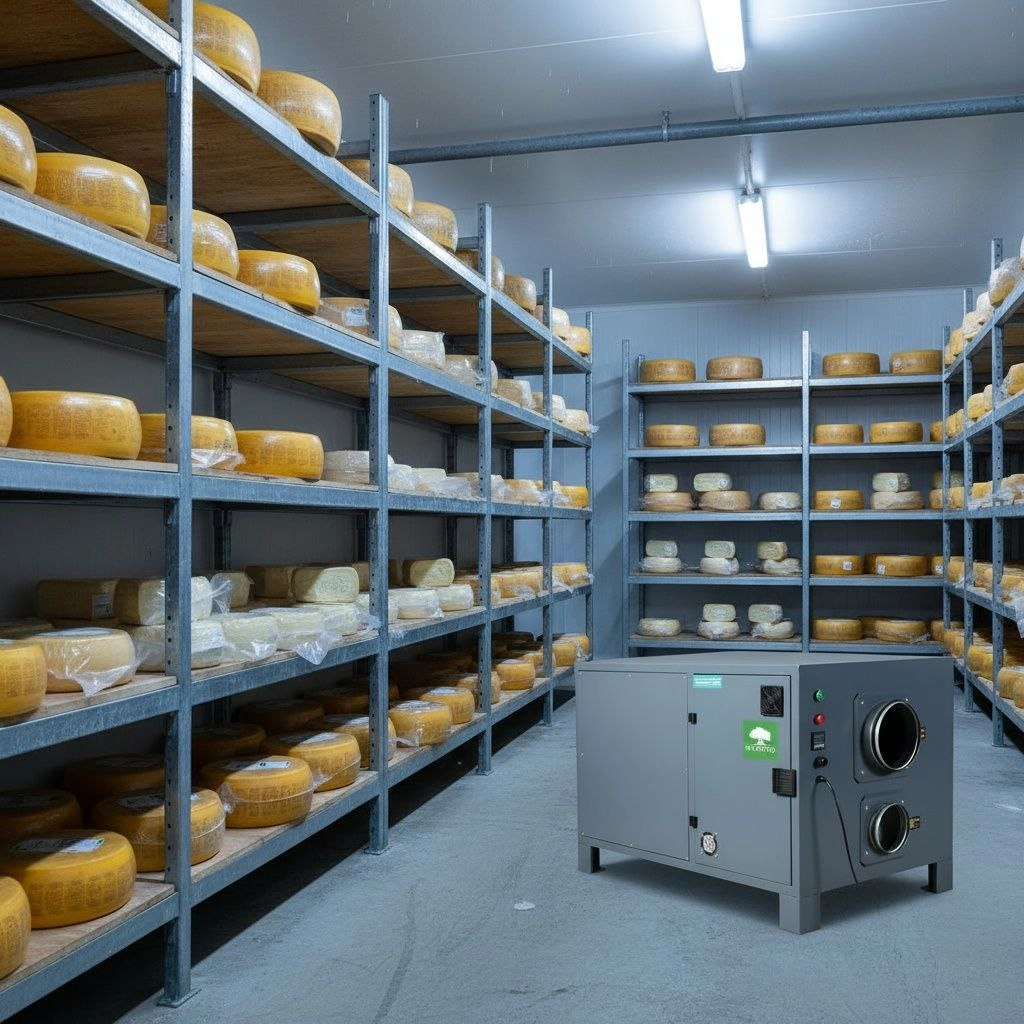
Passive warehouses have low moisture loads, with the main source of moisture being vapor permeability through the building envelope and minimal infiltration through leaks. In such spaces, the dehumidification system can be compact with low capacity.
Active warehouses are characterized by high dynamic loads due to frequent door openings, movement of forklifts, the presence of personnel, and incoming moist goods. A comparative example: a warehouse with a volume of 3000 m³ with one door opening per hour requires a dehumidifier capacity of about 2-3 kg/h; the same warehouse with 20 openings per hour requires 15-25 kg/h — an 8-10x difference with the same room size.
Moisture load calculation
Proper calculation of moisture loads is key to effective design. Door openings are the main source and account for 60-80% of the total load in active warehouses. For example, for a gate measuring 4 by 3.5 meters under outside conditions of 28°C and 75% relative humidity (humidity ratio about 18 g/kg) and inside conditions of 18°C and 45% relative humidity (humidity ratio about 6 g/kg), with airflow through the open gate of 0.8 m/s and an opening time of 2 minutes, one opening brings in approximately 1.2-1.5 kg of moisture. At 15 openings per hour, this amounts to 18-22 kg/h.
Other sources of moisture include:
- Infiltration through gaps and leaks: 10-25% of the load
- Vapor permeation through walls, floor, and roof: less than 5%
- Occupancy load: 40-100 g/h per person
- Moisture release from hygroscopic goods (cardboard, wood, textiles)
It is important to note that many designers overestimate the vapor permeability factor and spend significant funds on additional vapor barriers, whereas even doubling wall permeability increases the total load by only 3-4%. It is more economical to invest in door opening management.
Choosing a dehumidification system
Condensing (refrigerant) dehumidifiers are optimal when air temperature is above 15°C and the target dew point is above 7-10°C. Their coefficient of performance (COP) is 2.0-4.0, which makes them economical at high moisture loads and moderate dryness requirements. A limitation is condensate freezing on the evaporator at low temperatures.
Desiccant dehumidifiers are necessary when air temperature is below 15°C or the target dew point is below 5°C. They are indispensable for cold stores, low-temperature rooms, and spaces with strict humidity requirements. It is important to consider that a desiccant dehumidifier increases the outlet air temperature by 10-15°C due to the heat of adsorption.
Hybrid systems combine the advantages of both technologies. A typical scheme includes pre-cooling the air before the desiccant stage. For example, cooling the supply air from 32°C and 20 g/kg to 18°C and 12 g/kg reduces the load on the desiccant dehumidifier by 40%, which decreases its size and the regeneration energy consumption.
Load reduction: architectural and organizational measures
Architectural and organizational measures are often the most cost-effective ways to reduce moisture load:
- High-speed doors reduce opening time from a typical 120-180 seconds to 20-30 seconds, proportionally reducing the moisture load.
- Air curtains create a barrier between outdoor and indoor air with 70-85% effectiveness when properly selected and installed. Air velocity should be 8-12 m/s, and the tilt angle 15-20° outward.
- Plastic strip curtains are especially important for high openings over 3 meters, where intense convective flow occurs due to the density difference between cold and warm air.
- Airlock vestibules with double doors are effective for rooms with strict humidity requirements.
Organizational measures include controlling door opening time. In one project, reducing the average opening time from 3 to 1 minute lowered the moisture load by 72% without any capital expenditures, solely through staff training and installing an audible alarm. It is also recommended to concentrate loading and unloading operations within specific hours.
Distribution of dehumidified air and automation
The main principle of distributing dehumidified air is to supply the driest air exactly where it is needed most. For example, in a warehouse with an integrated cold room, placing supply diffusers for dry air directly at the cold room doors reduced the load on the cold room’s internal dehumidifier by 35%.
Recommendations for diffuser placement include positioning along the wall with the gates and near openings to cold zones. Modulating regeneration power in desiccant dehumidifiers provides 40-60% energy savings at part loads.
Humidity sensors are recommended to be installed at a height of 1.5 m from the floor in an area with good air circulation, no closer than 2 m from doors, sources of heat or cold, and supply diffusers.
Common design mistakes
The following mistakes are often made when designing dehumidification systems:
- Excessive focus on sealing walls instead of managing door openings. In one project, spending 40000 euros on additional vapor barriers and wall sealing reduced the load by only 6%, whereas installing high-speed doors for 12000 euros cut the load by 45%.
- Calculating for average rather than peak loads, which leads to insufficient system capacity during critical periods.
- Ignoring initial drying, when new buildings and newly delivered goods can release moisture for weeks.
- Lack of coordination with the operations team — the best system will not work if staff leave doors open.
- Controlling relative humidity without considering surface temperatures, when a nominal 40% RH does not prevent condensation on cold structural elements.
FAQ
What relative humidity is needed to prevent corrosion of steel products?
Maximum 40% at a stable temperature of 18-22°C.
What fundamentally differs in design for passive versus active warehouses?
A 5-10x difference in loads due to different frequencies of door openings and goods movement.
When is it essential to use desiccant dehumidifiers?
When air temperature is below 15°C or the required dew point is below 5°C.
What is more effective for reducing humidity: sealing walls or closing doors quickly?
Definitely closing doors quickly, since in active warehouses 60-80% of moisture enters through door openings.
How should humidity be properly controlled in a warehouse with a cold room?
Control by dew point, which should be 2-3°C below the temperature of the coldest surfaces. It is also important to position the supply of dry air near the cold room doors.
Conclusions
Successful design of a warehouse dehumidification system is based on three key principles:
- Define the real project goal, not just formal humidity metrics
- Calculate loads with the right priorities, where doors matter more than walls
- Select the system for the specific temperature conditions and required dew point
Organizational and architectural measures are often more effective than expensive equipment. A phased approach is recommended: first implement organizational measures, assess their effect, and then select equipment for the real, not theoretical, load.


