






































Author: Mycond Technical Department
Choosing the right dehumidifier is an investment in your home’s health and comfort for the next 10–15 years. A poorly chosen device can lead to disappointment: one that’s too weak won’t handle excess humidity, one that’s too powerful will mean overpaying, and one that’s too noisy will disturb sleep or relaxation. Many people also overlook the device’s size, which can take up too much space in a small apartment.
In this guide, we’ll cover 7 key criteria for choosing a dehumidifier: capacity, noise level, dimensions, tank volume, Smart features, air filtration, and energy consumption. We’ll also provide specific recommendations for selecting a model for different usage conditions.
The Mycond line of household dehumidifiers offers an ideal solution for any scenario—from a compact bedroom to a large home. Regardless of room size or special requirements, you’ll find a model that perfectly fits your needs.
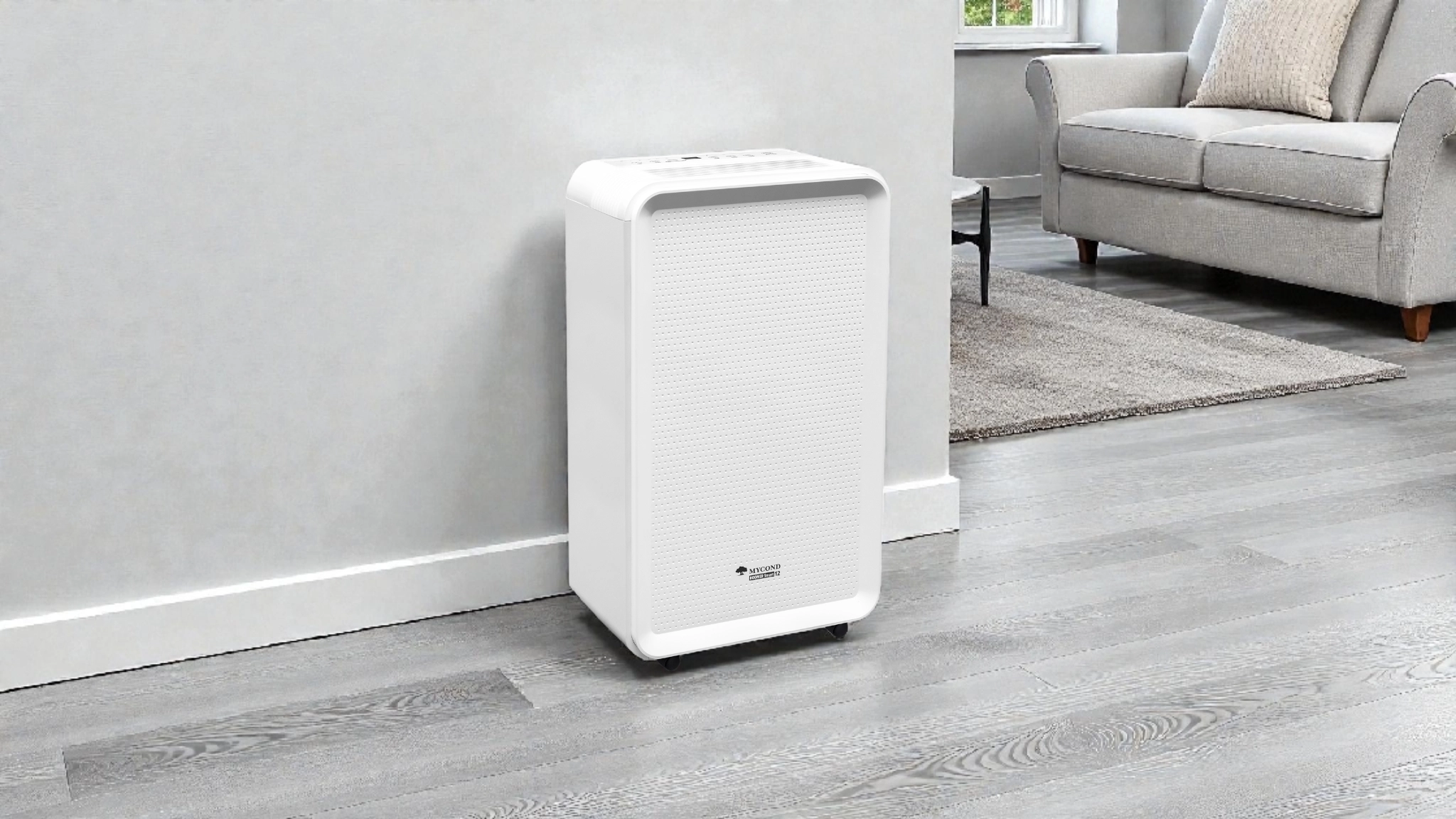
What to consider when choosing a dehumidifier
What to consider when choosing a dehumidifier: capacity as the main criterion
What to consider when choosing a dehumidifier? First and foremost—capacity, which is the most important characteristic. A dehumidifier’s capacity is the number of liters of water the device can collect per day under standard conditions (temperature 30°C and relative humidity 80%). This indicator helps you understand how effectively the dehumidifier will handle humidity in your room.
There’s a simple formula for calculating the required capacity: the room area in m² divided by 2.5 equals the minimum required dehumidifier capacity in liters per day. For example:
- For a 20 m² room: 20 ÷ 2.5 = 8 L/day, recommended from 12 L/day
- For a 35 m² studio: 35 ÷ 2.5 = 14 L/day, recommended 16 L/day
- For a 60 m² one-bedroom apartment: 60 ÷ 2.5 = 24 L/day, recommended 25 L/day
- For a 100 m² house: 100 ÷ 2.5 = 40 L/day, two dehumidifiers recommended
| Room area | Minimum capacity | Recommended models |
|---|---|---|
| up to 25 m² | 12 L/day | Roomer Smart 12 or TIBO Eco 12 |
| 25-35 m² | 16 L/day | Yugo Smart 16 |
| 35-60 m² | 25 L/day | Roomer Smart 25 or |
| 60-100 m² | 25+ L/day | Two dehumidifiers (e.g., Roomer Smart 25) |
It’s important to choose a dehumidifier with a 20–30% capacity reserve above the calculated value. This is necessary for several reasons:
- After renovations or leaks, increased drying power is needed
- Drying laundry indoors adds a significant amount of moisture
- With a higher reserve, the comfortable humidity level is reached faster
- The dehumidifier runs less intensively, increasing its longevity
The Mycond range with capacities from 12 to 25 L/day is the ideal solution for rooms of any size. Each model is optimized for its target area, ensuring effective dehumidification with minimal electricity consumption.
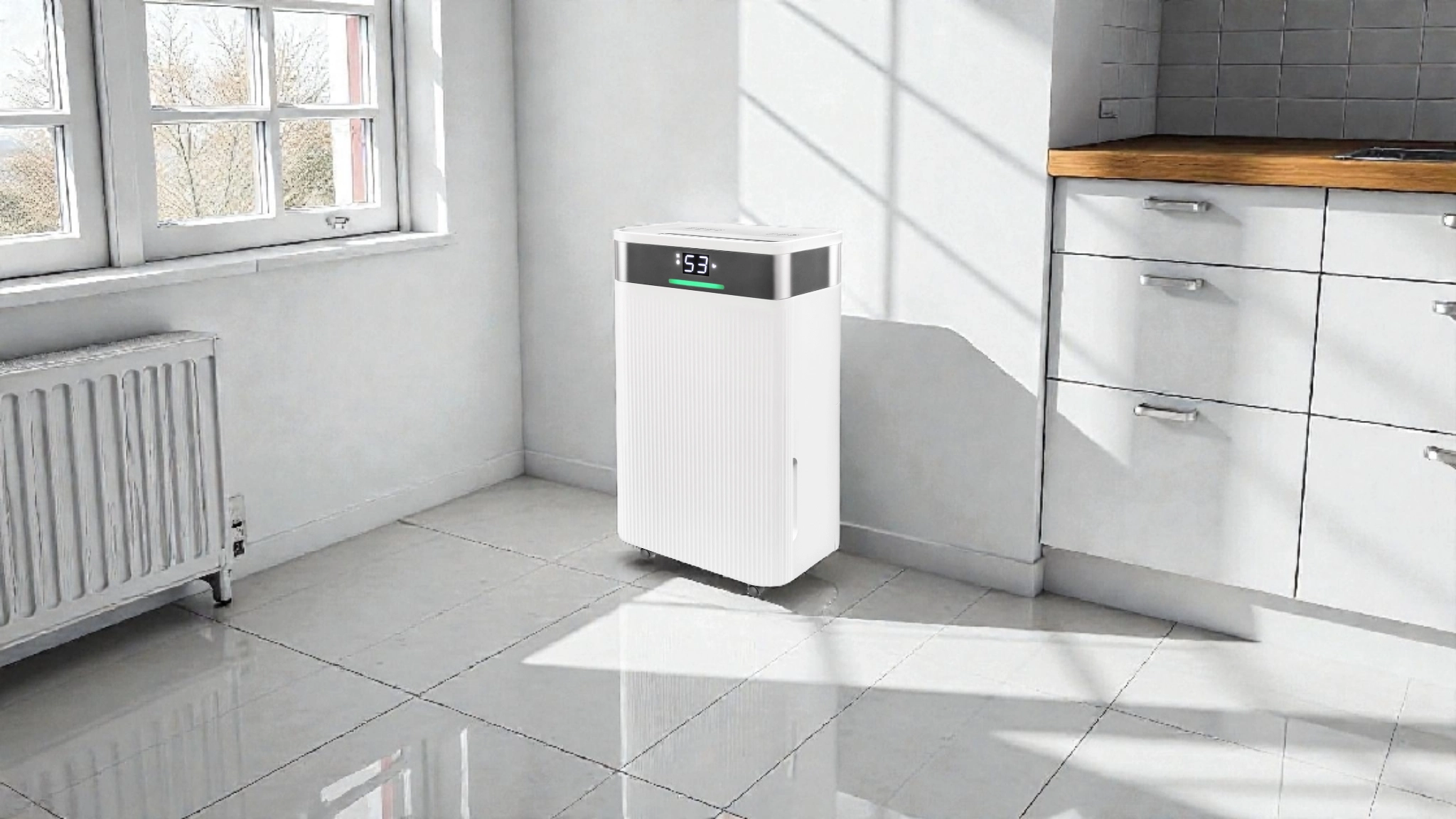
Dehumidifier noise level
What dehumidifier noise level is comfortable for a bedroom
What dehumidifier noise level is comfortable for a bedroom? This is a crucial question, as noise can significantly impact the device’s usability. The installation location determines how critical the noise level is:
- Bedroom – noise level is critically important because the device runs nearby during sleep
- Living room – noise matters, as it can interfere with watching TV, conversations, or work
- Utility room or garage – noise is not a major concern
For better understanding, here’s a comparative noise scale:
- 36 dB – quiet whisper, barely audible
- 38 dB – a soft whisper at one meter
- 45 dB – normal conversation level
- For comparison: refrigerator – 40–45 dB, computer – 30–40 dB
Comparison of Mycond dehumidifier models by noise level:
| Model | Noise level | Recommended room |
|---|---|---|
| Roomer Smart 12 | 36 dBA (quietest) | Ideal for bedroom |
| TIBO Eco 12 | 38 dBA | Suitable for bedroom |
| Yugo Smart 16 | 38 dBA | Suitable for bedroom |
| Roomer Smart 25 | 45 dBA | For living room or utility room |
| Roomer HEPA 25 | 45 dBA | For living room or utility room |
Conclusion: for a bedroom, choose a dehumidifier with a noise level of 36–38 dB; for a living room, up to 45 dB is acceptable; and for utility areas, any will do. Roomer Smart 12, with just 36 dBA, is the perfect solution for those who value silence and restful sleep, as it’s practically inaudible.
Dehumidifier size and weight
What to look for when buying a dehumidifier: size and weight
What to look for when buying a dehumidifier? In addition to capacity and noise level, important characteristics include the device’s size and weight. These parameters determine how convenient it will be to use the dehumidifier in your space and how often you can move it.
| Model | Dimensions (W×D×H), mm | Weight, kg | Compactness rating |
|---|---|---|---|
| TIBO Eco 12 | 250×220×445 | 11 | Most compact |
| Roomer Smart 12 | 280×200×450 | 12 | Compact |
| Yugo Smart 16 | 280×201×505 | 12 | Medium |
| Roomer HEPA 25 | 350×235×578 | 14.5 | Medium |
| Roomer Smart 25 | 395×290×653 | 14.5 | Medium |
Dehumidifier compactness is especially important in the following situations:
- Small apartments where every centimeter of space matters
- Need to move the device frequently between rooms
- Desire to store the dehumidifier in a closet during summer when not in use
- Use in small spaces such as bathrooms or walk-in closets
Note that all Mycond dehumidifier models are equipped with casters for easy movement and a built-in handle, making them mobile even with substantial weight. This allows you to effortlessly move the device between rooms or within a room.
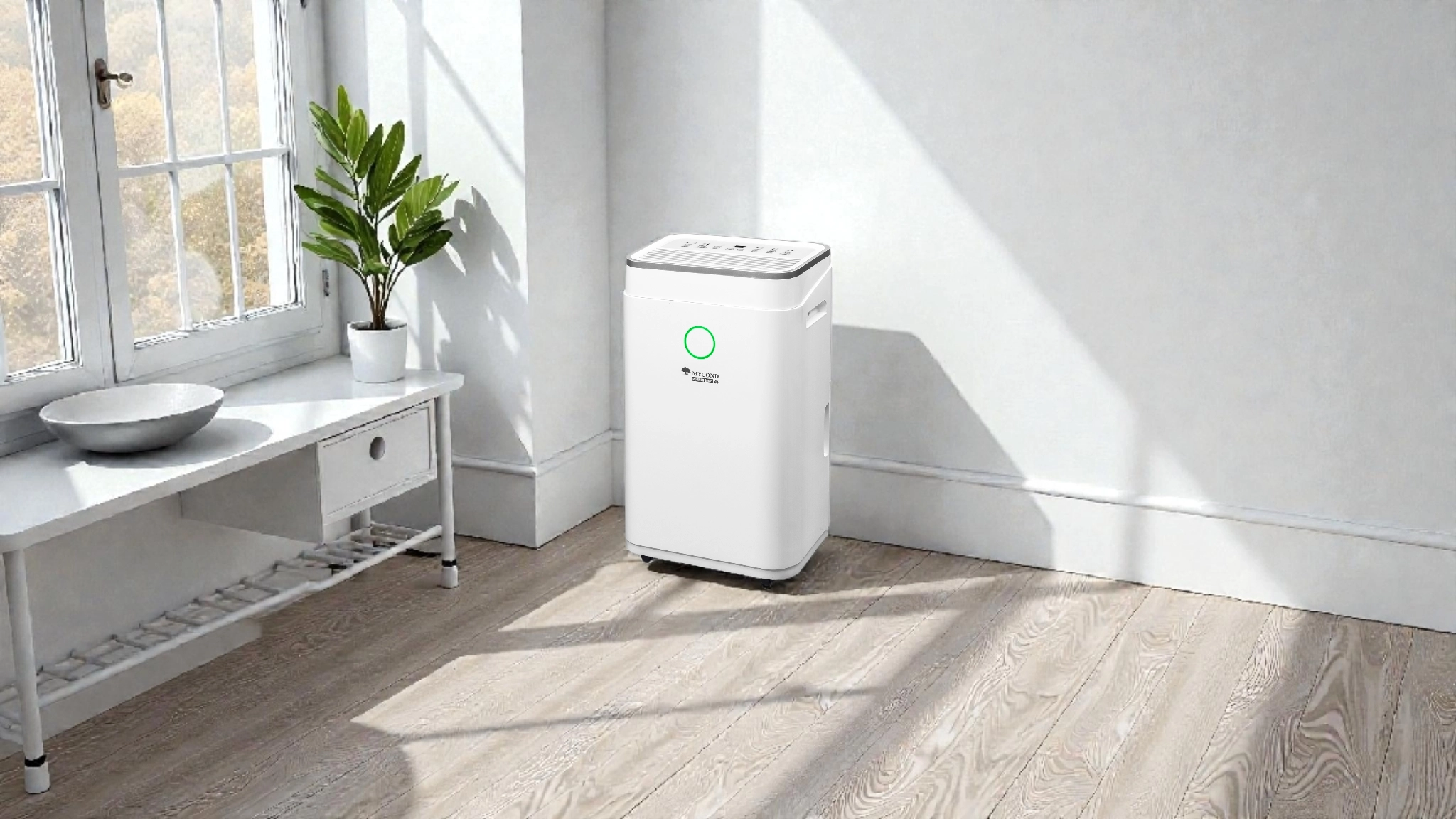
Water tank volume and continuous drainage
Water tank volume and continuous drainage
Understanding how water collection works in a dehumidifier is an important aspect when choosing a model. The principle is simple: moisture from the air condenses and collects into a special removable tank. When this tank fills up, the dehumidifier automatically turns off and emits a sound signal to let you know it needs emptying. After emptying, the tank is reinserted and the device continues operation.
The larger the tank volume, the less often you’ll need to empty it, which is especially important in high humidity or 24/7 operation.
| Model | Capacity, L/day | Tank volume, L | Emptying frequency at maximum operation |
|---|---|---|---|
| TIBO Eco 12 | 12 | 2.0 | 4–6 times per day |
| Roomer Smart 12 | 12 | 2.0 | 4–6 times per day |
| Yugo Smart 16 | 16 | 2.0 | 6–8 times per day |
| Roomer HEPA 25 | 25 | 4.0 | 6–7 times per day |
| Roomer Smart 25 | 25 | 6.5 | 3–4 times per day |
An alternative to manual tank emptying is continuous drainage. All Mycond dehumidifier models are equipped with a special port for connecting a continuous drain hose. This allows you to route the hose to a sewer, bathtub, or other drain, enabling continuous operation without needing to empty the tank.
Continuous drainage is especially useful in these situations:
- After a leak or flooding, when the dehumidifier must run 24/7
- In basements or utility rooms with access to drainage nearby
- When you don’t want to wake up at night to empty the tank
- When installing the dehumidifier in a hard-to-reach location
Roomer Smart 25, with the largest 6.5 L tank, is the ideal solution for those who don’t want to empty water often and prefer autonomous operation. Under standard conditions, this tank needs emptying only 3–4 times per day even at maximum capacity, which is much more convenient compared to models with smaller tanks.
Dehumidifier Smart features
Dehumidifier with Wi‑Fi control: Smart features
A dehumidifier with Wi‑Fi control brings a new level of convenience and climate control to your home. In the Mycond lineup, three models support Smart features: Roomer Smart 12, Yugo Smart 16, and Roomer Smart 25.
These models allow you to control the dehumidifier via the MYCOND app, available for iOS and Android smartphones. Key Smart control features:
- Remote real-time humidity monitoring
- Turning the dehumidifier on and off from anywhere via the internet
- Scheduling operation (e.g., automatically turn on at 8:00 and off at 23:00)
- Combined operation with other Mycond equipment within a single ecosystem
- Voice control via Alexa and Google Home
- Setting target humidity and operation modes
Importantly, Roomer Smart 12 and Yugo Smart 16, in addition to Smart features, are equipped with a carbon filter and air ionization to improve air quality.
Models without Smart features (TIBO Eco 12 and Roomer HEPA 25) use traditional control via the panel on the body. The display shows the current humidity level, and the user can manually set target humidity and operating mode. After setup, the device works automatically, maintaining the set humidity level.
Who needs Smart features:
- Those who value modern technology and the convenience of remote control
- If you want to monitor humidity while away from home
- Smart home enthusiasts
- Users of voice assistants like Alexa or Google Home
- Those who want to set flexible operation schedules
Who can do without Smart features:
- If simplicity matters more than cutting-edge tech
- When the dehumidifier is installed permanently and runs with fixed settings
- If remote control isn’t needed
- For those who want to save money, as models without Smart features are usually more affordable
For smart home fans, Mycond Smart series dehumidifiers are the ideal solution thanks to full integration with the MYCOND ecosystem and voice assistants. This allows you to create a truly comfortable indoor climate controlled from a single app or with voice commands.
Air filtration in a dehumidifier
Dehumidifier with a HEPA filter for allergy sufferers
A dehumidifier with a HEPA filter for allergy sufferers is a special type of device that not only reduces humidity levels but also significantly improves air quality. Standard dehumidifiers have basic filtration that traps only large dust particles, while smaller allergens remain in the air even after dehumidification.
The model stands out thanks to its HEPA (High Efficiency Particulate Air) filter, which can trap 99.97% of particles larger than 0.3 microns. This effectively removes from the air:
- Pollen
- Mold spores
- Dust particles
- Dust mites and their waste
- Bacteria and viruses
- Pet hair and dander
Roomer HEPA 25 is essential in the following cases:
- If you or your family members are allergic to pollen, dust, or mold
- In the presence of asthma and other respiratory conditions
- If there are small children at home who need extra protection from allergens
- If you have pets that are a source of allergens
- If mold has been detected indoors, as its spores remain in the air
If you don’t suffer from allergies and simply need dehumidification, you can choose a model without a HEPA filter. However, keep in mind that clean air is beneficial for everyone, regardless of allergies.
The uniqueness of Roomer HEPA 25 lies in combining powerful dehumidification (25 L per day) for large rooms up to 60 m² with highly efficient air filtration. Essentially, it’s two devices in one—a dehumidifier and an air purifier—making it the perfect solution for families with allergy sufferers and asthmatics, where clean, allergen-free air is as important as humidity control.
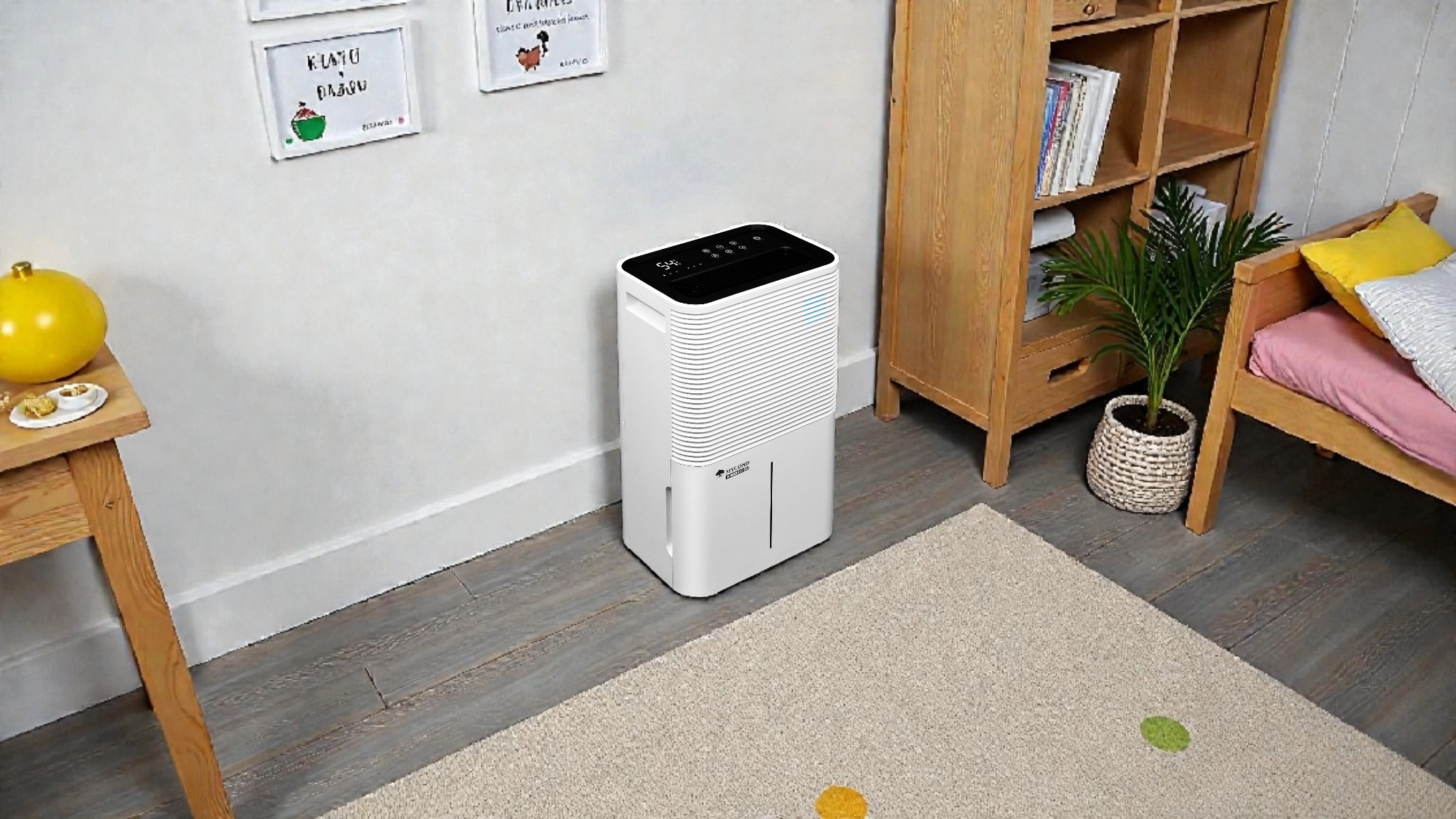
Dehumidifier energy consumption
How much electricity does a dehumidifier use
How much electricity does a dehumidifier use? This question often concerns those who plan to use the device regularly. Dehumidifiers are energy-consuming devices, but their usage is significantly lower than many other household appliances.
| Model | Power, W | Comparison with household appliances |
|---|---|---|
| Roomer Smart 12 | 180 | Like two 90 W bulbs |
| TIBO Eco 12 | 200 | Like two 100 W bulbs |
| Yugo Smart 16 | 270 | Like three 90 W bulbs |
| Roomer HEPA 25 | 370 | Like four 90 W bulbs |
| Roomer Smart 25 | 380 | Like four 95 W bulbs |
It’s important to understand that a dehumidifier doesn’t run at maximum power all the time. Thanks to the built-in humidistat, it works in cycles: it turns on when humidity exceeds the set level, removes excess moisture, then turns off until the next rise in humidity. On average, a dehumidifier actively runs only 40–60% of the time, which significantly reduces actual energy consumption.
Also consider that the electricity costs for running a dehumidifier are far lower than potential repair costs for damage caused by high humidity and mold. Excess moisture can lead to:
- Damage to furniture and wood structures
- Peeling wallpaper and paint
- Mold and mildew, which are expensive to remediate
- Damage to electronic equipment
- Health problems requiring medical treatment
Mycond dehumidifiers are an energy-efficient solution with an optimal balance of performance and power consumption. They use modern technologies to minimize energy use while maintaining high dehumidification efficiency.
Comparison of dehumidifier models
Which are the best home dehumidifiers: model comparison
Which are the best home dehumidifiers? The answer depends on many factors, including room size, specific needs (e.g., allergies), and budget. To help you decide, we’ve prepared a detailed comparison of five Mycond household dehumidifier models.
| Criterion | TIBO Eco 12 | Roomer Smart 12 | Yugo Smart 16 | Roomer Smart 25 | Roomer HEPA 25 |
|---|---|---|---|---|---|
| Capacity, L/day | 12 | 12 | 16 | 25 | 25 |
| Recommended area, m² | up to 25 | up to 25 | 25–35 | 35–60 | 35–60 |
| Noise level, dBA | 38 | 36 | 38 | 45 | 45 |
| Tank volume, L | 2.0 | 2.0 | 2.0 | 6.5 | 4.0 |
| Smart Wi‑Fi | No | Yes | Yes | Yes | No |
| HEPA filter | No | No | No | No | Yes |
| Ionization | No | Yes | Yes | No | No |
| Dimensions, mm | 250×220×445 | 280×200×450 | 280×201×505 | 395×290×653 | 350×235×578 |
| Weight, kg | 11 | 12 | 12 | 14.5 | 14.5 |
| Who it suits | Budget-conscious users, small rooms | Quiet and tech lovers | Medium rooms, Smart control | Large rooms, technology | Allergy sufferers, large rooms |
Let’s consider 5 specific scenarios for choosing a dehumidifier:
Scenario 1: 18 m² bedroom, quiet operation is crucial
Calculation: 18 ÷ 2.5 = 7.2 L/day, a minimum of 12 L/day is needed. Since the device will operate in a bedroom, quietness and compactness are key factors. Recommendation: Roomer Smart 12—the quietest (36 dB) dehumidifier with Wi‑Fi control, making it ideal for a bedroom. Alternative: TIBO Eco 12—slightly louder (38 dB), but more affordable.
Scenario 2: 35 m² studio apartment
Calculation: 35 ÷ 2.5 = 14 L/day, a 16 L/day model is recommended. Recommendation: Yugo Smart 16—an ideal solution thanks to optimal capacity, Smart features, and air ionization, which is especially important for studios where the kitchen is combined with the living area.
Scenario 3: 55 m² one-bedroom apartment with a child with allergies
Calculation: 55 ÷ 2.5 = 22 L/day, a capacity of about 25 L/day is required. Key factors are dehumidification power and air purification from allergens. Recommendation: —ideal for families with allergies thanks to the combination of power (25 L/day) and HEPA filtration that removes virtually all allergens from the air.
Scenario 4: 70 m² two-bedroom apartment, tech-savvy family
Calculation: 70 ÷ 2.5 = 28 L/day, a capacity of about 25 L/day is needed. Important factors: power, Smart control, and a large water tank. Recommendation: Roomer Smart 25—ideal for tech-loving families thanks to maximum capacity, Smart features, and the largest tank (6.5 L).
Scenario 5: 100 m² house with a living room and bedrooms
Calculation: 100 ÷ 2.5 = 40 L/day; one dehumidifier won’t handle this area. Recommendation: use two dehumidifiers—Roomer Smart 25 for the living room and kitchen (45 dB is acceptable for these areas) and Roomer Smart 12 for the bedroom (quiet, 36 dB). A combination of two Mycond models is ideal for large homes, ensuring effective dehumidification and comfort in all zones.
Questions and answers about dehumidifiers
FAQ: Answers to the most common questions about dehumidifiers
1. What are the best home dehumidifiers?
The best choice depends primarily on room area. For small rooms up to 25 m², Roomer Smart 12 or TIBO Eco 12 are optimal. For medium rooms of 25–35 m², Yugo Smart 16 is ideal. For large rooms up to 60 m², we recommend Roomer Smart 25 or . Each model has its advantages: Roomer Smart 12—the quietest; Yugo Smart 16—optimal for medium rooms; Roomer HEPA 25—for allergy sufferers; Roomer Smart 25—with the largest tank.
2. What should I consider when choosing a dehumidifier?
The main criterion is capacity, which can be calculated using the formula: room area in m² divided by 2.5 equals the required capacity in L/day. Additionally, consider: noise level (for a bedroom, under 40 dB), water tank volume, device dimensions, availability of Smart features (if remote control matters), and a HEPA filter (for allergy sufferers).
3. Which dehumidifier for a 100 m² home?
For a 100 m² home, a capacity of about 40 L/day is needed (100 ÷ 2.5 = 40). Since a single household dehumidifier won’t provide that, we recommend using two devices: Roomer Smart 25 for main areas (living room, kitchen) and Roomer Smart 12 for the bedroom. This approach not only provides the required capacity but also optimizes noise levels in different zones.
4. What dries the air best?
An electric dehumidifier is the most effective solution for humidity control indoors. It is hundreds of times more effective than silica gel or salt-based moisture absorbers. Modern dehumidifiers with 12–25 L/day capacity effectively handle rooms of 25–60 m², maintaining an optimal humidity level of 40–60%.
5. What should I look for when buying a dehumidifier?
When choosing, prioritize the following factors: 1) Capacity—the main parameter; 2) Noise level—especially important for bedrooms; 3) Water tank volume—affects convenience; 4) Device size—important for small spaces; 5) Smart features—for convenient remote control; 6) HEPA filter—necessary for allergy sufferers.
6. How many liters per day does my apartment need?
You can determine the required dehumidifier capacity using the formula: room area in m² divided by 2.5 equals the required capacity in L/day. For example, for a 50 m² apartment: 50 ÷ 2.5 = 20 L/day; therefore, a 25 L/day dehumidifier (with a small reserve) is recommended. For higher humidity or special conditions, an additional 20–30% reserve is advisable.
7. Roomer Smart 12 or TIBO Eco 12: which is better?
Both models have the same capacity of 12 L/day but differ in other parameters. Roomer Smart 12 is quieter (36 vs 38 dB), has Smart features, and air ionization. TIBO Eco 12 is more compact and usually more affordable. The choice depends on priorities: if quiet operation and Smart control are important—choose Roomer Smart 12; if compactness and budget are key—TIBO Eco 12.
8. How does Roomer HEPA 25 differ from Roomer Smart 25?
Both models have the same 25 L/day capacity but serve different purposes. features a HEPA filter for allergy sufferers, has a 4 L tank, but no Smart features. Roomer Smart 25 has Wi‑Fi control and the largest tank (6.5 L), but no HEPA filtration. Recommendation: allergy sufferers should choose Roomer HEPA 25, while tech enthusiasts should choose Roomer Smart 25.
9. Do I need Smart features in a dehumidifier?
Smart features are useful if you value remote control convenience, want to monitor humidity from anywhere, set operation schedules, or integrate the dehumidifier into a smart home system. If the dehumidifier is stationary with constant settings, you can do without Smart features and save on cost.
10. Which dehumidifier is best for allergy sufferers?
is the only model with a HEPA filter that traps 99.97% of allergens (pollen, dust, mold spores, pet dander). With a capacity of 25 L/day, it’s suitable for rooms up to 60 m² and is the ideal choice for families with allergy sufferers, asthmatics, and pet owners.
Conclusion
How to choose the perfect dehumidifier for your home
Choosing the right dehumidifier solves the problem of high humidity for many years. We’ve covered 7 key selection criteria, with capacity being the most important. Each of the five Mycond models addresses specific tasks:
- TIBO Eco 12 – a combination of compactness and affordability for small rooms
- Roomer Smart 12 – the quietest model with Smart control and ionization for bedrooms
- Yugo Smart 16 – the optimal solution for medium-sized rooms with Smart features
- Roomer Smart 25 – a powerful model with Wi‑Fi control and a large tank for spacious rooms
- – a combination of powerful dehumidification and air purification for allergy sufferers
Each Mycond household dehumidifier model is an ideal solution for its use case. The Mycond lineup offers a comprehensive, modern, and energy‑efficient way to manage your home’s microclimate, without forcing you to overpay for a big-name brand.
If you’re still unsure which dehumidifier to choose, take advantage of our free consultation. Our specialists will help calculate the required capacity and select the optimal model for your situation. Contact us by phone or via the form at the bottom of the page to ensure the perfect indoor climate in your home.


