









































Author: Mycond Technical Department
Optimizing capital expenditures for air dehumidification systems is a strategic task that affects project economics throughout the entire equipment life cycle. In dehumidification projects there is always a trade-off between capital (first cost) and operating costs. Higher upfront investments often mean lower operating costs, but this is not always justified from the standpoint of overall economic efficiency.
The basic principle of minimizing capital expenditures is to remove only the minimum necessary amount of moisture in the most efficient way. This makes it possible to optimize both the size of the system and its energy consumption.
It is necessary to consider the opportunity cost of inaction. Corrosion of process equipment worth tens of thousands of euros, production downtime up to 5,000 euros per day, and deterioration in product quality are just some of the possible consequences of ineffective humidity control. Given that the typical service life of dehumidification systems is 15–20 years, the cumulative effect of the right decision can exceed the initial investment many times over.
The economic benefits of optimized dehumidification systems include four categories: lower operating costs, reduced capital investment in other equipment, improved product quality, and increased operational flexibility. Each of these categories has a measurable financial impact that should be taken into account when making investment decisions.
Minimizing moisture loads as the basis for reducing capital expenditures
The size and cost of a dehumidification system are directly proportional to the moisture load. This is a fundamental relationship that determines project economics. Reducing the load by 50% can cut capital expenditures by 50–60%, which makes minimizing moisture loads the highest priority in optimization.
The sources of moisture load in an industrial space have a clear hierarchy:
- Open doors and gates – 50–70%
- Supply ventilation air – 15–30%
- Infiltration through gaps – 5–15%
- Conveyor and process openings – 3–8%
- Breathing and evaporation from people – 2–5%
- Vapor permeability through building envelopes – 1–3%
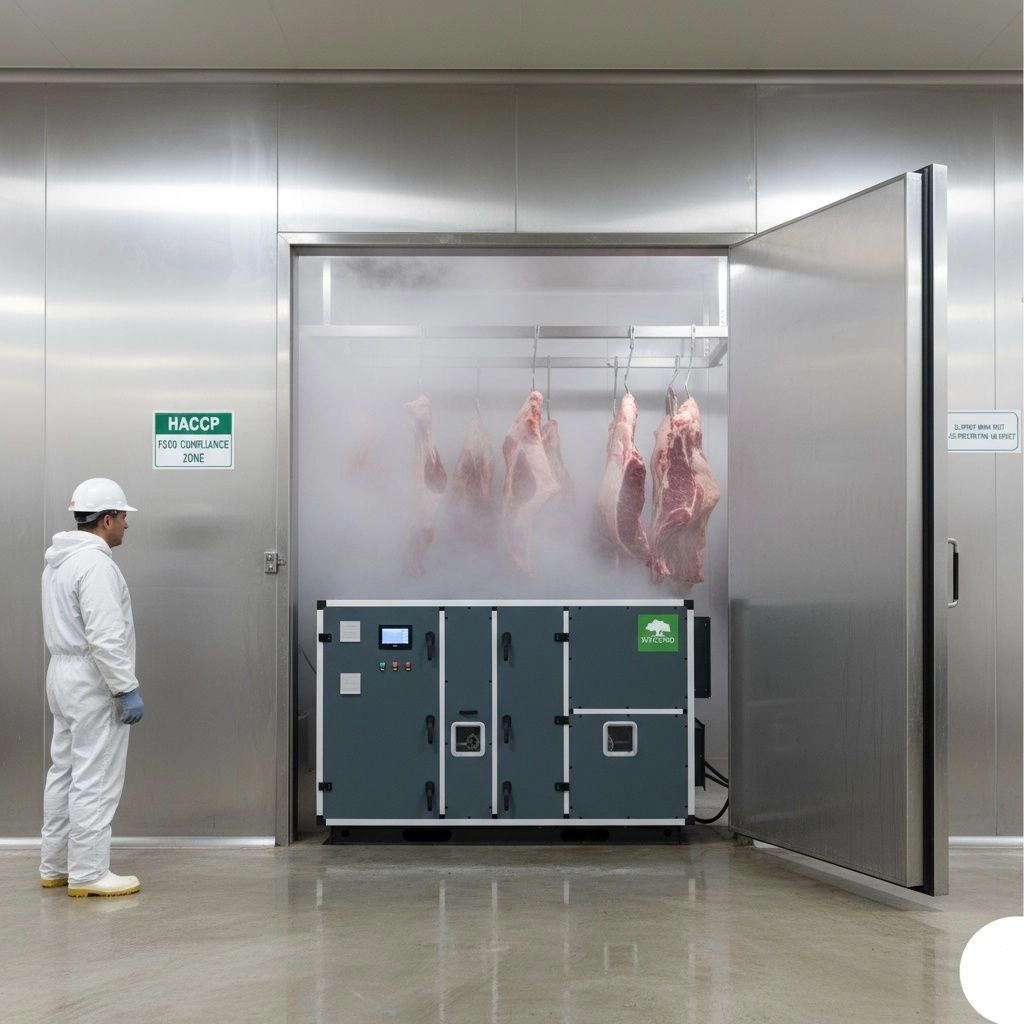
Consider a cold store with a temperature of -18°C. With a practice of opening loading gates for 3 minutes for each truck entry/exit (15 cycles per hour), the moisture load reaches approximately 135 kg/h of water vapor. This load requires a dehumidifier with an airflow over 15,000 m³/h. However, reducing the open time to 1 minute lowers the load to approximately 20 kg/h (airflow 2,500 m³/h) — an 85% reduction, enabling the use of a dehumidifier six times smaller in capacity and cost.
To reduce the load from doors, the following methods are effective:
- High-speed roll-up doors with opening time under 3 seconds – 40–60% load reduction
- Air curtains with airflow velocity of 8–12 m/s – 30–50% reduction
- Vestibule airlocks with a volume of 15–30 m³ – 60–80% reduction
- PVC strip curtains – 20–40% reduction
It is important to understand that infiltration through gaps is often more important than vapor permeability of structures. For example, a 1.5 mm wide, 1 m long gap at a pressure differential of 10 Pa passes about 50 g/h of moisture, whereas 50 m² of painted 200 mm concrete wall passes only 5–8 g/h. Practical sealing methods include aluminum foil tape (EUR 2–5/m), silicone sealants (EUR 5–10/cartridge), and sealing grommets on cable penetrations (EUR 10–30/pc).
Vapor permeability of building envelopes typically accounts for less than 3–5% of the total load, so investing in premium-class vapor barrier membranes is not economically justified until gaps and doors are addressed.
Optimization of control levels and tolerances
The cost of a dehumidification system rises exponentially with the depth of drying. With an internal load of 5 kg/h of water vapor, to maintain a dew point of +5°C (moisture content 5.4 g/kg) you need an airflow of about 1,200 m³/h. For a dew point of -10°C (moisture content 1.8 g/kg) you already need 3,500 m³/h, and for -25°C (moisture content 0.5 g/kg) — more than 12,000 m³/h. That is a tenfold increase in airflow for just a 30-degree drop in dew point!
The key here is the “dry enough” principle — defining the minimum humidity level that delivers the process result without excessive margin. Overstated dew point requirements can dramatically increase system cost without a proportional increase in benefit.
A significant problem is ambiguity in specifications in statements of work. For example, if the SOW requires moisture content of 2 g/kg ±0.7 g/kg but does not specify where to measure, different interpretations are possible. Specifying control at the diffuser outlet requires a dehumidifier capacity of 10 kg/h, while demanding uniform moisture content throughout a 500 m³ room with a deviation no more than 0.7 g/kg between any two points requires a system with 8,000–10,000 m³/h airflow and 25–30 kg/h capacity.
Temperature tolerance also strongly affects humidity control. At 10% relative humidity and a temperature of 21°C ±2°C, the absolute moisture content varies from 1.4 to 1.9 g/kg, which can be critical for pharmaceutical processes. Therefore, the dew point must be specified in absolute terms (°C or g/kg).
Consultations with equipment suppliers at the stage of drafting the SOW are extremely important to avoid differing interpretations that can lead to system proposals with 2–3x cost differences.

Pre-dehumidifying the supply air
Outdoor air is often the dominant source of moisture in industrial premises. In a typical industrial room controlled at a dew point of -10°C with 2,000 m³/h of ventilation, the supply air under summer conditions (30°C, 18 g/kg) brings in about 43 kg/h of moisture, which can be 70–90% of the total load.
An effective strategy is deep dehumidification of the ventilation air before mixing with recirculated air. Consider a design example: outside air at 32°C and 21 g/kg dehumidified by a desiccant to 1 g/kg provides a drying capacity of 20 g per kilogram of dry air. At 1,000 m³/h (air density 1.15 kg/m³), this allows removal of up to 23 kg/h of internal moisture, sufficient for a 500–800 m² space.
The limitation of this strategy is that the internal load must not exceed the drying capacity of the supply flow. However, it is particularly effective for cleanrooms, where supply volumes are large due to air change requirements of 20–60 times per hour.
Precooling the supply air before desiccant dehumidification has a significant economic effect. Cooling from 32°C to 12°C (dew point) reduces the moisture content from 21 to 9 g/kg, i.e., removes 57% of the moisture by the cheaper refrigeration method (removal cost 0.8–1.2 EUR/kg of moisture), leaving only the deep finishing to the desiccant (1.5–2.5 EUR/kg).
Combined refrigeration and desiccant dehumidification systems
The principle of allocating load according to efficiency is one of the keys to optimizing capital expenditures. Refrigeration/condensing dehumidification is economically efficient at dew points above +8...+12°C (moisture content over 6–8 g/kg), while desiccant adsorption is efficient at dew points below +8°C.
The physical reason for this difference is that at low dew points the evaporator of the refrigeration machine operates at +2...+5°C with a COP of only 2.0–2.5 and a risk of frosting, requiring defrost cycles. A desiccant has no such temperature limitation, and its effectiveness even increases with deeper drying.
There are several typical combined schemes:
- Dehumidifying only the supply air with a desiccant — applied for small internal loads up to 5 kg/h and large supply over 3,000 m³/h. Advantages: simplicity and low capital cost. Drawback: limited capacity.
- Precooling the supply to 12–14°C with a chiller plus desiccant dehumidification of the mixture of supply and recirculated air — used for dew points from 0 to -15°C and loads of 10–50 kg/h. This is the most common option with an optimal balance of capital and operating costs.
- Mixing supply and recirculated air, precooling the mixture to 10–12°C, then desiccant dehumidification — used when high energy efficiency is required and inexpensive 6–8°C chilled water is available. Provides the lowest operating costs but requires larger heat exchangers.
- Fully desiccant system without precooling — used when free waste heat for regeneration is available (from cogeneration, process heat, solar collectors) or when a high supply temperature level of 35–45°C is acceptable for the process (product drying). Provides the lowest capital expenditures on refrigeration equipment.
Selection criteria for a combined system include: SHR below 0.65–0.70, ventilation volume over 30% of the total airflow, target dew point below +5°C, availability of thermal energy costing less than 0.03 EUR/kWh.
It is effective to use waste heat from refrigeration condensers for desiccant regeneration. A typical condenser of a 50 kW chiller rejects 60–70 kW of heat at 40–50°C, sufficient for partial regeneration of a desiccant rotor and to cut gas or electricity consumption by 30–50%.
A properly designed combined system can be 25–40% cheaper in CAPEX and 20–35% more economical in operation compared to a single-technology solution for dew points in the range of -5...-20°C.
Typical design mistakes and their economic consequences
In dehumidification system design, errors are often encountered that significantly increase capital expenditures:
- Excess power margin of 50–100% — leads to the system operating at 30–50% load most of the time with a COP 20–30% lower, and to CAPEX overstated by 40–80%.
- Ignoring operational factors — calculating based on the existing practice of door opening without attempting optimization can overstate the design load by 50–200%.
- Over-specifying the dew point — requiring -40°C when -25°C is sufficient for the process increases system cost by 2–3 times.
- Tight tolerances without process justification — demanding ±0.3 g/kg instead of ±1.0 g/kg can double the airflow and system cost.
- Choosing only one technology — using desiccant-only dehumidification for a +5°C dew point where refrigeration would be 40% cheaper.
- Ignoring precooling — feeding air at 35°C and 22 g/kg directly to the desiccant instead of cooling to 14°C and 10 g/kg increases the size of the desiccant block by 60–80%.
- Overemphasis on vapor permeability — investing 50–100 EUR/m² in premium vapor barrier membranes while cable penetrations and door gaps remain unsealed, accounting for 90% of the load.
- No power modulation — a system without variable-speed fan control and staged regeneration heaters runs in on/off mode with 25–40% energy overconsumption and parameter fluctuations.
Operational and organizational factors
Managing door openings requires a systematic approach with specific recommendations:
- Develop procedures for personnel with a standard requiring gates to be closed within 60 seconds after vehicle passage
- Install visual signaling that turns on after 30 seconds and an audible alarm after 60 seconds from opening
- Design vestibule airlocks with a volume of 20–40 m³ with an interlock so one door cannot open until the other is closed, reducing the load by 60–80%
- Automatic high-speed doors with opening/closing time under 2–3 seconds and safety light curtains
System modularity provides significant advantages: designing a base system for 70% of typical load with an additional module for 40–50% for peak periods (weekly washing, seasonal variations) ensures the main equipment operates at a high 80–95% load and COP.
Maintenance is also critically important:
- Replace filters every 2–3 months — dirty filters increase pressure drop by 50–150 Pa and reduce airflow by 15–25%
- Lubricate fan bearings every 6 months to prevent overheating and seizure
- Check ductwork tightness annually — leaks in a negative-pressure system are not visually obvious but can amount to 10–20% of flow
The cost ratio of preventive maintenance to emergency repair with production downtime is typically 1:10 or 1:15, which makes regular maintenance economically justified.
Conclusions
Optimizing capital expenditures for air dehumidification systems should follow a clear sequence of three steps:
- Reduce the load through sealing and door management
- Optimize the control level to the minimum necessary
- Choose the optimal combination of technologies
Before starting design, the engineer should ask five key questions:
- What is the real, not inflated, load?
- What is the minimally acceptable humidity level?
- Can the load be reduced by organizational measures?
- What is the cost of thermal energy for regeneration?
- Are there sources of waste heat?
It is important to remember that the greatest economic effect comes from the simplest and cheapest measures (sealing gaps, personnel procedures), while the smallest effect comes from expensive materials and excessive automation.
A dialogue among the designer, the client, and the operations staff is critical for a realistic assessment of the loads and to avoid both under- and over-specifying system parameters. This approach will ensure the optimal balance between capital expenditures and operating performance of the dehumidification system.


