









































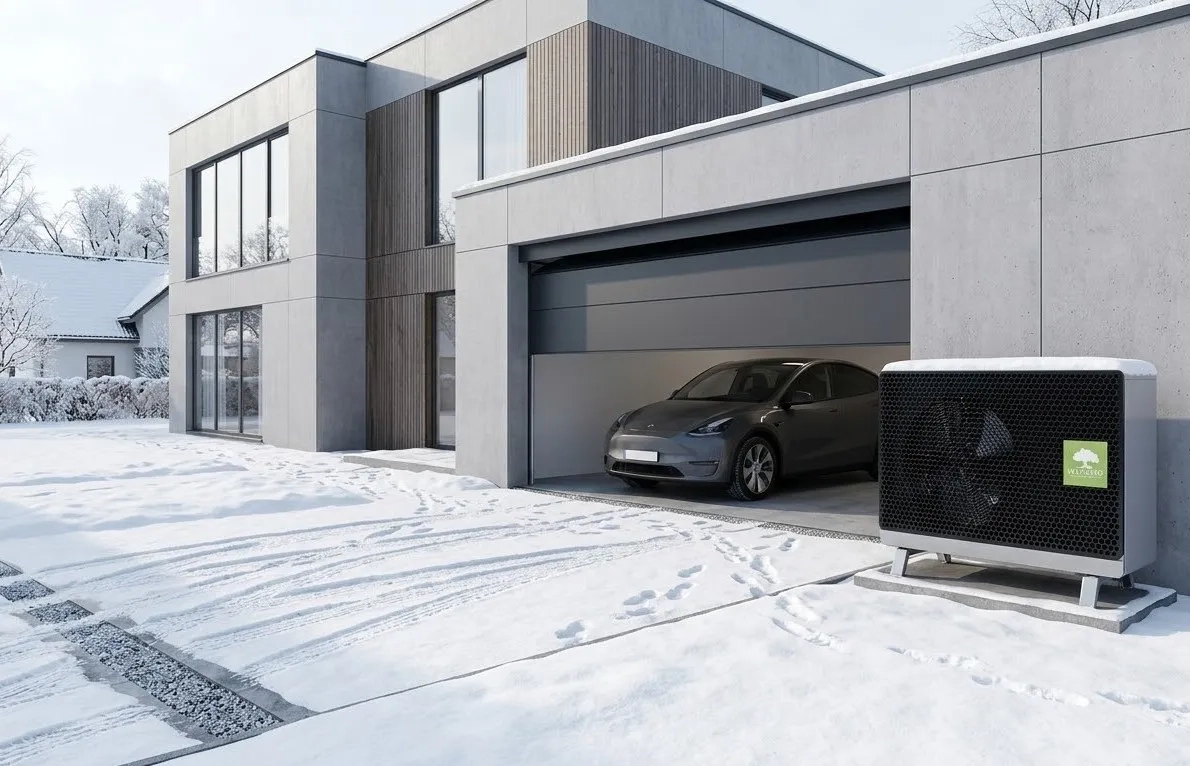
Based on Heat Pump KEYMARK certificate data
EN 14825 • EN 14511 • EN 12102-1
1. Why KEYMARK numbers are worth trusting
Heat pumps sell fast across Europe these days, and the spec sheets sell even faster. Every manufacturer has a COP figure, a noise claim, a seasonal rating — and very little of it is independently verified. That's where KEYMARK fills the gap.
Heat Pump KEYMARK is a voluntary certification scheme under CEN, the European standards body. Manufacturers submit units to third-party labs for testing under EN 14511 and EN 14825. The lab has no stake in the outcome. Results go up on heatpumpkeymark.com, publicly searchable.
So when you look up a certificate, the numbers you see aren't marketing. Two units from completely different brands, tested at different labs, are still directly comparable — because the protocol is the same.
Why this pairing? The Mycond MHCS 035 and the Panasonic Aquarea J Series 7 kW are both single-phase R32 splits with rated capacities of 6.4 and 6.0 kW. Six percent apart — comfortably within the 15% window that keeps comparisons valid.
⚠️ A gap worth flagging. The two certificates are four years apart: Mycond, April 2024 (Rev 13 rules); Panasonic, January 2020 (V7 rules). The rule versions differ in how they handle Cdh and SCOP calculations. This article accounts for that throughout, but keep it in mind when a number looks too clean.
2. Are we comparing the same kind of thing?
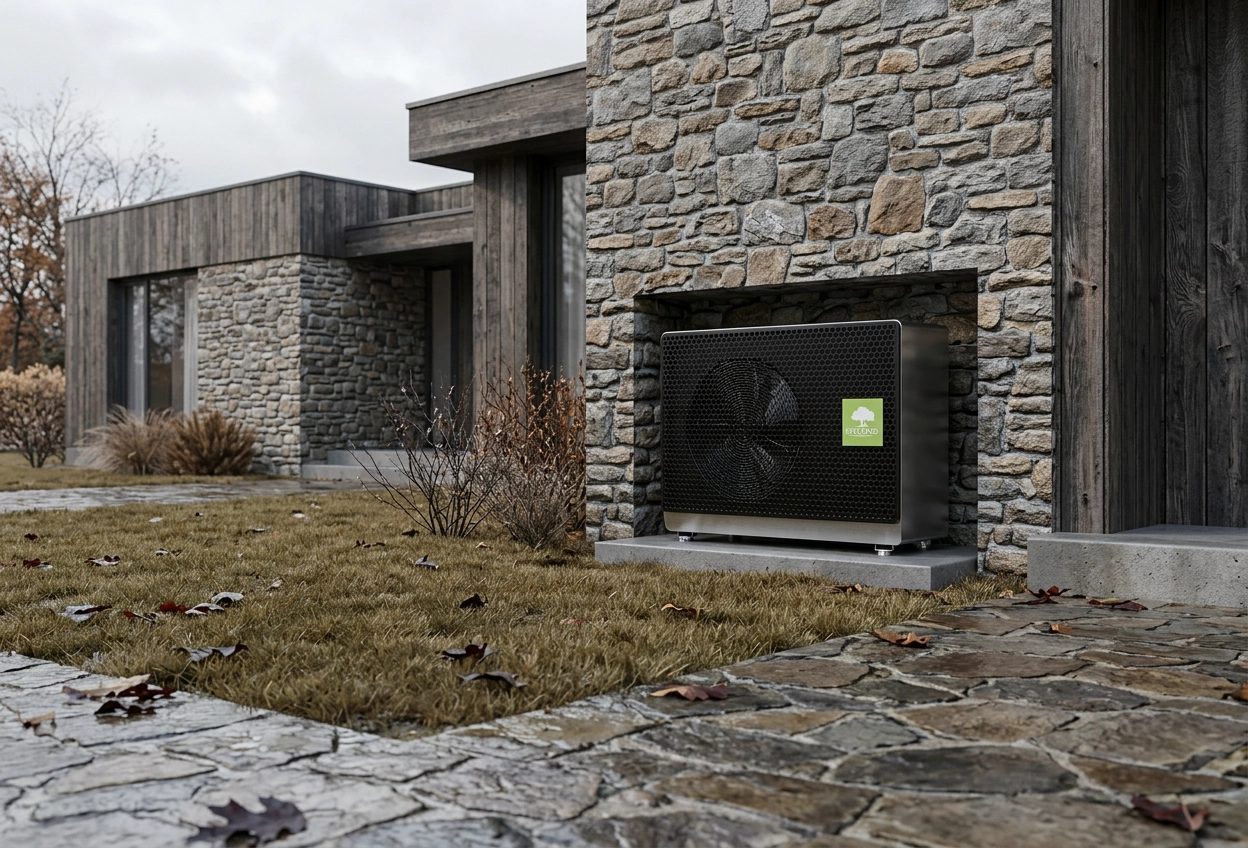
Short answer: yes, close enough. Both are split systems — a hydronic indoor module paired with an outdoor unit — running on R32 at single-phase voltage. Here's the full picture:
| Parameter | Mycond BeeSmart MHCS 035 | Panasonic Aquarea Split 7 kW (J Series) |
|---|---|---|
| Model | MHCS 035 NBS / MHCS 035 UBS | WH-SDC0709J3E5 / WH-UD07JE5 |
| Configuration | Split (Indoor + Outdoor) | Split (Indoor + Outdoor) |
| Refrigerant | R32 (1.4 kg) | R32 (1.27 kg) |
| Certification body | BRE Global Limited | DIN CERTCO |
| Registration number | 041-K088-04 | 011-1W0208 |
| Certified | 03.04.2024 | 08.01.2020 |
| KEYMARK rules | Rev 13 | V7 |
| Power supply | 1×230V 50Hz | 1×230V 50Hz |
| Declared use | Heating (medium temp) | Heating + DHW + low temp |
One practical note: the Panasonic certificate includes domestic hot water preparation. The Mycond certificate doesn't declare DHW — which doesn't say anything about the hardware, just about what was tested and signed off.
3. Rated capacity and the numbers behind the numbers
Prated — the rated heating capacity — is the load EN 14825 assigns to a standard reference building. It's not the maximum output, not the minimum, just the benchmark figure that everything else hangs off: SCOP, annual energy consumption, the whole seasonal efficiency picture.
| Parameter | Mycond LT / MT | Panasonic LT / MT | What it means |
|---|---|---|---|
| Prated (kW) | 6.39 / 5.97 | 6.00 / 7.00 | Reference capacity under EN 14825 |
| Tbiv (°C) | −7 / −7 | −10 / −7 | Calculation parameter for SCOP — not your real bivalent point |
| TOL (°C) | −10 / −10 | −10 / −10 | Floor temperature for operation — below this, the pump shuts off |
| WTOL (°C) | 57 / 57 | 55 / 55 | Highest flow temp the unit can deliver at TOL |
| Psup LT / MT (kW) | 1.07 / 1.17 | 0.00 / 0.80 | Backup heater load assumed by EN 14825 below TOL |
Two things stand out. Tbiv LT: Panasonic sits at −10°C, Mycond at −7°C. It's a calculation input for the reference building model — not a site setting. For a monovalent setup with no backup heater, the difference is meaningful. For everything else, the installer picks the actual bivalent point based on the specific building.
ℹ️ On Tbiv. Seeing −10°C in the Panasonic certificate doesn't make it a better fit for cold regions by default. It's a number the EN 14825 methodology plugged in for its reference building. Your project will have its own.
WTOL is 57°C on the Mycond versus 55°C on the Panasonic. Two degrees rarely changes anything — but on the coldest permitted night, that margin can matter for older radiator systems with high flow temperature requirements.
4. COP — moment-to-moment efficiency
Think of COP as a live efficiency reading: heat delivered divided by electricity consumed, measured at one specific set of conditions. Change the outdoor temperature or the flow temperature and the number changes. It's useful for comparing units head-to-head, but it won't tell you what your winter bill will look like — that's SCOP's job.
EN 14511 — the standard lab point (+7°C outside)
| Mode | Mycond LT | Panasonic LT | Mycond MT | Panasonic MT |
|---|---|---|---|---|
| Heating output (kW) | 5.72 | 7.00 | 8.04 | 7.00 |
| Power input (kW) | 1.09 | 1.47 | 3.16 | 2.48 |
| COP | 5.26 ✓ | 4.76 | 2.54 | 2.82 ✓ |
5.26 versus 4.76 — Mycond's lead in LT at +7°C outside, 35°C flow. Not a huge number on paper, but the kind of difference that quietly reduces electricity use through every mild day of the shoulder season. Move the flow to 55°C and Panasonic takes over: 2.82 to 2.54.
EN 14825 — across all test points (average European climate)
| Point | Mycond LT | Panasonic LT | LT result | Mycond MT | Panasonic MT | MT result |
|---|---|---|---|---|---|---|
| A (−7°C) | 3.19 | 3.04 | Mycond ✓ | 1.94 | 1.86 | Mycond ✓ |
| B (+2°C) | 4.43 | 4.96 | Panasonic ✓ | 3.34 | 3.33 | ≈ Even |
| C (+7°C) | 6.36 | 6.50 | Panasonic ✓ | 4.60 | 4.52 | Mycond ✓ |
| D (+12°C) | 8.37 | 8.42 | ≈ Even | 6.49 | 6.26 | Mycond ✓ |
| E (TOL −10°C) | 2.82 | 2.95 | Panasonic ✓ | 1.71 | 1.70 | ≈ Even |
Mycond edges Panasonic at −7°C in LT — 3.19 to 3.04. Worth knowing, but that temperature doesn't drive most of your heating bill. The +2°C point is worth focusing on — heating systems across central Europe accumulate more runtime hours there than at any other temperature on this table. Panasonic leads in LT at that point: 4.96 to 4.43.
ℹ️ Bivalent systems. When a boiler or backup heater takes over below a set outdoor temperature, what the heat pump does below that threshold has no effect on your energy bills. So the TOL point data is mainly relevant for fully monovalent systems — setups where no backup exists.

5. SCOP — the full heating season, in one number
SCOP is the number that actually connects to your heating bill. It weighs each outdoor temperature by how many hours a typical season spends there, adds in the losses from compressor cycling, and includes standby consumption — all rolled into one figure.
| Parameter | Mycond | Panasonic | Notes |
|---|---|---|---|
| SCOP LT (35°C) | 4.61 | 4.90 ✓ | Panasonic ahead for underfloor / fan coil systems |
| SCOP MT (55°C) | 3.32 | 3.32 | Dead heat for conventional radiators |
| ηs LT (%) | 181 | 193 ✓ | Panasonic higher seasonal efficiency rating in LT |
| ηs MT (%) | 130 | 130 | Equal in MT |
With a 35°C flow — underfloor systems, fan coils — Panasonic runs a SCOP of 4.90 against Mycond's 4.61. Six percent across a heating season. In money terms, that depends on your tariff and how many hours the system runs, but it's not trivial. At 55°C — old radiators, no plans to change them — both score 3.32. Exactly. Choosing between them on seasonal efficiency alone makes no sense in MT mode.
⚠️ A word of caution. These certificates are four years apart and use different calculation rules. The SCOP LT gap of 0.29 is real, but some of it is methodology, not hardware. The Panasonic advantage holds up — just probably not the full 0.29 of it.
6. Annual consumption and cycling losses
Qhe is the annual electricity consumption for the reference building — the number you multiply by your tariff to get an actual cost.
| Parameter | Mycond | Panasonic | Context |
|---|---|---|---|
| Qhe LT (kWh/year) | 2,864 | 2,532 ✓ | 332 kWh/year less with Panasonic at LT |
| Qhe MT (kWh/year) | 3,720 ✓ | 4,354 | 634 kWh/year less with Mycond at MT |
| Cdh at −7°C (LT) | 0.900 ✓ | 0.970 | Mycond lower — fewer cycling losses (direct comparison limited by rule version gap) |
| Cdh at +2°C (LT) | 0.900 ✓ | 0.930 | Same caveat applies |
In LT, Panasonic saves 332 kWh per year against the reference building. In MT, Mycond saves 634. The swing between modes is bigger than most people expect — it's worth knowing which operating mode your system will actually spend most of its time in before drawing conclusions.
Cdh captures how much efficiency is lost when the compressor cycles on and off under partial load. Mycond holds a constant 0.900 across all points (the minimum under Rev 13 rules). Panasonic varies from 0.970 at −7°C down to 0.900 at +7°C and above. Given the rule version difference, comparing these directly isn't fully reliable — but the pattern is there.
7. Noise
LWA — sound power level — is measured at the source, not at a listener. Move the microphone closer or further away and the LWA stays the same, which is why certification bodies use it and why it's the only sensible basis for comparing units tested in different facilities.
| Parameter | Mycond | Panasonic | Notes |
|---|---|---|---|
| Outdoor LWA LT (dBA) | 53 ✓ | 59 | 6 dB difference — roughly four times less acoustic energy |
| Outdoor LWA MT (dBA) | 54 ✓ | 59 | 5 dB quieter — noticeable to anyone nearby |
| Indoor LWA LT (dBA) | 45 | 41 ✓ | Panasonic quieter indoors by 4 dB |
| Indoor LWA MT (dBA) | 46 | 41 ✓ | Panasonic wins inside |
On a logarithmic scale, 6 dB means the Mycond outdoor unit puts out roughly a quarter of the acoustic energy of the Panasonic. Under a bedroom window or beside a shared fence, that's not a number on a spec sheet — it's whether the unit wakes anyone up.
Indoors the situation reverses. Panasonic's hydronic module is 41 dBA; Mycond runs 4–5 dB louder. In practice, 4 dB quieter indoors means the Panasonic module disappears into the background more easily. Whether that matters depends on where the unit goes — but a room that shares a wall with a bedroom is exactly where you'd want those extra 4 dB.
8. Standby and off-mode consumption
Small wattages, long hours — the combination catches people off guard when they see the annual total.
| Parameter | Mycond (W) | Panasonic (W) | What it adds up to |
|---|---|---|---|
| PTO | 19 ✓ | 44 | ~50 kWh/year difference in favour of Mycond |
| PSB | 10 | 10 | Same |
| POFF | 10 | 2 ✓ | ~70 kWh/year if left plugged in all year |
| PCK | 27 ✓ | 10 | Frost protection heater — not running all winter |
The PTO figure covers all those hours when the thermostat is satisfied but the system hasn't shut down — controller running, pumps on standby. Mycond uses 19W in that state, Panasonic 44W. Spread across a year, that adds up to something worth putting through your tariff calculator. Flip to POFF and Panasonic wins: 2W off versus 10W. Which figure matters more depends on whether your system goes fully off in summer or just idles. Your operating pattern decides which matters more.
9. Summary
| Parameter | Mycond | Panasonic | Winner | Note |
|---|---|---|---|---|
| SCOP LT (35°C) | 4.61 | 4.90 | Panasonic ✓ | Rule version caveat |
| SCOP MT (55°C) | 3.32 | 3.32 | Even | — |
| Qhe LT (kWh/year) | 2,864 | 2,532 | Panasonic ✓ | −332 kWh |
| Qhe MT (kWh/year) | 3,720 | 4,354 | Mycond ✓ | −634 kWh |
| COP LT EN 14511 (+7°C) | 5.26 | 4.76 | Mycond ✓ | Lab point |
| Outdoor noise LT | 53 dBA | 59 dBA | Mycond ✓ | −6 dBA |
| Indoor noise LT | 45 dBA | 41 dBA | Panasonic ✓ | −4 dBA |
| PTO (W) | 19 | 44 | Mycond ✓ | −25W |
| POFF (W) | 10 | 2 | Panasonic ✓ | −8W |
| WTOL (°C) | 57 | 55 | Mycond ✓ | +2°C buffer |
| Tbiv LT (°C) | −7 | −10 | Panasonic ✓ | Monovalent installs only |
10. Where each one makes sense
Mycond BeeSmart MHCS 035
The strongest case for Mycond is a house with conventional radiators running at 55°C. In MT mode it consumes 634 kWh less per year than the Panasonic — that's not a marginal difference, it's a real saving you can calculate directly from your tariff.
The outdoor noise advantage is the other big one. At 53–54 dBA against Panasonic's 59 dBA, the Mycond outdoor unit is substantially quieter — and in built-up areas or gardens that share a fence with neighbours, 6 dB is enough to make or break planning approval in some municipalities.
The lower PTO draw (19W vs 44W) is less dramatic but adds up. In a house where the system stays powered year-round but doesn't heat constantly, that's roughly 50 kWh per year saved without doing anything.
Concrete scenario: bivalent system with a boiler cutting in below −7°C, radiators at 55°C, outdoor unit mounted below a bedroom window. Qhe MT difference: 634 kWh/year. Outdoor noise: 6 dB quieter. Mycond makes sense here.
Panasonic Aquarea Split 7 kW J Series
Underfloor heating and fan coils are where Panasonic earns its keep. SCOP LT of 4.90 versus 4.61, Qhe LT lower by 332 kWh/year — the seasonal advantage in low-temperature operation is consistent and certified.
The indoor module runs at 41 dBA — 4–5 dB below Mycond. In a small technical cupboard or a room that shares a wall with a bedroom, that gap shows up on quiet evenings.
The deeper Tbiv (−10°C LT) matters for fully monovalent systems — no backup, no boiler, just the pump. Those are uncommon, but where they exist, Panasonic carries that certified margin.
11. Bottom line
No clear winner across the board — context decides.
Mycond BeeSmart MHCS 035 is the grounded choice for 55°C radiator systems and noise-sensitive locations. Its MT efficiency advantage is backed by certified data.
Panasonic Aquarea Split 7 kW J Series is where to look for underfloor heating (LT, 35°C) and installations where the indoor module sits near living spaces. The SCOP LT edge and the lower Qhe LT are real, not theoretical.
One thing cuts across both: the certificate numbers are only as good as the installation behind them. Get hydraulic balancing done properly and set up weather compensation correctly. Hydraulic balancing and weather compensation settings decide more about real efficiency than the 0.29 SCOP gap between these two units.
Found an error in the data? Use the feedback form below — corrections help keep this useful for everyone.
Technical notes
- SCOP figures do not include the circulation pump's power consumption. If the pump is integrated, check whether its draw is captured in the PE values of the test report.
- SCOP_ref (not SCOP_on) is the legally relevant figure for EU energy labelling.
- The permitted tolerance between declared and measured SCOP is −8% (EN 14825, KEYMARK rules).
- All figures come from a single tested unit under lab conditions. What happens on site depends on installation quality, hydraulic balance, and how the controller is set up.
- Variable outlet temperature: where this mode is declared, the flow temperature tracks outdoor conditions rather than staying fixed. Weather-compensated control typically improves real-world SCOP.
- Rule version gap: four-plus years between certifications (2020 vs 2024), two different KEYMARK rule versions (V7 and Rev 13). Direct numerical comparisons of SCOP and Cdh carry that caveat.
Sources
- Mycond BeeSmart DC Inverter Air to Water Heat Pump Unit – R32-09 — reg. no. 041-K088-04, BRE Global Limited, 03.04.2024. heatpumpkeymark.com
- Panasonic Marketing Europe GmbH — Aquarea Split 7 kW STD (J Series) — reg. no. 011-1W0208, DIN CERTCO, 08.01.2020. heatpumpkeymark.com
- EN 14825:2022 — Testing and rating at part load conditions and calculation of seasonal performance.
- EN 14511:2022 — Testing at rated conditions.
- EN 12102-1:2017 — Measurement of airborne noise.
- HP KEYMARK Scheme Rules Rev 13 (2022) and V7 (2018)..


