









































Author: Mycond Technical Department
Sound familiar — you wake up in the morning and there are water droplets on the windows again? You open the closet and your clothes smell musty? And those dark corners with mold marks that keep appearing no matter how much you clean? You air out your apartment regularly, but the problem of excess humidity doesn’t go away?
High humidity is more than just discomfort. It creates a breeding ground for fungi and mold, which can trigger allergies and respiratory problems. Damaged furniture, peeling wallpaper, corrosion on metal surfaces — all of these are consequences of excessive moisture indoors.
In this article, we’ll talk about a device that can solve these problems once and for all — a dehumidifier. You’ll learn what it is, how it works, why you need it, and how to choose the optimal model for your home.

What is a dehumidifier in simple terms
A dehumidifier is a household appliance you could call a “vacuum cleaner for moisture.” Its main task is to remove excess moisture from the air and maintain an optimal indoor humidity level (typically from 40% to 60%).
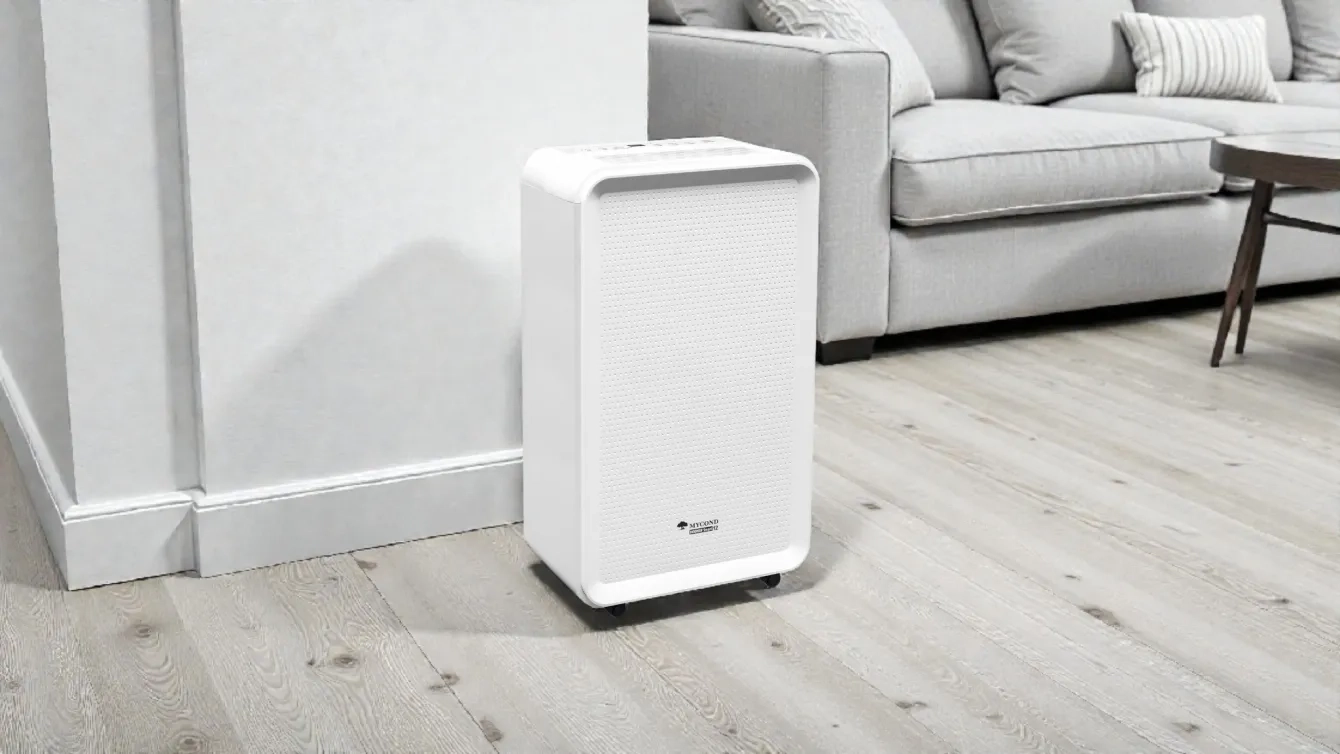
From the outside, a dehumidifier resembles a small air conditioner or an air purifier. It’s a compact device, usually 40 to 60 cm tall and up to 30 cm wide and deep. It’s easy to place in any room corner, under a window, or near a wall.
Key components of a dehumidifier:
- Case — usually made of durable plastic;
- Control panel — with buttons or a touch display;
- Air intake grille — humid air enters through it;
- Air outlet grille — dry air comes out here;
- Condensate tank — the container where water collects;
- Filter — traps dust and other particles;
- Compressor and evaporator — internal components that enable the dehumidification process.
What a dehumidifier is NOT:
- It’s not an air conditioner. Although air conditioners have a dehumidifying function, their primary task is to cool the air. A dehumidifier specializes exclusively in removing moisture and does it far more efficiently.
- It’s not a fan. A fan simply moves air without changing its properties, whereas a dehumidifier actively removes moisture from it.
- It’s not a heater. Dehumidifiers can slightly increase room temperature as a side effect of the compressor, but that’s not their main purpose.
- It’s not an air purifier. While some dehumidifiers are equipped with filters and can partially clean the air of dust, they cannot replace specialized purifiers with HEPA filters.
How a dehumidifier works
To understand how a dehumidifier works, think about what happens when you take a cold bottle from the fridge on a hot day. Water droplets quickly form on its surface. Where do they come from? It’s not water “seeping” from the bottle. It’s condensate — moisture from the air that settled on the cold surface.
A dehumidifier operates on the same principle but on a household scale, with the ability to collect and remove this moisture.
Step-by-step dehumidification cycle:
- Intake of humid air — a built-in fan draws room air in through the intake grille;
- Air cooling — the air passes over a cooling element (evaporator) whose temperature is below the dew point;
- Moisture condensation — upon contact with the cold evaporator surface, water vapor condenses into droplets;
- Water collection — the condensate drains into a special tank or is discharged through a drain hose;
- Air reheating — the dried air passes through the condenser, where it warms slightly;
- Return of dry air — the now dry, slightly warmer air returns to the room through the outlet grille.
While operating, you may hear a gentle hum from the fan and compressor, as well as occasional clicks from the thermostat. Modern models, such as the Roomer Smart 12, run very quietly (just 36 dBA), allowing you to use them even in the bedroom while sleeping.
Visible signs that a dehumidifier is working include the gradual filling of the water tank (usually from 0.5 to 2 liters per day, depending on room humidity) and dropping humidity readings on a hygrometer (built into most modern dehumidifiers).

Why you need a dehumidifier
A dehumidifier isn’t just a fad or an extra gadget. It’s a device that can solve a range of concrete problems many apartment and home owners face.
1. Fighting condensation on windows
Water droplets on windows aren’t just an aesthetic issue. Constant wetting of window frames can lead to deformation, mold growth, and even damage to the plaster around the window. A dehumidifier effectively reduces indoor humidity, preventing condensation.
2. Preventing mold growth
Mold is not just an unsightly stain on walls and ceilings. It’s a serious health threat, especially for people with allergies or asthma. Mold spores enter the respiratory tract and can trigger allergic reactions and inflammation. By maintaining humidity below 60%, a dehumidifier creates an environment unfavorable for fungi and mold.
3. Eliminating musty odors
The distinctive smell of dampness and mustiness is more than an unpleasant odor. It indicates excessive humidity and possibly ongoing decay or microbial growth. A dehumidifier doesn’t mask the smell like an air freshener — it removes the cause: excess moisture.
4. Protecting belongings from dampness
Clothing, books, electronics, musical instruments — all of these can suffer from excessive humidity. Fabrics absorb moisture and develop a musty smell, electronics can fail due to contact corrosion, and wood can warp. A dehumidifier creates optimal conditions for storing your belongings.
5. Speeding up laundry drying in winter
If you dry laundry indoors, especially during the cold season, you know how problematic it can be. Clothes take a long time to dry, and indoor humidity rises, which can lead to all the problems mentioned above. A dehumidifier speeds up drying and prevents humidity from rising.
6. Rapid drying after leaks
If you’ve had a mishap — upstairs neighbors flooded you, a pipe burst, or a lot of water was spilled — a dehumidifier becomes indispensable. It accelerates the drying of floors, walls, and furniture, preventing mold growth and material deformation.
How easy is it to use a dehumidifier
Modern dehumidifiers are convenient and intuitive devices designed for users without special technical knowledge.
Step-by-step setup simplicity:
- Unbox and place — no complex installation required. Simply unbox it, set it on a level surface, and leave free space (at least 20 cm) on all sides for normal air circulation.
- Connect to power — just plug it into a standard 220 V outlet.
- Select the desired humidity level — on the control panel choose a comfortable humidity level (recommended 40–60%) or simply “AUTO.”
- Turn it on — press “ON” and the dehumidifier will start working.
- Monitor the water level — most models automatically turn off when the tank is full and indicate that it needs to be emptied.
Models with Wi‑Fi (like TIBO Eco 12 and Roomer Smart 12) can be configured and controlled via the MYCOND mobile app, adding convenience.
Minimal maintenance:
- Regularly empty the tank — depending on humidity levels, this may be once every 1–3 days.
- Periodic filter cleaning — simply rinse it with warm water once a month.
- Exterior cleaning — wipe with a damp cloth as needed.
Safety features:
Modern dehumidifiers are equipped with numerous safety systems:
- Automatic shutoff when the tank is full;
- Overheat protection;
- Anti-freeze protection (defrost function);
- Safe, eco-friendly refrigerant R290.
Entry-level dehumidifier models
If you’re considering buying a dehumidifier for the first time, it’s worth looking at basic yet reliable models. Let’s review two optimal entry-level options from Mycond: TIBO Eco 12 and Roomer Smart 12.
| Parameter | TIBO Eco 12 | Roomer Smart 12 |
|---|---|---|
| Dehumidification capacity | 12 L/day | 12 L/day |
| Coverage area | up to 25 m² | up to 25 m² |
| Airflow | 120 m³/h | 120 m³/h |
| Power | 200 W | 180 W |
| Noise level | 38 dBA | 36 dBA |
| Tank capacity | 2 L | 2 L |
| Dimensions (H×W×D) | 250×220×445 mm | 280×200×450 mm |
| Weight | 11 kg | 12 kg |
| Wi‑Fi control | Yes | Yes |
| Carbon filter | No | Yes |
| Ionization | No | Yes |
| Refrigerant | R290 | R290 |
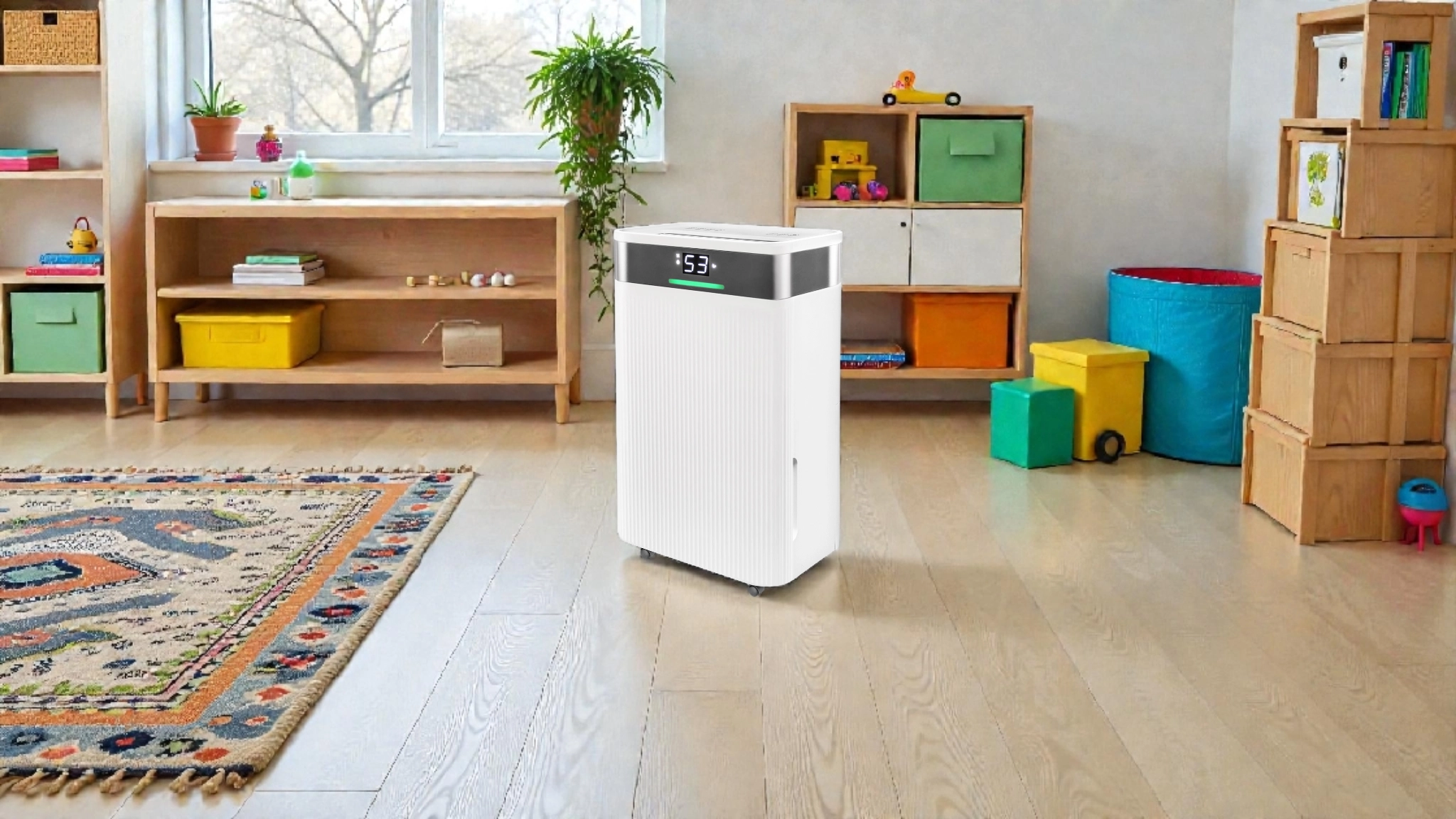
TIBO Eco 12 — a maximally compact and simple dehumidifier. An ideal choice for those who value minimalism and functionality without extra options. At the same time, the model is equipped with Wi‑Fi and can be controlled via the MYCOND app.
Roomer Smart 12 — the quietest dehumidifier in its class with additional air-cleaning features. Equipped with a carbon filter to remove odors and an ionization system for extra freshness. Control is possible both via the control panel and through the MYCOND app.
Debunking seven dehumidifier myths
Myth 1: Dehumidifiers use a lot of electricity
Modern dehumidifiers are very economical. The TIBO Eco 12 and Roomer Smart 12 models consume 200 W and 180 W respectively — less than most electric kettles. Moreover, they don’t run constantly but cycle on only when humidity exceeds the set level.
Myth 2: Dehumidifiers make the air too dry
Modern dehumidifiers are equipped with a humidistat that lets you set the desired humidity level (typically 40% to 60%). When this level is reached, the unit turns off automatically and only turns back on if humidity rises.
Myth 3: Dehumidifiers are very noisy
Modern models like the Roomer Smart 12 operate at just 36 dBA — quieter than a whisper in a library. This noise level won’t disturb sleep, work, or relaxation.
Myth 4: Dehumidifiers can replace an air conditioner
Although dehumidifiers slightly increase room temperature as a side effect of compressor operation, they cannot cool the air like air conditioners. These are different devices with different functions.
Myth 5: Dehumidifiers aren’t needed in winter
In fact, in winter the problem of excessive indoor humidity can be especially acute. Due to temperature differences, condensation forms on windows, washing machines run more often, and ventilation is limited because of the cold.
Myth 6: Dehumidifiers are hard to maintain
Maintaining a dehumidifier comes down to regularly emptying the water tank and periodically cleaning the filter. This takes just a few minutes and requires no special skills.
Myth 7: Dehumidifiers are harmful to your health
On the contrary, maintaining an optimal humidity level (40–60%) supports health. It prevents mold and dust mites that can cause allergies and respiratory diseases. Models with ionization, like the Roomer Smart 12, additionally freshen the air.
Answers to the most popular questions
1. How much water does a dehumidifier collect per day?
It depends on the model and the humidity level in the room. The TIBO Eco 12 and Roomer Smart 12 can collect up to 12 liters per day at high humidity and temperature. Under normal conditions, it’s usually 1–3 liters per day.
2. Can the collected water be used?
The water a dehumidifier collects is distilled water. You can use it for irons, humidifiers, and watering plants (not edible crops). It’s not recommended for drinking or preparing beverages.
3. Can I leave a dehumidifier running overnight?
Yes, modern dehumidifiers are designed for continuous operation. The TIBO Eco 12 and Roomer Smart 12 are very quiet (38 and 36 dBA respectively), so they won’t disturb your sleep.
4. Which is better — a dehumidifier or an air conditioner with a dehumidifying function?
If your main problem is excessive humidity, a dedicated dehumidifier will be more effective and economical. An air conditioner with a dehumidifying function is more appropriate if your main goal is cooling.
5. How do I choose a dehumidifier capacity?
For a standard apartment or a room up to 25 m², a 12 L/day model like the TIBO Eco 12 or Roomer Smart 12 is usually sufficient. Larger spaces or very high humidity may require more powerful models.
6. Is it economical to use a dehumidifier?
Yes, especially considering indirect costs. A dehumidifier helps prevent damage to furniture, electronics, clothing, and renovations, and reduces the risk of respiratory diseases caused by mold and dampness.
7. Can I use a dehumidifier for drying laundry?
Yes, dehumidifiers are very effective at speeding up indoor laundry drying, especially in winter. Simply hang your laundry in a room with the dehumidifier, and it will dry much faster without raising indoor humidity.
8. Do I need to replace filters regularly?
Most dehumidifiers have reusable filters that only need periodic rinsing with warm water. Carbon filters (as in the Roomer Smart 12) are recommended to be replaced every 6–12 months, depending on usage intensity.
9. Are dehumidifiers with R290 refrigerant safe?
Yes, R290 (propane) is an eco-friendly refrigerant that doesn’t harm the ozone layer and has a low global warming potential. During normal operation, the refrigerant circulates in a closed system and doesn’t contact indoor air.
10. Is a drain hose necessary for a dehumidifier?
Not necessarily. The TIBO Eco 12 and Roomer Smart 12 have a 2-liter tank that you can simply empty as it fills. However, for convenience, you can connect a drain hose (usually included) for automatic water removal.
Step-by-step dehumidifier setup checklist
- Unpack the device and make sure there is no transport damage;
- Place the dehumidifier on a level, stable surface, leaving at least 20 cm of free space on all sides;
- Ensure the water tank is empty and properly installed;
- Connect the device to the power supply;
- Turn the dehumidifier on by pressing “ON/OFF”;
- Set the desired humidity level (recommended 40–60%);
- For Wi‑Fi models — download the MYCOND app and connect the device to the network;
- For maximum effectiveness, close the windows and doors in the room.
A simple rule for choosing between the two models
Choose TIBO Eco 12 if:
- You need a compact and lightweight dehumidifier;
- You value simplicity without extra features;
- Your primary goal is fighting humidity rather than air purification;
- Energy savings matter to you.
Choose Roomer Smart 12 if:
- An ultra-low noise level is critical for you;
- You need additional air-cleaning features (carbon filter, ionization);
- You value modern design and advanced control options;
- You have issues with odors or allergies.
Three common beginner mistakes
Mistake 1: Incorrect placement of the dehumidifier
Many beginners place the dehumidifier in a corner or right up against a wall, which significantly reduces its effectiveness. The right way: place the unit in the center of the damp room or at least leave 20 cm of free space on all sides for proper air circulation.
Mistake 2: Setting the humidity too low
Some users set a target humidity of 30% or lower, believing that “the drier, the better.” This can overdry the air, causing discomfort, dry skin, and mucous membranes. The right way: set humidity to 40–60% — the optimal range for human health and comfort.
Mistake 3: Neglecting filter maintenance
A dirty filter reduces dehumidifier efficiency and can lead to breakdowns. The right way: regularly (every 2–4 weeks) check and clean the filter according to the manual.
Conclusion
A dehumidifier is not just a trendy gadget but a truly useful and often necessary household appliance that solves a number of specific problems: from condensation on windows to mold on walls and musty odors.
Mycond is a leader in the segment for those seeking a comprehensive, modern, and energy-efficient microclimate solution without overpaying for a global brand. The TIBO Eco 12 and Roomer Smart 12 are ideal entry-level solutions that combine affordability, functionality, and modern technology.
If you still have questions or would like a consultation on choosing the most suitable model for your needs, contact us by phone or fill out the form at the bottom of the page. Our specialists will gladly help you create a healthy and comfortable indoor climate in your home!


