









































Author: Mycond Technical Department
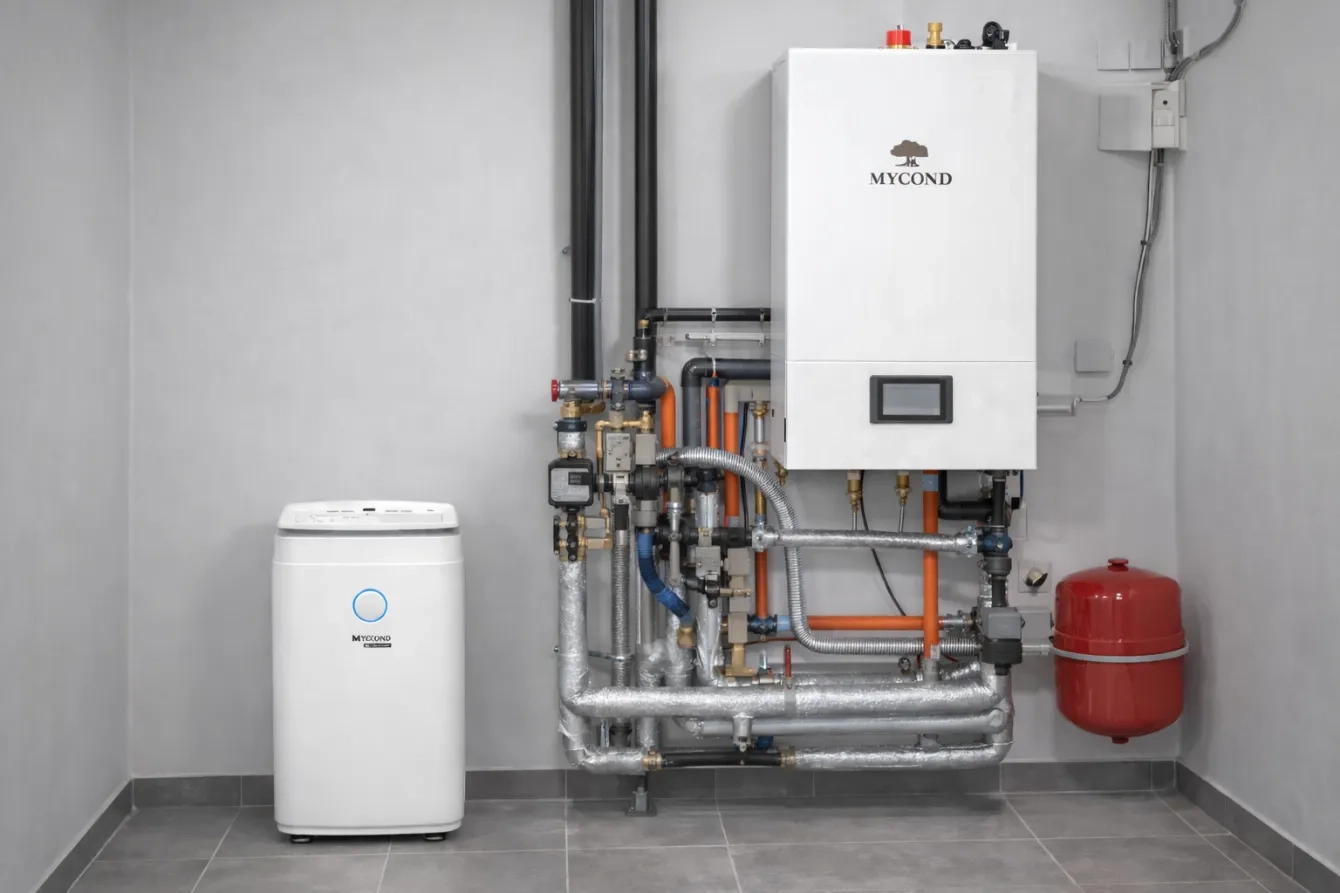
Efficient use of energy resources in modern HVAC systems is one of the key engineering tasks. Refrigeration-type air dehumidifiers generate a significant amount of heat during operation, which is traditionally discharged into the environment. Integrating this heat into heating or domestic hot water systems can significantly increase the overall energy efficiency of the entire equipment complex. Let’s look at how to properly implement this approach and get the maximum benefit from dehumidifier waste heat.
Thermal balance of a refrigeration-type dehumidifier as a source of waste heat
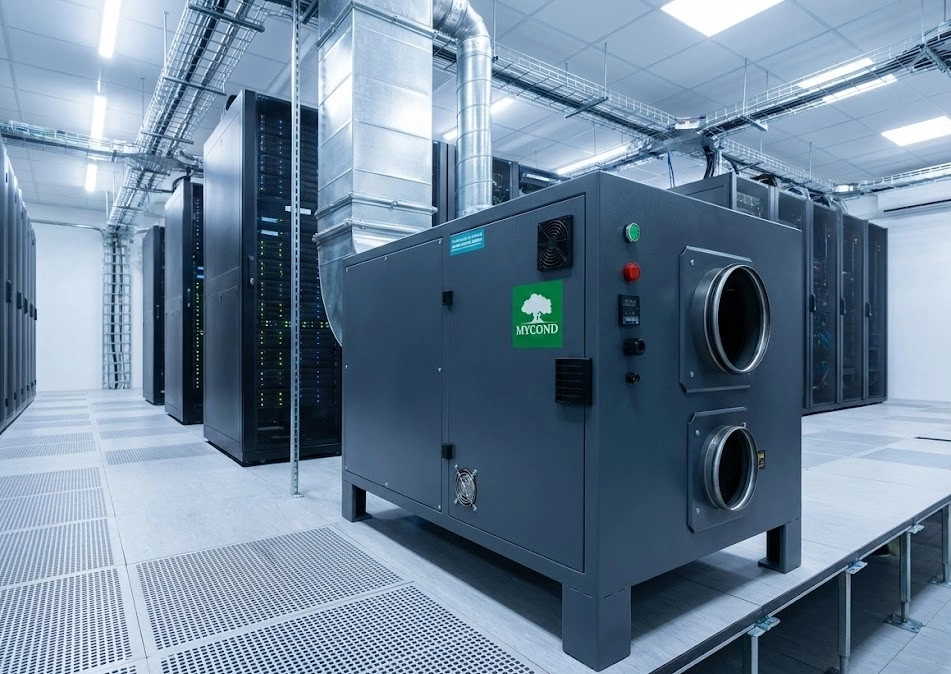
A refrigeration-type dehumidifier operates by cooling air below its dew point. Moist air passes through the evaporator where it is cooled, water vapor condenses, and then the dehumidified cold air is heated on the condenser and returned to the room. This process is accompanied by the release of a significant amount of thermal energy at the condenser.
The key to understanding the recovery potential is the condenser’s energy balance. The heat at the condenser consists of three components:
Q(condenser) = Q(latent) + N(compressor) + Q(sensible)
Where:
- Q(latent) - the latent heat of condensation of moisture released when water vapor turns into liquid on the evaporator
- N(compressor) - electrical power consumed by the compressor
- Q(sensible) - sensible heat of air, the additional air heating during dehumidifier operation
The latent heat of condensation is calculated as:
Q(latent) = G × r
Where G is the dehumidification rate in kilograms per hour, and r is the heat of vaporization of water in kilojoules per kilogram. It is important to understand that r is not a constant and depends on the condensation temperature—typically in the range of 2300-2500 kJ/kg and taken from steam tables for the specific temperature.
The compressor power N(compressor) is the electrical power consumed by the dehumidifier’s compressor. This value is taken from the equipment’s technical data or calculated within a refrigeration cycle analysis.
The sensible heat Q(sensible) depends on the dehumidifier design and its operating mode. Its share in the overall heat balance is usually smaller compared to the first two components.
On a psychrometric h-d diagram, the dehumidification process can be represented as a sequence of three stages: first, air cooling with moisture removal (decreasing temperature and humidity ratio), then moisture condensation on the cold surface of the evaporator, and finally heating of the dehumidified air on the condenser (increasing temperature at constant humidity ratio).
Theoretical basis of heat recovery: condenser potential and temperature levels
For effective heat recovery from a dehumidifier, it is important to understand the difference between the refrigerant condensation temperature and the heat transfer fluid temperature. The refrigerant condensation temperature is determined by the temperature of the cooling medium (air or water) plus the heat exchanger temperature approach.
For a dehumidifier with an air-cooled condenser operating in a room at 25°C, the refrigerant condensation temperature can be 35-45°C. For a dehumidifier with a water-cooled condenser at a water temperature of 30°C, the condensation temperature may be in the 40-50°C range. These values are not universal constants but the result of calculation for specific operating conditions.
To evaluate dehumidifier efficiency in the context of heat recovery, the Coefficient Of Performance (COP) is used. Two types of COP are distinguished:
1. COP(heating) = Q(condenser) / N(compressor) - the ratio of heat output to power input
2. COP(cooling) = Q(evaporator) / N(compressor) - the ratio of cooling capacity to power input
It is important to note that dehumidifier catalogs often specify SMER (Specific Moisture Extraction Rate) in liters or kilograms per kilowatt-hour, which differs from COP and characterizes moisture removal efficiency rather than thermal efficiency.
Integration schemes: three basic approaches
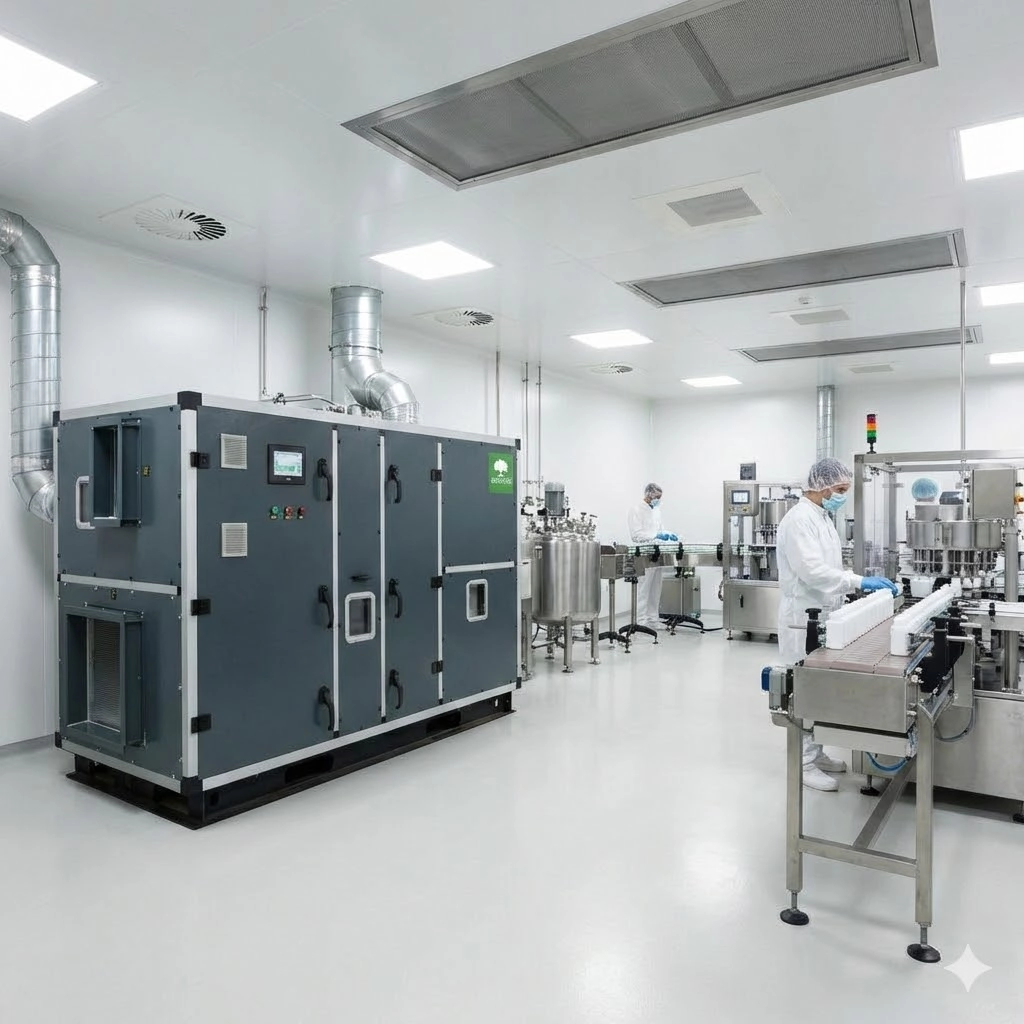
There are three primary schemes for integrating dehumidifiers with heating and domestic hot water systems:
Scheme 1: Separate water heat exchanger
In this scheme, a plate or shell-and-tube heat exchanger is installed on the condenser side. On the hot side of the heat exchanger, the refrigerant or the air after the condenser circulates (depending on the dehumidifier design), while on the cold side, there is water from the heating or domestic hot water system.
Hydraulic connection is made to the heating return line or the domestic hot water circuit. The scheme includes a circulation pump, an expansion tank, and balancing valves.
Advantages: simple implementation, possibility to retrofit existing systems.
Disadvantages: additional hydraulic resistance, the need to install a separate circulation pump.
Scheme 2: Cascaded connection with a heat pump
In this scheme, the dehumidifier heats water from temperature T(1) to T(2) (for example, from 20°C to 40°C), and the heat pump raises it from T(2) to T(3) (for example, from 40°C to 60°C) for domestic hot water. A buffer tank is installed between them to smooth operating modes.
Advantages: reduced load on the heat pump, increased overall system COP since the heat pump operates with a preheated source.
Disadvantages: complex automation, the need to coordinate the operating modes of two devices.
Scheme 3: Direct low-temperature consumers
In this scheme, condenser heat is used directly for low-temperature consumers: underfloor heating (30-40°C), ventilation supply air preheating (20-30°C), or pool water heating (26-30°C).
Advantages: temperature levels are well matched, maximum recovery without additional equipment.
Disadvantages: the site must have low-temperature consumers.
The choice of scheme depends on the availability of heat consumers, their temperature levels, and their operating schedules throughout the year.
Indicative compatibility of a dehumidifier with different heat consumers:
- Underfloor heating (30-40°C): good compatibility, direct connection possible
- Domestic hot water (55-60°C): limited compatibility, cascade or post-heating required
- Heating radiators (50-70°C): limited compatibility, advisable only in cascade with a heat pump
- Swimming pool (26-30°C): excellent compatibility, ideal year-round consumer
Recovered heat calculation: a detailed example
Let’s consider a specific example of recovering heat from a dehumidifier for a swimming pool.
Input data:
- Dehumidification rate G = 20 kg/h (from pool moisture emission calculation)
- Room air temperature = 28°C
- Room relative humidity = 60%
- Dehumidifier electrical power N(compressor) = 6 kW (from technical data)
Step 1: Calculating the latent heat of moisture condensation
The heat of vaporization at 28°C is approximately r = 2435 kJ/kg (according to steam tables).
Latent heat:
Q(latent) = G × r = 20 kg/h × 2435 kJ/kg = 48700 kJ/h = 13.5 kW
Step 2: Condenser heat balance
Heat at the condenser:
Q(condenser) = Q(latent) + N(compressor) = 13.5 kW + 6 kW = 19.5 kW
This is the total thermal capacity released at the condenser.
Step 3: Recovered capacity through the water heat exchanger
Assume heat exchanger effectiveness of 80% (a realistic value for a properly selected plate heat exchanger; depends on type, area, and temperature approach).
Recovered heat:
Q(recovered) = Q(condenser) × 0.80 = 19.5 kW × 0.80 = 15.6 kW
Step 4: Heating pool water
Water flow through the heat exchanger m = 0.5 kg/s (selected based on temperature approach and circuit hydraulics).
Water specific heat c = 4.19 kJ/(kg·K).
Temperature rise:
ΔT = Q(recovered) / (c × m) = 15.6 kW / (4.19 kJ/(kg·K) × 0.5 kg/s) = 7.4 K
If inlet water temperature is 26°C, the outlet will be 33.4°C, which is suitable for pool heating.
Step 5: Economic effect
Without recovery, all pool heating would be provided by a gas boiler or electric heater. With 15.6 kW of recovered “free” heat, the load on the main heater is reduced.
Annual savings depend on the number of dehumidifier operating hours per year, gas or electricity tariffs, and the availability of alternative heat sources. A specific calculation requires project data.
Seasonal use: winter, shoulder season, summer
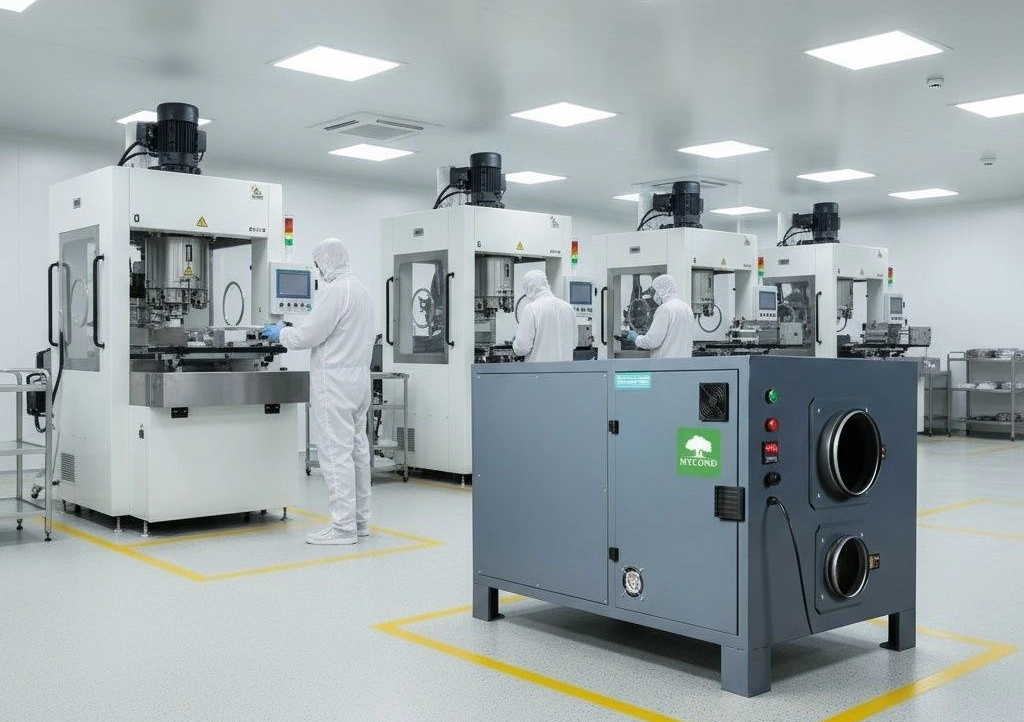
The effectiveness of dehumidifier heat recovery depends on the season and requires appropriate control strategies:
Winter mode
In winter, condenser heat is directed to heating or pool heating. The dehumidifier is controlled by humidity setpoints, and heat is fully recovered without dumping it into the room.
If the consumer is low-temperature heating (underfloor heating), the system can operate autonomously without an additional source. If higher temperature is required (domestic hot water at 60°C), the dehumidifier provides base heating up to 45-50°C, and additional post-heating is provided by a boiler or a heat pump.
Shoulder season (spring-autumn)
In the shoulder season, part of the heat is recovered while heating is still needed, and part may be excess when heating is off but dehumidification is still operating.
A switching system is needed—an automatic three-way valve that directs heat either to heating, to a dump (if heating is not needed but the dehumidifier is running), or to a buffer tank.
Summer mode
If there is a year-round heat consumer (pool, process heating), heat is directed there throughout the year.
If there is no consumer, a heat rejection system is required: a dry cooler, a cooling tower, or simply disconnecting the water circuit. In the latter case, the dehumidifier releases heat into the room, increasing the load on the air conditioning system.
The control scheme may include a three-way valve and a dry cooler with the following logic: if outdoor air temperature is above 20°C, or indoor temperature is above 26°C, or there is no heating demand from the thermostat, then heat is directed to the dry cooler or into the room; otherwise—to the heating circuit.
Automation uses temperature sensors on the supply and return of each circuit, and valve control is implemented via a programmable controller or DDC system.
Impact of integration on dehumidification efficiency, condensation temperature, and performance
When integrating a dehumidifier with heating systems, it is important to consider the impact on the dehumidifier’s own efficiency. The following chain of events occurs:
- Rising cooling water temperature at the condenser leads to an increase in refrigerant condensation temperature
- This leads to higher condensation pressure
- Higher condensation pressure results in reduced refrigerant mass flow through the compressor
- Reduced refrigerant mass flow leads to lower evaporator cooling capacity
- Lower evaporator capacity leads to reduced dehumidification performance
The magnitude of the effect depends on compressor type, refrigerant, and initial conditions. For typical scroll compressors on R410A, a 10 K increase in condensation temperature can lead to a reduction in compressor mass flow by an amount dependent on the specific model’s design. Exact values should be taken from the compressor performance charts provided by the manufacturer.
A compromise solution is to limit the maximum outlet temperature of the heat transfer fluid. For example, if domestic hot water at 55°C is required, and the dehumidifier can provide only 45°C without a critical drop in performance, it is advisable to use a cascade scheme: the dehumidifier heats water from 20°C to 45°C, and the heat pump boosts it from 45°C to 60°C.
Systems with inverter-driven compressors can partially compensate for performance drop by increasing speed, but this raises power consumption. It is important to find an optimal balance between dehumidification performance and energy use.
When integration makes engineering sense: application criteria
Integrating a dehumidifier with heating systems is advisable if all of the following conditions are met simultaneously:
Condition 1: Stable moisture emissions
The dehumidifier should not operate sporadically but at least 10-15 hours per day for 6 or more months per year. Typical sites where this condition is met: pools, laundries, drying zones, vegetable stores, pharmaceutical production.
Condition 2: Presence of a constant low-temperature heat consumer
Heat consumers up to 50°C are required: underfloor heating, pool heating, supply air preheating, low-temperature radiators, process heating.
Condition 3: A solution for the summer period
There must be a year-round heat consumer (pool), a heat rejection system (dry cooler, cooling tower), or a coordinated operating schedule (the dehumidifier runs at night when heat does not hinder daytime air conditioning).
Condition 4: Proper capacity ratio
The thermal capacity of the dehumidifier should be at least 20-30% of the site’s base heating load; otherwise, the complexity of integration will not be justified by capital costs. This is an indicative threshold that depends on equipment cost and tariffs.
Integration does NOT make engineering sense if at least one of the following conditions is observed:
- The dehumidifier operates sporadically (1-2 hours per day, summer only)
- No low-temperature consumers are available (only high-temperature heating >70°C or DHW without a cascade option)
- Economics: the cost of integration (heat exchanger, piping, controls, installation) exceeds 8-10 years of savings on energy carriers at current tariffs
There are also limiting modes in which the approaches above do not work or require adjustment:
- Room temperature below 15°C (dehumidification efficiency drops sharply)
- Condensation temperature above 60°C (most residential and commercial compressors are not designed for such high pressure)
- Regions with a very short heating season (less than 3 months)
Typical design mistakes: what to avoid
Mistake 1: Ignoring dehumidifier heat rejection when calculating cooling load
Consequence: in summer, the air conditioner cannot cope, room temperature exceeds the norm, discomfort is created.
Example: a pool with a dehumidifier thermal capacity of 25 kW, but the cooling design considered only moisture emissions from occupants and solar gains. The dehumidifier’s heat rejection was not accounted for, resulting in a 3-5 kW shortfall in cooling capacity and room overheating.
Mistake 2: No ability to reject heat in summer
Consequence: in summer, the dehumidifier either cannot operate (emergency shutdown due to high condensation pressure) or overheats the room (additional load on the air conditioner).
Solution: provide a dry cooler or a summer heat consumer (pool, process heating). Allocate space, piping, and power supply at the design stage.
Mistake 3: Incorrect selection of heat transfer fluid temperature without analyzing the impact on dehumidification
Mistake: the client wants 60°C water for DHW; the designer connects the dehumidifier directly without a cascade.
Result: condensation temperature rises to a critical level (55-60°C), dehumidification performance drops, and room humidity is not maintained at the design level.
Solution: cascade scheme (the dehumidifier heats to 45°C, and a boiler or heat pump raises it to 60°C) or limit the maximum temperature of the heat transfer fluid.
Mistake 4: No buffer tank in a system with variable heat consumption
Consequence: the dehumidifier is controlled by humidity (on/off by hygrostat), while the heating consumer is controlled by temperature (thermostat). Operating modes become uncoordinated—the dehumidifier runs when heat is not needed, or vice versa. This leads to frequent compressor starts/stops and equipment wear.
Solution: a buffer tank for commercial systems to smooth short-term mode discrepancies. The exact volume depends on system capacity and inertia.
Mistake 5: Long distances between dehumidifier and consumer without calculating heat losses
Example: dehumidifier in the basement, consumer on the roof, 50 meters distance, pipelines without insulation or with thin insulation (20 mm instead of 50 mm).
Result: heat losses in pipelines can constitute a significant part of the useful capacity.
Solution: place the dehumidifier closer to the consumer or provide quality insulation 50-100 mm thick (mineral wool or elastomeric foam).
Frequently asked questions (FAQ)
What are the temperature limits for the heat transfer fluid when recovering heat from a dehumidifier condenser?
The minimum temperature is limited by the necessary temperature difference for heat exchange (usually 5-7 K), i.e., not lower than 15-20°C, which in practice is not a limitation for heating systems, since return water is usually higher.
The maximum temperature depends on the allowable condensation pressure of the compressor. For most dehumidifiers using R410A, the outlet temperature of the heat transfer fluid should not exceed 50-55°C (depends on compressor model). Industrial models with high-pressure compressors can provide up to 60-65°C. Exceeding these values leads to emergency shutdown due to high pressure or compressor failure.
For domestic hot water at 60°C, a cascade is required: the dehumidifier heats water from 20°C to 45-50°C, and the boiler or heat pump raises it from 50°C to 60°C.
Can a dehumidifier fully replace the heating system?
For facilities with stable moisture emissions (pools, laundries, drying zones, vegetable stores) and low-temperature heat consumers (underfloor heating 30-40°C, pool heating 28°C), the dehumidifier can serve as the primary heat source in the shoulder season (spring-autumn) and partially in winter, provided a backup source (electric boiler, gas boiler) is available for peak frosts.
For typical residential, office, or retail spaces without significant continuous moisture emissions—no, because the amount of available heat is limited by dehumidification capacity. Available heat is a function of moisture emissions, not the building’s heat losses. If moisture emissions are small, indoor air is dry in winter, the dehumidifier hardly operates, and thus there is no heat when it is most needed.
What to do with heat in summer if heating is not needed?
There are three options to solve this problem:
- Year-round heat consumer: swimming pool (requires heating in summer as well), process heating. Heat is recovered continuously without seasonality.
- Dry cooler or cooling tower: to reject heat to the atmosphere. This requires additional capital expenditure for equipment and operational costs (fan electricity). Advisable if there is no year-round consumer.
- Disconnect the water circuit in summer: heat goes into the room as in the standard dehumidifier mode. This requires higher air conditioning capacity, which must be considered at the design stage. The simplest solution without additional costs.
The choice depends on the length of the summer period, the possibility of diverting heat to other consumers, and the ratio of dry cooler cost to annual energy savings.
How to assess the economic effect of integration?
The economic calculation consists of several steps:
- Determine recovered heat over the heating season: average dehumidification rate (kg/h) × total operating hours per season × specific heat of condensation × heat exchanger recovery factor = kWh per season.
- Determine displaced energy: how much energy from the main source (gas boiler, electric boiler, heat pump) is replaced by heat from the dehumidifier.
- Calculate annual savings: displaced energy (kWh) × difference in specific energy cost (€/kWh) between the main source and the additional electricity consumption of the dehumidifier. If the dehumidifier would have run anyway, there is no additional consumption.
- Determine payback period: capital costs for the integration system (heat exchanger, piping, circulation pump, expansion tank, controls, installation) ÷ annual savings = payback period in years.
Specific figures depend on the dehumidifier’s annual operating hours, local gas and electricity tariffs, equipment and installation costs, and the presence of year-round heat consumers.
Conclusions
Integrating a dehumidifier with a heating system or a heat pump through condenser heat recovery is an effective engineering solution for facilities with stable moisture emissions and low-temperature heat consumers. This is not a universal solution, but a tool for specific conditions.
Key success factors:
- Proper thermal balance and a clear energy balance of the condenser
- Matching temperature levels (maximum heat transfer fluid temperature aligned with compressor capabilities)
- A solution for the summer period (dry cooler, year-round consumer, or coordinated operating schedule)
- Realistic expectations (understanding that heat quantity is limited by moisture emissions, not heat losses)
Recommendations for design engineers:
- Always analyze the possibility of heat recovery at the design stage, even if implementation is postponed
- Provide embedded provisions and space allowance for equipment
- Perform at least one detailed calculation with specific input data
- Plan for future upgrades (pipe sleeves, space for a heat exchanger, power supply for pumps)
Criteria for feasibility: stable moisture emissions for 6+ months + low-temperature consumer up to 50°C + summer solution. If at least one condition is not met, integration requires additional techno-economic justification and may be impractical.
Typical mistakes to avoid: ignoring heat balance when designing cooling, overestimating the potential to replace primary heating, lack of a summer heat rejection system, improper equipment placement leading to high pipe heat losses.
Dehumidifier heat recovery is not a universal solution but an engineering tool for specific conditions. Success depends on design quality, detailed thermal balance, and a realistic economic feasibility calculation for the specific facility with its specific input data.


