









































Author: Mycond Technical Department
Imagine: it’s a hot summer day, you take a glass of cold water from the fridge, set it on the table, and after a few minutes droplets appear on the outside surface. Where did they come from? The liquid inside the glass isn’t leaking through. This is one of the simplest examples of a phenomenon studied by psychrometrics.
What psychrometrics is and why it matters
Psychrometrics is the science of the properties and behavior of moist air. Essentially, it’s the “user manual” for air containing water vapor. For an HVAC engineer (heating, ventilation, air conditioning), psychrometrics is as important as math is for an accountant — without it, you simply can’t work professionally.
Understanding psychrometrics enables engineers to solve a wide range of practical tasks:
- Calculate how much water will condense on supermarket refrigeration equipment
- Determine optimal temperature and humidity parameters for office spaces
- Explain why apartments feel dry in winter, making lips crack
- Prevent mold growth in bathrooms and on window surfaces
- Calculate how much energy is needed to dry air for pharmaceutical production
Seven key parameters of moist air
To fully describe the state of air, you need to know several characteristics. Imagine 1 kilogram of air in an invisible box from a typical living room: temperature 21°C, relative humidity 50%. Let’s look at seven main parameters of this air.
1. Dry Bulb Temperature
This is the ordinary air temperature measured by a standard thermometer. Denoted as T or t, measured in °C. When we say “the room is +21°C,” we mean this temperature. On a psychrometric chart, it is the bottom horizontal axis, where temperature increases from left to right.
Dry-bulb temperature is the primary parameter of thermal comfort. People feel best at 20–24°C in winter and 23–26°C in summer.
2. Relative Humidity
Relative humidity is the percentage of the maximum possible amount of water that air can hold at a given temperature. Denoted as RH or φ, measured in percent (%).
An important nuance: the term “relative” means this parameter depends on temperature — a frequent source of confusion. Imagine a sponge: at 21°C it can hold a maximum of 100 units of water (100% humidity). If it currently has 50 units — that’s 50% RH. If you heat the sponge to 30°C, it can hold 200 units, but the water in it is still 50 units, so RH is now 50/200 = 25%.
A comfortable relative humidity range is 40–60% RH. Below 30% the air is too dry (dry skin, static electricity), and above 70% it’s too humid (risk of mold and a feeling of stuffiness).
3. Humidity Ratio
Humidity ratio is the actual physical amount of water vapor in grams per kilogram of dry air. Denoted as d, w, or x, measured in g/kg. Unlike relative humidity, the humidity ratio does not depend on temperature — it’s an absolute value.
In our example: temperature 21°C, RH 50%, humidity ratio 7.8 g/kg. This means 1 kg of dry air contains 7.8 g of water vapor. If we heat this air to 30°C, the humidity ratio will remain 7.8 g/kg, but RH will drop to about 27%.
Practical use: calculating how much water a dehumidifier needs to remove. Formula: Water amount (kg/h) = Airflow (kg/h) × Humidity ratio difference (g/kg) / 1000.
4. Dew Point Temperature
Dew point is the temperature to which air must be cooled to become saturated (100% RH) and for moisture to start condensing. Denoted as Td, measured in °C.
For example, the surface of a cold-water glass is below the room air’s dew point, so moisture condenses on it. In our example: air 21°C, 50% RH, 7.8 g/kg — dew point +10°C.
Simplified dew point formula: Td ≈ T - ((100 - RH) / 5).
Dew point is critically important for engineers. If the temperature of any surface (window glass, pipe, wall) is below the air’s dew point, moisture will condense on that surface, which can lead to mold and material degradation.
5. Vapor Pressure
Vapor pressure is the partial pressure created by water vapor molecules in air. Denoted as pv, measured in Pa or kPa.
Each water molecule pushes on its surroundings; the more molecules, the higher the vapor pressure. In our example: humidity ratio 7.8 g/kg, vapor pressure is about 1240 Pa (1.24 kPa).
Moisture moves from higher vapor pressure to lower, similar to air escaping a punctured tire. Therefore in winter, when a room is warm with 40% RH (vapor pressure ~1000 Pa), and outdoors it’s -10°C and 80% RH (vapor pressure ~200 Pa), the 800 Pa difference drives moisture through the walls to the outside.
6. Enthalpy
Enthalpy is the total energy of air, including the heat of the air itself (sensible heat) and the heat used for water evaporation (latent heat). Denoted as h or i, measured in kJ/kg.
Our example: temperature 21°C, humidity ratio 7.8 g/kg, enthalpy 41 kJ/kg, of which sensible heat is ~21 kJ/kg and latent heat is ~20 kJ/kg.
Practical use — calculating an air conditioner’s cooling capacity: Cooling capacity (kW) = Airflow (kg/s) × Enthalpy difference (kJ/kg).
7. Wet Bulb Temperature
Wet-bulb temperature is the reading of a thermometer wrapped in a wet cloth with air passing over it. Denoted as Tw, measured in °C.
Water evaporates from the cloth, removing heat and cooling the thermometer. The drier the air, the more intense the evaporation and the lower the wet-bulb temperature. In our example: T=21°C, RH=50%, Tw=15°C.
Wet-bulb temperature is the minimum temperature to which air can be cooled by evaporating water without mechanical refrigeration. For example, on a hot day at 35°C and 30% RH, Tw=22°C — by spraying water you can cool the air to 22–24°C without an air conditioner.
The psychrometric chart — the map of moist air
All seven parameters are interrelated, and the psychrometric chart (Mollier diagram) is a graphical tool that shows all these relationships at once.
How to use the chart: if you know any TWO parameters, you can find all the others. For example, knowing T=21°C and RH=50%, at the intersection of the corresponding lines we find a point that gives us: d=7.8 g/kg, Td=10°C, h=41 kJ/kg, Tw=15°C.
Practical examples for HVAC engineers
Example 1: Cooling and dehumidifying air with an air conditioner
Task: outdoor air at 32°C, 70% RH needs to be cooled to 18°C.
Determine the initial parameters: T₁=32°C, RH₁=70%, from the chart d₁=21 g/kg, h₁=85 kJ/kg, Td₁=26°C. The air passes through an evaporator with a surface temperature of +8°C. It first cools at the same humidity ratio, and upon reaching the dew point, condensation begins. At 8°C: d₂=6.5 g/kg, RH=100%.
Condensate amount: 1200 kg/h × (21 - 6.5) / 1000 = 17.4 kg/h of water. Cooling capacity: 1200/3600 × (85 - 22) = 21 kW.
Example 2: Why apartments are dry in winter
Winter outdoor air (-5°C, 80% RH) has a humidity ratio of only 2.2 g/kg. When this air is heated indoors to 21°C, the humidity ratio remains 2.2 g/kg, but the relative humidity drops to 14% — very dry!
To raise humidity to a comfortable 45%, you need to add 4.8 g of water per kg of air. With ventilation at 50 m³/h, this is about 7 liters of water per day.
Example 3: Drying air with a desiccant
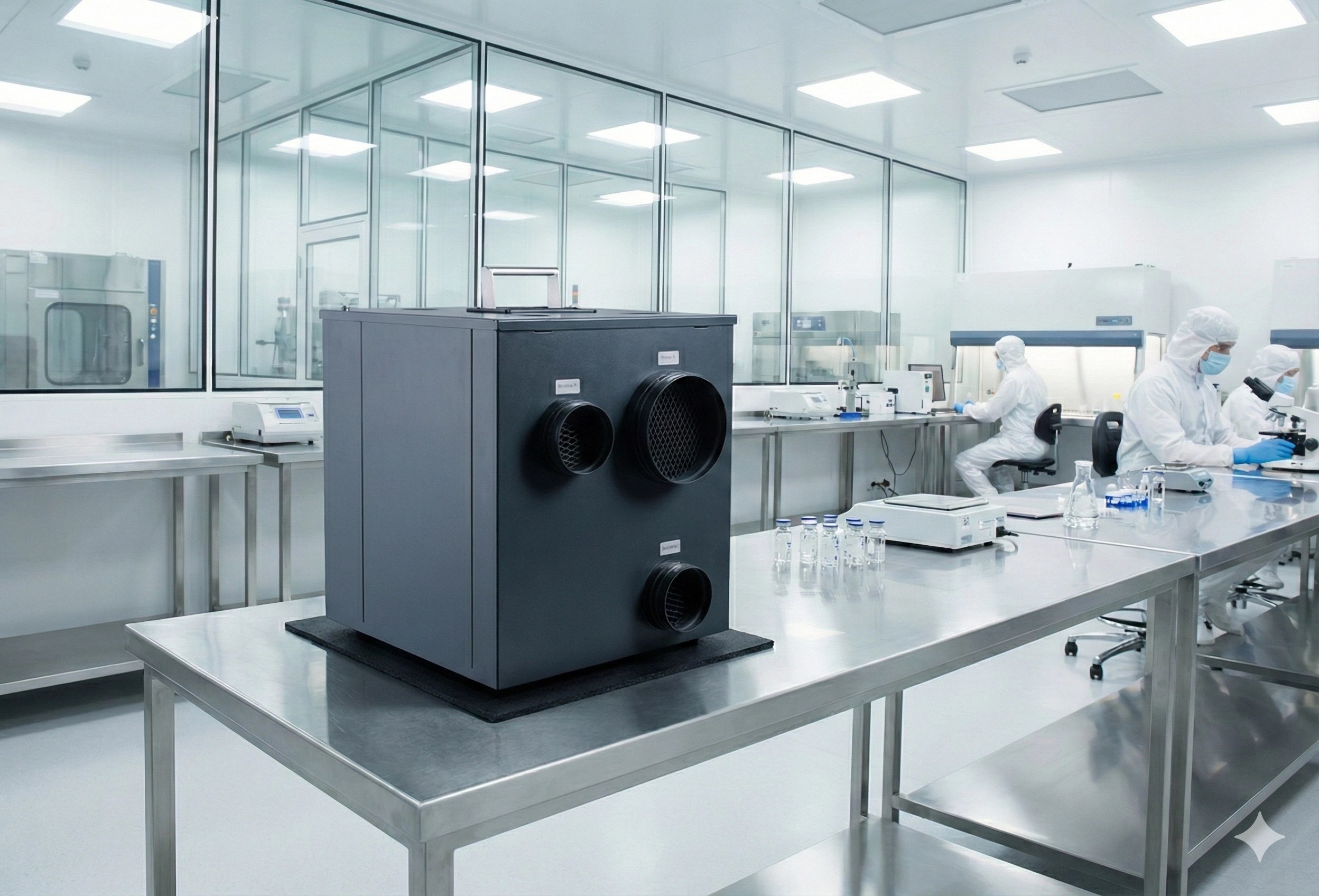
Pharmaceutical production requires air with a dew point of -10°C at 21°C (d=1.6 g/kg, RH=15%). In summer, supply air has 28°C, 65% RH (d=15.5 g/kg). You need to remove 13.9 g/kg of moisture.
A standard air conditioner isn’t suitable because achieving such a humidity ratio would require cooling the air to -10°C, which would freeze the heat exchanger. The solution is a desiccant dehumidifier, which operates at any temperature and achieves dew points down to -40°C and below.
Frequently asked questions about psychrometrics
What is psychrometrics in simple terms?
Psychrometrics is the science of moist air properties that helps engineers calculate how air will behave at different temperatures and humidity levels.
Why doesn’t relative humidity show the actual amount of water in the air?
Relative humidity only shows how full the air “sponge” is at a specific temperature. When temperature changes, the “sponge’s” capacity changes, so 50% RH at 30°C contains more water than 50% RH at 20°C.
Why is indoor air dry in winter even if outdoor humidity is high?
Cold air physically contains little water, even at high relative humidity. When this air is heated indoors, the humidity ratio remains low but the “sponge capacity” increases, causing low relative humidity.
What’s the difference between sensible and latent heat?
Sensible heat changes the air temperature, which we can measure with a thermometer. Latent heat is spent on evaporation or condensation of moisture without changing temperature.
Conclusions — why an HVAC engineer needs psychrometrics
Understanding psychrometrics is essential for HVAC engineers for four key reasons:
- System design: without psychrometrics, you can’t correctly size air conditioners, dehumidifiers, and humidifiers.
- Energy savings: the psychrometric chart helps find the optimal air-treatment strategy with minimal energy use.
- Problem prevention: understanding dew point helps avoid condensation, freezing, mold, and corrosion.
- Air quality control: the right combination of temperature and humidity ensures occupant comfort and compliance with process requirements.
The basic rule: to fully define the state of air, you need to know at least TWO parameters; all others can be found with the psychrometric chart.
Psychrometrics is not abstract theory, but a practical engineering tool that helps make the right decisions, save energy and clients’ money, and create comfortable and safe indoor conditions.


