








































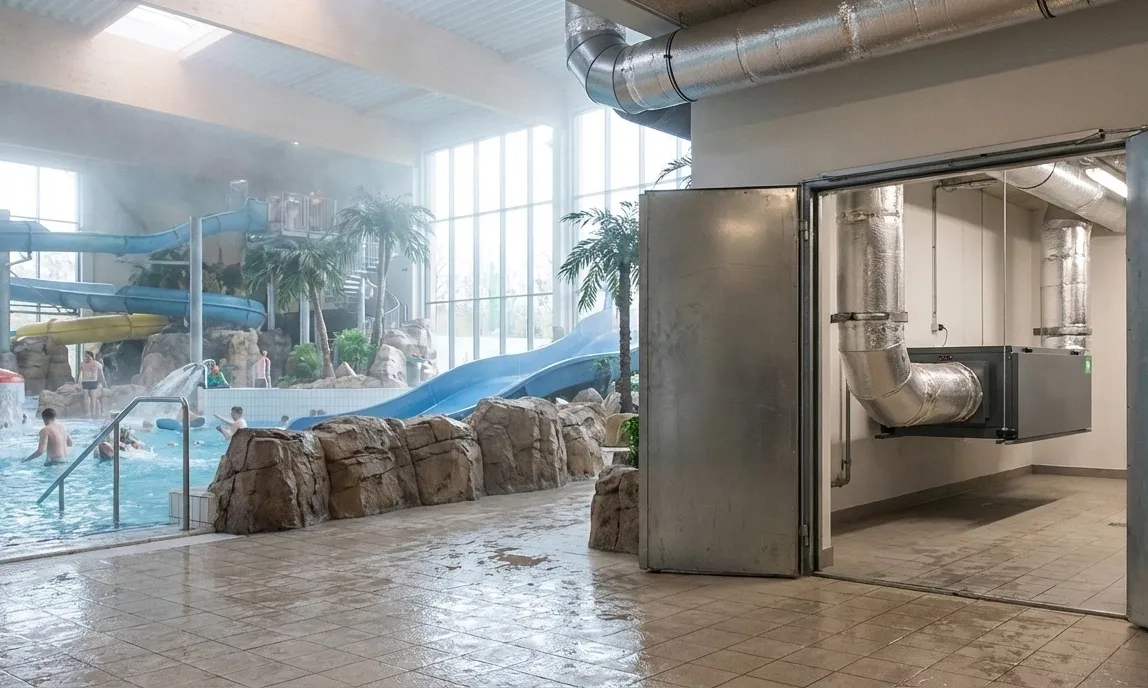
Commercial pools are a completely different level of requirements and responsibility compared to private ones. Every day, such facilities receive hundreds of visitors, creating an enormous load on climate control systems. Strict sanitary standards, legal liability to clients, and constant monitoring of facility conditions are just part of the challenges faced by hotel, fitness club, and sanatorium owners.
A typical mistake when equipping commercial pools is installing a dehumidifier with insufficient capacity. The result is persistently high humidity indoors, condensation on walls and windows, and complaints from visitors about discomfort. The consequences can be catastrophic: damp walls quickly become covered with mold, posing a serious health risk to visitors; metal structural elements and equipment corrode; finishing materials degrade.
Reputational risks should not be underestimated either: a single photo of mold in your pool posted on social media can drive customers away, and violations of sanitary norms can lead to fines, temporary closure, or even lawsuits.
The solution is a professional engineering calculation and installation of MSHA(C) Series X duct dehumidifiers from Mycond, specifically designed for continuous operation in the high-humidity conditions of commercial pools.
Operating principle: Does a dehumidifier pull moisture out of the walls?
The primary source of moisture in pools is evaporation from the water surface. Depending on temperature, 5 to 10 liters of water can evaporate per square meter of water surface per day. Additional moisture sources include showers and jacuzzis (adding up to 30% humidity), people’s bodies (15–20%), and possible groundwater infiltration through the pool structure if waterproofing is inadequate.
The mechanism of humidity problems in pool spaces is quite simple. Water evaporates, raising relative humidity to 70–90%. Warm humid air condenses when it contacts cooler surfaces (walls, ceilings, windows). Hygroscopic building materials (drywall, wood, plaster) absorb moisture, creating ideal internal conditions for mold and fungi to develop.
It’s important to understand: a dehumidifier cannot directly “suck” moisture out of walls. However, it effectively influences the process in two ways:
- Direct action — reducing relative humidity from 80% to an optimal 50–55%.
- Indirect action — creating a humidity gradient between the wall and the air. When the air becomes drier, moisture naturally evaporates from the wall, and the dehumidifier removes it. This cycle repeats continuously, gradually drying the building structures.
The drying speed of materials depends on their type and the dehumidifier’s capacity:
- Concrete — 1–3 months
- Brick — 2–4 months
- Drywall — 2–4 weeks
- Wood — 3–6 weeks
A weak household dehumidifier with a capacity of 30 liters per day simply won’t cope with such a task, whereas industrial MSHA(C) Series X duct dehumidifiers with capacities of 250–1000 liters per day will effectively solve the problem in 1–3 months of continuous operation.
Let’s look at the performance of the main MSHA(C) Series X models:
- MSHA(C) 250 — collects up to 250 liters of moisture per day
- MSHA(C) 380 — collects up to 380 liters of moisture per day
- MSHA(C) 500 — collects up to 500 liters of moisture per day (half a ton of water!)
- MSHA(C) 750 — collects up to 750 liters of moisture per day
- MSHA(C) 1000 — collects up to 1000 liters of moisture per day (over 40 liters per hour)
For context: a typical commercial pool measuring 10 by 15 meters (150 square meters of water surface) evaporates from 750 to 1500 liters of water per day. For such a facility, an MSHA(C) 750 or MSHA(C) 1000 dehumidifier is required.
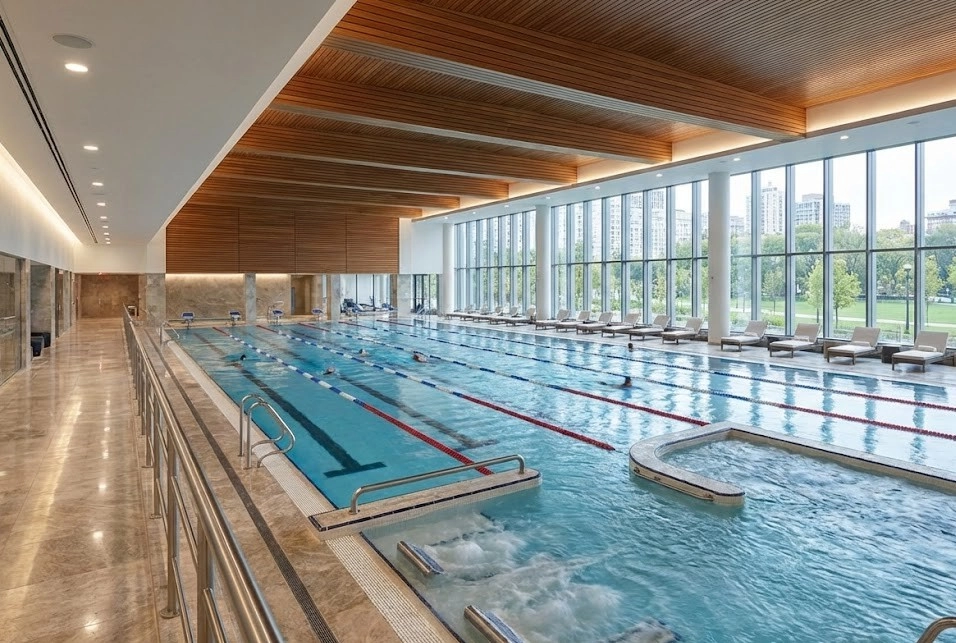
Professional sizing of a dehumidifier for a commercial pool
Correctly selecting the dehumidifier capacity is key to ensuring an optimal microclimate in a commercial pool. Consider the main factors that must be accounted for in the calculation:
Factors affecting dehumidifier sizing
- Water surface area — the main factor, since most evaporation occurs from the water surface.
- Water temperature — the standard pool temperature is 26–28°C. Each additional degree increases evaporation by 5–7%. Children’s pools at 30–32°C have 20–30% more evaporation.
- Air temperature — the optimal air temperature should be 2–3°C higher than the water temperature. Otherwise, condensation on cold surfaces increases.
- Usage intensity — the number of visitors significantly affects humidity:
- Sanatoriums: 10–20 visitors per day
- Hotels: 30–50 visitors per day
- Fitness clubs: 100–200 visitors per day
- Water parks: 500+ visitors per day
- Additional moisture sources:
- Jacuzzi: +20–30% to humidity
- Showers: +10–15% to humidity
- Saunas and hammams: +30–50% to humidity
Sizing formula
For a rough estimate of the amount of moisture evaporating from the pool surface (liters per hour), you can use the formula:
Evaporation (L/h) = Pool area (m²) × Base coefficient × Adjustment factors
Base coefficients depend on the type of facility:
- Private pool: 0.1
- Commercial pool with low intensity (sanatorium): 0.15
- Commercial pool with medium intensity (hotel): 0.2
- Commercial pool with high intensity (fitness club): 0.25–0.3
Adjustment factors:
- Water temperature over 28°C: ×1.2
- Presence of a jacuzzi: ×1.3
- Showers nearby: ×1.15
- Children’s pool (30–32°C): ×1.3
- Water park: ×1.5
Let’s consider an example for a fitness club with a pool area of 150 m² and a 20 m² jacuzzi:
- Main pool: 150 m² × 0.25 (high-intensity use) = 37.5 L/h
- Jacuzzi: 20 m² × 0.25 × 1.3 (adjustment factor for jacuzzi) = 6.5 L/h
- Total evaporation: 37.5 + 6.5 = 44 L/h
- Per day: 44 × 24 = 1056 L/day
- With a 20% safety margin: 1056 × 1.2 = 1267 L/day
Conclusion: this facility needs an MSHA(C) 1000 dehumidifier or two MSHA(C) 750 units, which will provide the necessary redundancy and operational flexibility.
Typical facilities and recommended dehumidifier models
| Type of facility | Pool size (m²) | Usage intensity | Evaporation (L/day) | Recommended model |
|---|---|---|---|---|
| Boutique hotel | ~72 | Low | ~260 | MSHA(C) 380 |
| Hotel (3 stars) | ~120 | Medium | ~430 | MSHA(C) 500 |
| Hotel (4–5 stars) | ~200 | Medium-high | ~720 | MSHA(C) 750 |
| Mid-size fitness club | ~150 | High | ~900 | MSHA(C) 1000 |
| Large fitness center | ~300 | Very high | ~1800 | 2 × MSHA(C) 1000 |
| Sanatorium | ~200 | Medium | ~720 | MSHA(C) 750 |
| Sports complex | ~312 | High | ~1870 | 2 × MSHA(C) 1000 |
| Rehabilitation center | ~96 | Low–medium | ~350 | MSHA(C) 380 |
| Children’s pool (32°C) | ~60 | Medium, elevated temperature | ~350 | MSHA(C) 380 |
| Indoor water park | ~600 | Extreme | ~4500 | 5 × MSHA(C) 1000 |
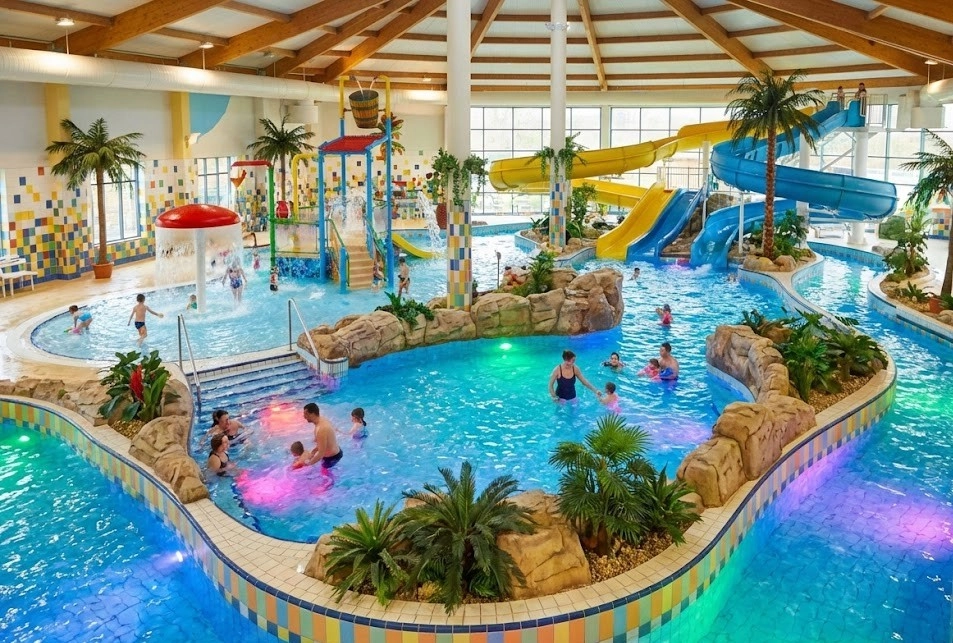
Humidity standards for commercial pools and why they matter
According to sanitary norms, relative humidity in pool spaces should be maintained within 50–60%, with an optimal level of 55%. Air temperature should be 2–3°C higher than water temperature (for adult pools — 26–28°C, for children’s — 30–32°C). It is also necessary to ensure an air exchange rate of 80–100 m³/h per person.
Why are these humidity levels optimal?
- Below 50%: discomfort, a sense of dryness, static electricity, feeling cold after exiting the water.
- 50–60%: optimal comfort, no condensation, mold does not grow, corrosion is minimal.
- Above 65%: condensation starts on cold surfaces.
- Above 70%: active mold and fungal growth.
- Above 75%: stuffiness, intensive corrosion of metal elements.
Mold and fungus growth thresholds
- Below 60% humidity: mold hardly grows.
- 60–70% humidity: risk of spore germination.
- Above 70% humidity: mold formation is guaranteed.
- Above 80% humidity: explosive growth; millions of spores spread through the air.
For commercial facilities, it is critical to maintain humidity at 55% CONSTANTLY. Even if the level is 55% in the morning but rises to 75% in the evening, that’s enough for mold to develop. MSHA(C) Series X duct dehumidifiers operate in automatic cycles, keeping humidity stable at the optimal level.
Business impact of non‑compliance with standards
Failure to meet humidity standards leads to serious consequences:
- Health risks: mold spores cause allergies and asthma; the Legionella bacterium, which multiplies at 20–45°C, spreads through aerosols and causes a severe form of pneumonia with a 10–15% fatality rate. Outbreaks of legionellosis in hotels have led to closures, lawsuits, and compensation payments.
- Property damage: destruction of finishes, equipment corrosion, decay of wooden elements. Instead of 10–15 years of service life, repairs may be needed in just 2–3 years.
- Legal consequences: fines, temporary closure, lawsuits from clients, loss of license.
- Reputational losses: negative reviews on social networks and travel platforms.
ROI of investing in professional dehumidifiers
For illustration, if an MSHA(C) 500 dehumidifier costs a nominal amount X, a single major repair due to moisture damage will cost 5–10X. And losses from reputational damage and business closure are impossible to quantify.
Bottom line: a professional dehumidifier is not an expense but an investment that protects your business and reputation.
Fighting mold in a commercial pool: a holistic approach
Mold in a pool is not just an aesthetic issue. It is a serious threat to the health of visitors and to your business’s reputation.
Why mold is so dangerous
The danger of mold is not limited to visible stains and unpleasant odors. The main threat is the millions of invisible spores circulating in the air, entering people’s lungs, and causing allergic reactions, asthma, and other respiratory diseases. This is especially dangerous for children, the elderly, and visitors with weakened immune systems.
The reputational risks are also huge: a single photo of mold in your pool published on social media can be disastrous for your business, leading to customer churn and a loss of trust in your facility.
Where does mold come from in a pool
Ideal conditions for mold development are humidity above 65–70% and temperatures of 20–30°C. It develops particularly quickly on organic materials (wood, drywall) and in areas with poor air circulation.
Typical places where mold appears in pools:
- Room corners and junctions between walls and floors
- Tile joints and grout
- Wooden decor and furniture elements
- Suspended ceilings
- Areas with persistent condensation
- Ventilation grilles
- Spaces behind furniture and equipment
Comprehensive solution to the mold problem
Effective mold control in a commercial pool includes five key elements:
- MSHA(C) Series X dehumidifier — the core of the system, maintaining humidity at 50–55%, under which mold simply does not grow and spores do not germinate. It’s important to understand that a dehumidifier does NOT kill existing mold; it creates conditions under which it cannot develop.
- HEPA H13 filter (option) — traps 99.5% of spores, bacteria, and viruses from 0.3 microns, preventing them from circulating in the air. This is critical for high-traffic commercial facilities, where recirculated contaminated air can lead to recontamination. A HEPA filter is mandatory for children’s pools, sanatoriums, and rehabilitation centers.
- UV sterilization (option) — ultraviolet radiation with a C wavelength of 253.7 nm destroys the DNA of microorganisms, sterilizing the air. It is particularly effective against Legionella, which multiplies in warm (20–45°C) water and spreads through aerosols in showers or jacuzzis. Outbreaks of Legionnaires’ disease (a severe form of pneumonia with a 10–15% fatality rate) are often associated with pools, so UV sterilization is not a luxury but insurance against serious problems.
- Fresh-air mixing — a function that allows adding 30–40% fresh outdoor air to the system. The problem with recirculation-only systems is that spores may slip through even HEPA filters and settle on surfaces. Outdoor air contains virtually no spores, so dilution and continuous air renewal are a mandatory requirement of sanitary regulations.
- Proper ventilation — the “dehumidifier + ventilation” pair works in tandem: the dehumidifier removes moisture, and ventilation ensures air movement, eliminates stagnant zones, exhausts contaminated air, and supplies fresh air. It is important that the system be supply-and-exhaust (not exhaust-only), balanced at 80–100 m³/h per person, and provide even air distribution without “dead zones.”
Algorithm for removing existing mold
If mold has already appeared, follow this algorithm:
- Mechanical removal — clean affected surfaces with special brushes and antiseptic agents; let them dry thoroughly.
- Install and switch on the dehumidifier — depending on room size, install an MSHA(C) 250–1000 and run it around the clock without shutting off. The goal is to reduce humidity to 50% and keep it there stably.
- Maintain low humidity — at least 2–4 weeks at 50% so that mold spores completely dry out, become inactive, and lose the ability to multiply on surfaces.
- Use a HEPA filter and UV lamp (if possible) — they capture and kill spores circulating in the air, preventing recurrence.
- Prevention — continuously maintain automatic 55% humidity, regularly inspect problem areas (corners, joints, grilles), and clean/replace filters on schedule.
Visible mold usually disappears 2–4 weeks after the start of comprehensive measures, and complete drying of building structures takes 1–3 months. A lasting result is achieved only with continuous maintenance of optimal humidity.
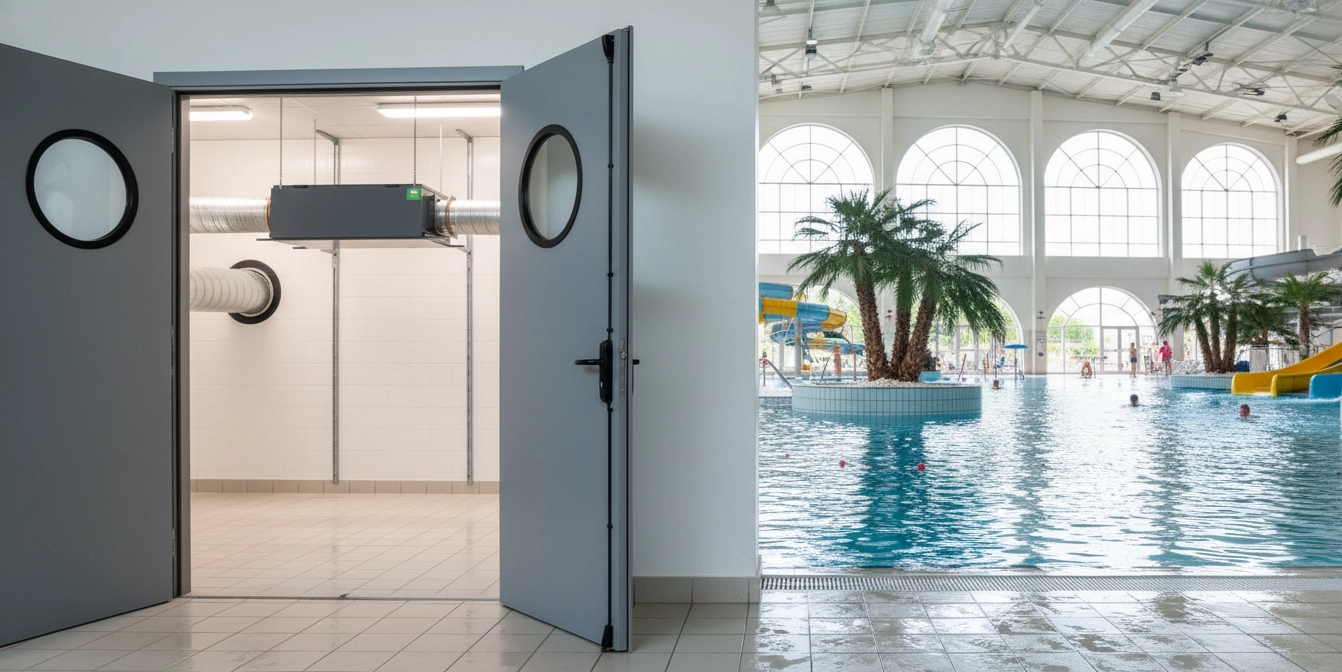
Why MSHA(C) Series X is the perfect choice for commercial pools
Capacity fit for commercial facilities
The MSHA(C) Series X duct dehumidifiers offer capacities from 250 to 1000 liters per day. By comparison, MBA-G wall-mounted dehumidifiers have a maximum capacity of up to 108 liters per day (model MBA10G), which is sufficient only for private pools up to 50 m².
Commercial facilities require more powerful solutions:
- MSHA(C) 250 collects 250 liters per day and covers pools up to 104 m²
- MSHA(C) 500 collects 500 liters per day and covers pools up to 208 m²
- MSHA(C) 1000 collects 1000 liters per day and covers pools up to 417 m²
Bottom line: for commercial pools larger than 50 m², you need MSHA(C) Series X duct dehumidifiers with a capacity of 250 liters per day and above.
Reliability for 24/7 operation
MSHA(C) Series X dehumidifiers are designed for industrial use and years of continuous operation. Here’s what ensures their exceptional reliability:
- Compressors from leading manufacturers (Matsushita, Panasonic, Embraco), selected for efficiency and reliability.
- Bearings rated for hundreds of thousands of operating hours.
- Blue Coating technology for copper tubes — corrosion protection in humid, aggressive environments, guaranteeing over 10 years of operation without degradation.
- Multilevel protection systems against overheating, overload, and condensate overflow.
- Intelligent automation with a humidistat — switches on when humidity rises and turns off when the set level is reached.
Unlike household dehumidifiers designed to run 8–12 hours per day with breaks, industrial MSHA(C) Series X dehumidifiers are engineered for uninterrupted 24/7 operation for many years.
Fresh-air mixing — two-in-one
Standards require an air exchange of 80–100 m³/h per person. For a room with 20 visitors present simultaneously, that is 1600–2000 m³/h of fresh air. Typically, this requires a separate supply unit — extra costs, space for installation, and maintenance.
MSHA(C) Series X solves two tasks at once:
- Dehumidifying the air to an optimal 55%
- Mixing in 30–40% fresh outdoor air
This allows you to partially or fully cover ventilation needs and save on a separate system.
Maximum protection with HEPA, UV, and ionizer
For a commercial pool, a HEPA filter and UV lamp are not options but insurance against legal liability. An owner who receives hundreds of visitors daily cannot take risks. A single legionellosis outbreak can lead to severe consequences: lawsuits, compensation, loss of reputation, and business closure.
The HEPA H13 filter traps 99.5% of spores, bacteria, and viruses, and the UV lamp kills Legionella and other pathogens. This is not only protection but also a marketing advantage: “Our pool is equipped with a medical-grade system with HEPA H13 and UV sterilization, like in operating rooms.” Parents who care about their children’s health are willing to pay more for safety.
Concealed installation — premium aesthetics
A professional commercial pool design should not suffer because of technical equipment. A wall-mounted dehumidifier hanging in plain sight is associated with a budget, temporary solution.
The MSHA(C) Series X duct dehumidifier is installed discreetly above a suspended ceiling, with only decorative supply and return grilles visible. It looks like part of the room’s architecture — professional and high-end. Clients don’t see the equipment, experiencing the comfortable microclimate as something natural that matches the facility’s premium standard.
Modularity and redundancy — business continuity
For large pools, it is often better to install two smaller dehumidifiers rather than one powerful unit. For example, two MSHA(C) 500 instead of one MSHA(C) 1000. Advantages of this approach:
- Redundancy — if one dehumidifier fails and needs repair, the other continues to operate, the business doesn’t stop, and the pool remains available to clients without discomfort.
- Flexibility — at low load, you can run only one dehumidifier, saving electricity. During peak hours — both at full capacity.
- Service convenience — you can switch off one dehumidifier for scheduled filter cleaning and maintenance without shutting down the pool.

Use cases of MSHA(C) Series X dehumidifiers
Case 1: Small hotel with humidity problems
Facility: A small hotel with a pool of about 75 m².
Problem: The previously installed household dehumidifier lacked sufficient capacity, leading to high humidity, constant condensation on windows, and guest complaints about stuffy air. The calculation showed the old unit covered only 35% of the moisture removal need.
Solution: Installed an MSHA(C) 380 duct dehumidifier with optional HEPA H13 filter and UV sterilization. The system was integrated into the existing ventilation.
Result: Stable humidity at 54–56%, complete absence of condensation on surfaces, and a marked improvement in guest reviews about comfort. The hotel even raised room rates for pool-access rooms because the environment became significantly more pleasant.
Case 2: Fitness club with mold issues
Facility: Fitness club with a 180 m² pool and a jacuzzi.
Problem: Persistent mold in room corners and on the ceiling, high humidity due to intensive use, and a risk of fines from the sanitary inspectorate. The calculation showed a need to remove over 1200 liters of moisture per day.
Solution: Installed two MSHA(C) 750 dehumidifiers with a redundancy system, HEPA filters, and UV lamps. Configured 40% fresh-air mixing to comply with ventilation standards.
Result: Humidity stabilized at 52–55%, visible mold completely disappeared within three weeks without additional treatment. Clients noted a significant improvement in air quality — it became “fresh and easy to breathe.” The sanitary inspectorate found no issues during a scheduled inspection.
Case 3: Sanatorium with a children’s pool
Facility: Sanatorium with a 60 m² children’s pool, water temperature 32°C.
Specifics: The elevated water temperature increases evaporation by 30%. Since the pool is used by children with weakened immunity, air cleanliness requirements are especially strict.
Solution: Installed an MSHA(C) 380 dehumidifier with a mandatory medical-grade HEPA filter and a powerful UV lamp to protect immunocompromised children.
Result: Ideal humidity at 54%, and a complete absence of pool-related respiratory illnesses. Parents were extremely satisfied, leading to an increase in repeat visits. The sanatorium uses the presence of a professional air purification system as a competitive advantage in its marketing materials.
FAQ: Answers to the most common questions
Does a dehumidifier pull moisture out of the walls?
Yes, but indirectly. A dehumidifier lowers air humidity to 50–55%, creating a gradient that causes moisture to naturally evaporate from the walls, and the dehumidifier removes it. Depending on the material, complete removal of moisture from walls takes 1–3 months, but adequate dehumidifier capacity is required.
How much water does a professional dehumidifier collect?
The MSHA(C) Series X lineup offers models with capacities from 28 to 1000 liters per day. For commercial pools, models of 250–1000 L/day are recommended. For comparison, the MSHA(C) 500 collects half a ton of water per day.
What humidity level is needed to prevent mold in a pool?
The optimal humidity to prevent mold growth is 50–60%, ideally 55%. Below 50% causes discomfort; above 65% condensation starts; above 70% mold grows actively — a violation of sanitary norms.
Will a dehumidifier help against existing mold?
Yes, but a comprehensive approach is needed: mechanically clean affected areas, reduce humidity to 50% with a dehumidifier, use HEPA filtration to remove spores from the air, and UV sterilization to kill microorganisms. Results will be visible after 2–4 weeks of maintaining low humidity.
How to calculate the required dehumidifier capacity for a pool?
Use the formula: pool area × intensity coefficient (0.15–0.3) × adjustment factors × 24 hours + 20% safety margin. For example, for a fitness club with a 150 m² pool: 150 × 0.25 × 24 × 1.2 = 1080 liters per day, requiring an MSHA(C) 1000 dehumidifier.
What is the danger of Legionella in a pool and how to combat it?
Legionella is a bacterium that multiplies in warm water (20–45°C) and spreads through aerosols (splashes, showers). It causes a severe form of pneumonia with a 10–15% fatality rate. Legionellosis outbreaks in hotels have led to closures, lawsuits, and huge compensation payouts. UV lamps in MSHA(C) Series X dehumidifiers effectively kill Legionella — your insurance against serious problems.
Is a HEPA filter necessary for a commercial pool dehumidifier?
Strongly recommended for all high-traffic commercial facilities. For children’s pools, sanatoriums, and rehabilitation centers, a medical-grade H13 HEPA filter (traps 99.5% of spores, bacteria, and viruses) is mandatory. It’s protection against legal claims and a marketing advantage that increases client trust.
Can a wall-mounted dehumidifier be used for a commercial pool?
No. For areas over 50 m², wall-mounted units (MBA-G series with a maximum of 108 L/day) are categorically insufficient. For commercial pools of 100–300 m² and more, MSHA(C) Series X duct dehumidifiers with capacities of 250–1000 L/day are required, engineered for 24/7 operation.
How much does it cost to operate an MSHA(C) dehumidifier?
The MSHA(C) 500 has a nominal power of 10 kW, but in real conditions it runs in cycles and consumes about 6–7 kW/h. Per day, that’s 144–168 kWh, with the monetary value depending on your tariff. However, these costs are far lower than repair costs due to humidity: a single capital repair is 5–10 times more expensive, not to mention fines and reputational losses. Payback for a professional dehumidifier is 1–2 years.
Is redundancy necessary for commercial pool dehumidifiers?
For large, high-traffic facilities, redundancy is strongly recommended. It’s better to install two smaller units (e.g., two MSHA(C) 500 instead of one MSHA(C) 1000). Advantages: if one fails, the other continues to operate and you won’t need to close the pool; maintenance can be done alternately; at low load you can run only one, saving electricity; at peak times — both at full power.
Conclusion: A professional solution for your business
Commercial pools require a completely different approach compared to private ones. They serve hundreds of visitors daily, are subject to strict standards, and every detail can affect the facility’s reputation. That’s why you need powerful MSHA(C) Series X duct dehumidifiers with capacities of 250–1000 liters per day.
Key points for successfully solving humidity problems:
- Professional calculation using a dedicated formula that accounts for all factors — not “by eye,” but with precise engineering methodology.
- Continuous maintenance of 55% humidity — a guarantee of no mold and compliance with sanitary standards.
- MSHA(C) Series X dehumidifiers with HEPA filtration and UV sterilization — maximum protection against Legionella and other pathogens, insurance against lawsuits, and protection of reputation.
A professional dehumidifier is not an expense, but an investment in your reputation, your clients’ health, asset preservation, and the avoidance of fines. The payback period for such an investment is 1–2 years.
Mycond offers a free consultation specifically for owners of commercial facilities: hotels, fitness clubs, sanatoriums, and sports complexes. Our engineers will perform a professional calculation for your pool with all specifics considered (area, temperature, usage intensity, presence of a jacuzzi), select the optimal model and configuration, and help determine which options are truly needed.
MSHA(C) Series X duct dehumidifiers are the ideal solution for commercial facilities where 24/7 reliability, high performance, and maximum protection of client health are essential.
You can contact us by phone or by filling out the form at the bottom of this page.


