









































Author: Mycond technical department
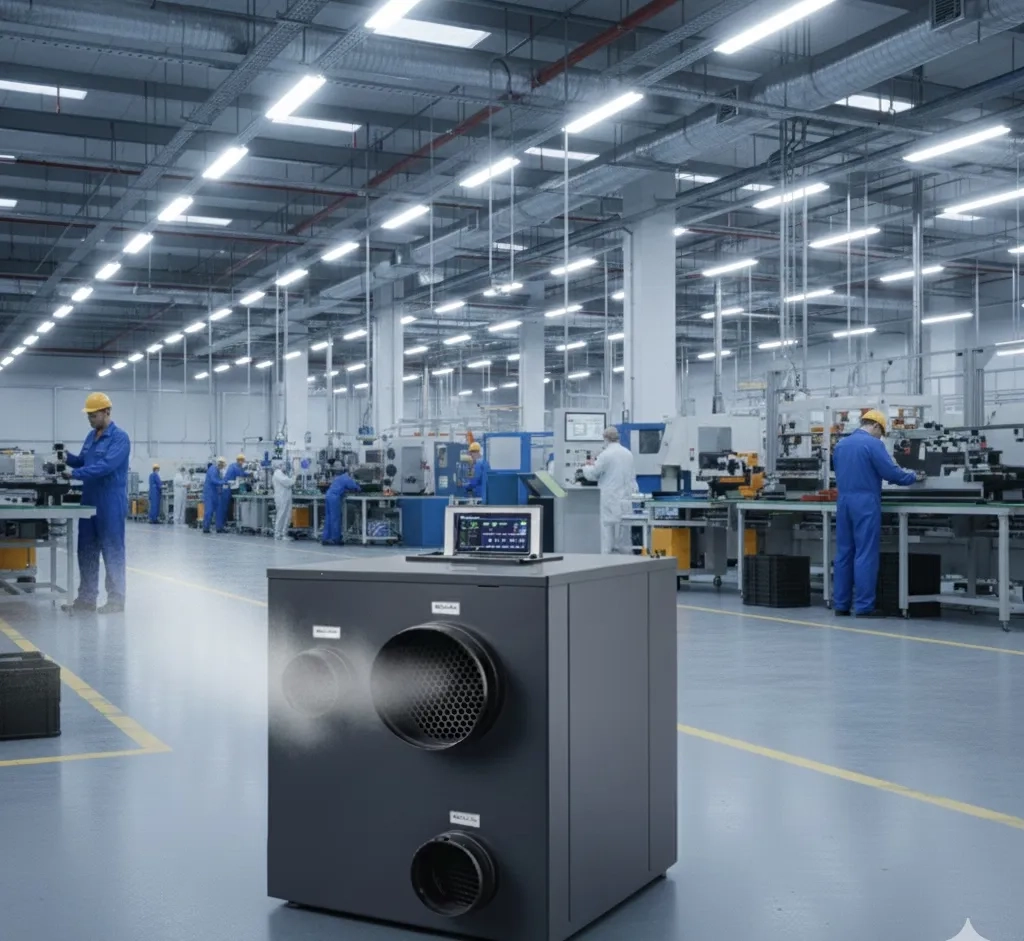
Desiccant cooling is an innovative air-conditioning technology that uses adsorptive air dehumidification followed by cooling to efficiently control both humidity and temperature. Unlike traditional vapor-compression systems, desiccant systems separate the treatment of sensible (temperature) and latent (moisture) loads, which enables a significant increase in energy efficiency.
The main drawback of the traditional approach to air conditioning is the need to cool air below its dew point to condense excess moisture, and then reheat it to a comfortable temperature (the reheat process). This leads to significant energy losses, especially with deep dehumidification. The magnitude of these losses depends on the initial air parameters, the depth of dehumidification, and the effectiveness of heat exchangers.
Physical principles of desiccant cooling
The operation of desiccant systems is based on the process of moisture adsorption from air. This is a physical process involving the diffusion of water vapor driven by the difference in partial pressures between the humid air and the desiccant surface. An important characteristic of desiccants is their enormous specific surface area, which can reach 400–800 m²/g for silica gel and other common materials.
Heating is used to regenerate desiccants saturated with moisture. Depending on the material type, the regeneration temperature may range from 60°C to 140°C. For silica gel, the most common desiccant, the optimal regeneration temperature is 80–120°C. Molecular sieves require higher temperatures of 150–200°C, while lithium chloride desiccants are sufficiently regenerated at 60–90°C.
Moisture adsorption releases heat of sorption, consisting of the latent heat of condensation (approximately 2500 kJ/kg of water) plus additional binding heat that depends on the desiccant type and may add another 10–20% of the latent heat. This effect is important when calculating the overall thermal balance of the system.
Components of a desiccant cooling system
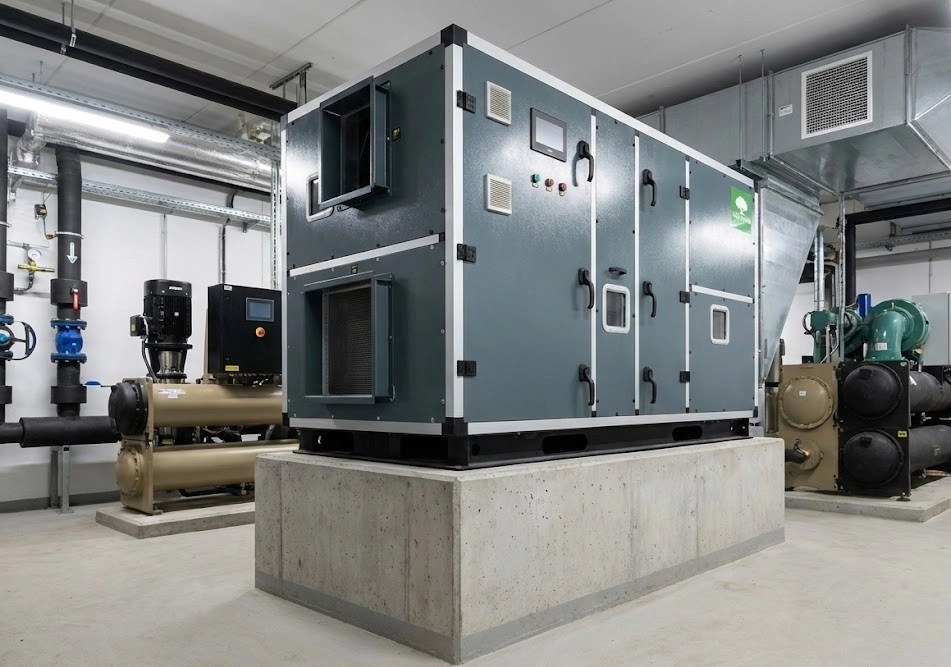
The central element of most desiccant cooling systems is a rotating desiccant wheel. It consists of a matrix (most often a honeycomb structure) coated with a desiccant. The wheel diameter is determined by the air flow rate and is sized so that the air velocity through the wheel cross-section does not exceed 2.5–4 m/s. The wheel depth usually ranges from 100 to 400 mm, and the rotational speed from 10 to 20 revolutions per hour.
The regeneration system includes a regeneration air heater that provides the temperature needed to remove moisture from the desiccant. The regeneration airflow typically amounts to 30–50% of the process airflow, though this ratio may vary depending on the regeneration temperature and outdoor air humidity.
Absorption chillers and their integration with desiccant systems
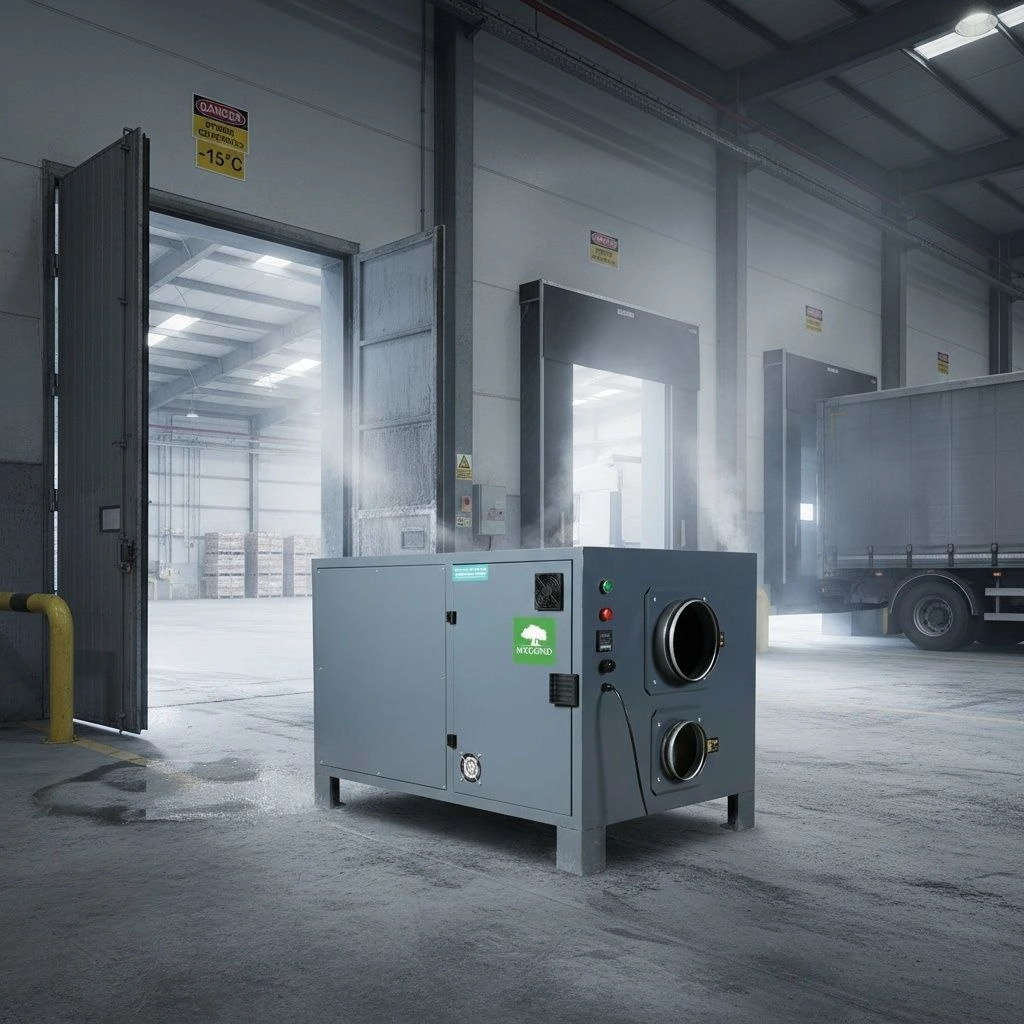
An absorption chiller is a heat-driven refrigeration device that uses water as the refrigerant and lithium bromide (LiBr) as the absorbent. Its operation is based on a four-part cycle:
1. Evaporator – water evaporates at low pressure (0.6–1.2 kPa) and low temperature (3–7°C), absorbing heat from the chilled water circuit.
2. Absorber – the water vapor is absorbed by a concentrated LiBr solution, releasing heat that is removed by cooling water.
3. Generator – the diluted LiBr solution is heated by an external heat source. For single-effect machines, the heating temperature is typically 80–110°C; for double-effect machines, 130–170°C.
4. Condenser – the water vapor condenses, releasing heat to the cooling water.
Typical coefficients of performance (COP) for absorption chillers are 0.6–0.8 for single-effect and 1.1–1.3 for double-effect machines. These are lower than for vapor-compression chillers (3.0–5.0), but absorption units use inexpensive thermal energy instead of costly electricity.
Integration schemes for desiccant systems with absorption chillers
There are three main schemes for integrating desiccant dehumidification with absorption chillers:
1. Series treatment: Air first passes through the desiccant wheel, where moisture is removed, and is then cooled by the absorption chiller. The main advantage is independent control of temperature and humidity. The dew point can be maintained at a consistently low level regardless of the room temperature.
2. Parallel treatment: The desiccant treats only fresh outdoor air, removing moisture before supplying it to the space. The absorption chiller treats recirculated air, removing the sensible heat load. The advantage is a reduction in the overall load on the chiller, allowing a smaller unit.
3. Cogeneration scheme: A single heat source (for example, a gas boiler) supplies both desiccant regeneration and the generator of the absorption chiller through a distribution system. The advantage is maximum utilization of the fuel’s primary energy; the overall system efficiency can reach 85–90%.

Energy efficiency and performance indicators
The coefficient of performance (COP) for desiccant cooling systems is defined as the ratio of useful cooling capacity to the sum of all energy inputs. Typical COP values depend on system configuration and may range from 0.5 to 2.5. When waste heat is used, COP can rise to 3.0–4.0.
Compared with traditional cooling–dehumidification systems, desiccant systems offer advantages in three cases:
- With a high share of latent load (sensible heat ratio below 0.7–0.75)
- When a low dew point is required (below 7–10°C)
- When low-cost thermal energy is available
To improve energy efficiency, two-stage regeneration is used, where the desiccant is first regenerated with lower-temperature heat (60–70°C), and then with higher-temperature heat (90–120°C). This saves 20–30% of high-temperature energy.
Frequently asked questions (FAQ)
How is desiccant cooling fundamentally different from traditional air conditioning, and when is it appropriate?
Traditional air conditioning uses a single process to reduce both temperature and humidity—cooling air below its dew point followed by reheating. This requires significant energy, the magnitude of which depends on the air parameters and the depth of dehumidification. Desiccant cooling separates the treatment of sensible and latent loads: moisture is first removed by adsorption, and then the air is cooled.
Desiccant cooling is appropriate when:
- The latent load share is high (over 30–40% of the total)
- Low humidity is required (dew point below 10°C)
- Low-cost thermal energy is available (waste heat, solar energy, low gas tariffs)
How does an absorption chiller work, and why does it combine effectively with a desiccant?
An absorption chiller operates on a thermochemical cycle in which water is used as the refrigerant and lithium bromide as the absorbent. Water vapor generated in the evaporator at low pressure (removing heat from the chilled water) is absorbed by a concentrated LiBr solution in the absorber. The diluted solution is then heated in the generator by an external heat source, which evaporates water that then condenses in the condenser.
Synergy with a desiccant arises for several reasons:
- Both systems consume thermal energy, allowing the use of a single heat source
- Pre-dehumidification with a desiccant allows raising the chilled-water temperature from the chiller (from the traditional 6–7°C to 12–15°C), improving the absorption machine’s COP by 15–30%
- Shifting load off the peak electrical grid reduces demand charges
What are typical mistakes when designing desiccant cooling systems?
The main design mistakes include:
- Underestimating adsorption heat – moisture adsorption releases heat (about 2500–3000 kJ/kg of removed moisture), which must be accounted for in cooling capacity calculations.
- Incorrect selection of flow ratios – the optimal ratio of process to regeneration streams depends on regeneration temperature, outdoor air parameters, and the target dew point. Proper selection requires calculations using adsorption isotherms of the specific desiccant.
- Ignoring air leakage – even small leaks (3–5%) between the process and regeneration zones can significantly reduce system performance. High-quality seals must be ensured and positive pressure maintained in the process zone.
- Insufficient air filtration – desiccant contamination significantly reduces its capacity. Filters of an appropriate class should be installed (at least F7 for process air).
Conclusions
Desiccant cooling with absorption chillers is an advanced technology that separates the treatment of sensible and latent loads while using thermal energy instead of electrical energy. This enables significant electricity savings and independent control of temperature and humidity.
Practical recommendations for engineers:
- Select the integration scheme according to the load structure: series for high latent load, parallel for a large amount of fresh air, cogeneration for complex energy needs
- Maximize the use of waste or renewable heat as the main driver of economic efficiency
- Account for adsorption heat when calculating cooling capacity
Desiccant systems are optimal when the latent load exceeds 30–40% of the total, a low dew point is required, and low-cost heat is available. The payback period of such systems is determined by the ratio of electricity to heat tariffs, the operating schedule, and the ability to recover heat.
Keep in mind that desiccant cooling has efficiency limitations in very dry climates, for small facilities (due to high specific capital costs), short cooling seasons, or when low-cost thermal energy is not available.


