









































Author: Mycond Technical Department
Humidity control is a critical factor in the production and storage of alcoholic beverages. For centuries, wine and beer producers used natural cellar spaces with relatively stable temperature and humidity. However, as production has scaled and quality requirements have increased, traditional methods have proven insufficient. Uncontrolled humidity leads to significant economic losses: according to industry studies, improper storage conditions can cause up to 12% product loss due to cork spoilage, growth of undesirable microorganisms, and accelerated equipment corrosion.
Specifics of winemaking
The winemaking process consists of several stages, each with specific climate requirements. During fermentation (15-25°C), a significant amount of CO₂ and moisture is released. Wine aging in oak barrels takes place under precisely controlled parameters: for red wines, the optimal temperature is 12-16°C with relative humidity of 60-70%; for white wines — 10-12°C and 65-75%, respectively.
Special attention should be paid to the physics of evaporation through oak barrels, known as the "angel's share." At too low humidity (below 50% RH), accelerated evaporation of alcohol occurs, reducing the wine’s strength. At excessive humidity (above 80% RH), more water is lost, increasing alcohol concentration and impairing flavor balance. The optimal balance is achieved at 65-70% RH, when losses are minimal and the concentration of aromatic compounds remains natural.
Natural cork stoppers are hygroscopic and extremely sensitive to humidity fluctuations. At RH below 50%, the cork dries out, shrinks, loses elasticity and the ability to seal the bottle. At humidity above 75%, there is a risk of mold growth, particularly Botrytis cinerea, which leads to “cork taint.”
Specifics of brewing
Beer production has its own humidity control specifics. The brewhouse is characterized by high temperatures (up to 100°C) and intense evaporation. In the fermentation area, it is critically important to control not only temperature (depending on the beer type, 5-24°C), but also CO₂ removal and the maintenance of optimal humidity of 50-60% RH to prevent the development of undesirable microorganisms.
The most challenging task in breweries is washing equipment with CIP systems (Clean-In-Place), which causes extreme humidity peaks. During cleaning cycles lasting 2-4 hours, relative humidity can jump from 40% to 95% RH, and the recovery to normal levels without dedicated dehumidification may take 6-8 hours.
Raw material storage also requires precise humidity control. Malt needs 50-60% RH to prevent mold growth and maintain enzymatic activity. Hops are extremely sensitive to oxidation, which is accelerated at elevated humidity.
Low-temperature psychrometry
Understanding psychrometric processes is key to preventing condensation in cellar spaces. At typical wine cellar temperatures (+10...+16°C), the saturation curve has specific characteristics. The dew point—the temperature at which water vapor begins to condense—is a critical parameter. For example, at an air temperature of +12°C and relative humidity of 70%, the dew point is approximately +6.5°C. This means that any surface in the room with a temperature below +6.5°C will be covered with condensation.
It should be understood that when temperature decreases, the relative humidity of air automatically rises even without additional moisture sources. For example, air at +20°C and 50% RH, when cooled to +10°C, will already have about 85% RH. That is why absolute humidity (moisture content) of air, measured in grams of water per kilogram of dry air (g/kg), is used for engineering calculations.
Microbiological aspects
Most harmful microorganisms actively develop at relative humidity above 65-70%. To assess risk, the concept of "water activity" (aw) is used, characterizing the availability of moisture for biological processes. At aw > 0,7 (which corresponds to RH > 70%), the risk of microbiological contamination increases sharply.
In wine cellars, the main threats are mold on walls and corks (Penicillium, Aspergillus, Botrytis); in breweries—wild yeasts and lactic and acetic acid bacteria. In addition to product spoilage, high humidity accelerates biocorrosion of metal structures and equipment, reducing their service life by 30-50%.
Recommended parameters and sources of moisture load
Based on industry standards and practical experience, optimal parameters can be defined for various stages of alcoholic beverage production. For aging red wines: 12-16°C and 60-70% RH; white wines: 10-12°C and 65-75% RH; bottle storage: 10-15°C and 60-70% RH. For breweries: ale fermentation: 15-24°C and 50-60% RH; lagering: 0-4°C and 70-80% RH; bottling: 4-10°C and 50-60% RH.
The main sources of moisture in production areas are infiltration through building structures (especially basement walls and floors), ventilation air, technological processes (fermentation, boiling, washing), and emissions from personnel. Particularly critical is capillary suction of moisture through the floor, which in old cellars without proper waterproofing can amount to 200-300 g/m² per day.
Methodology for engineering calculation of a dehumidification system
Designing an effective dehumidification system requires a clear methodology. Let’s consider the main steps using the example of a wine cellar sized 20×30×3 m with a temperature of +12°C and a target relative humidity of 65%:
1. Determining target parameters: convert 65% RH at +12°C to absolute humidity — approximately 6,2 g/kg.
2. Infiltration calculation: for a typical cellar with stone walls, this is approximately 1-2 kg/h.
3. Ventilation load: for a cellar with 10,000 liters of fermenting wine, it is necessary to remove about 15 kg of CO₂ per day, which requires approximately 100 m³/h of ventilation. This creates an additional load of 1.5-2 kg/h of moisture.
4. Technological loads: evaporation through barrels is approximately 0.5 kg/h plus washing peaks of 10-15 kg/h.
5. Total continuous load: 3-4 kg/h plus 20% reserve = 4-5 kg/h. Peak load: 15-20 kg/h.
Comparison of dehumidification technologies
There are two main air dehumidification technologies:
Condensation dehumidifiers operate by cooling the air below the dew point followed by condensate removal. Their efficiency drops sharply at temperatures below +15°C and is practically zero at +10°C and below. The advantage is relatively low energy consumption (0.3-0.5 kWh per 1 kg of removed moisture) and lower equipment cost.
Adsorption dehumidifiers use chemical sorption of moisture with special materials (silica gel, zeolite). They are effective at any temperature, including sub-zero, and can deliver very low dew points. The disadvantage is higher energy consumption (0.8-1.2 kWh per 1 kg of moisture) due to the need to reactivate the adsorbent.
Air distribution system design and energy efficiency
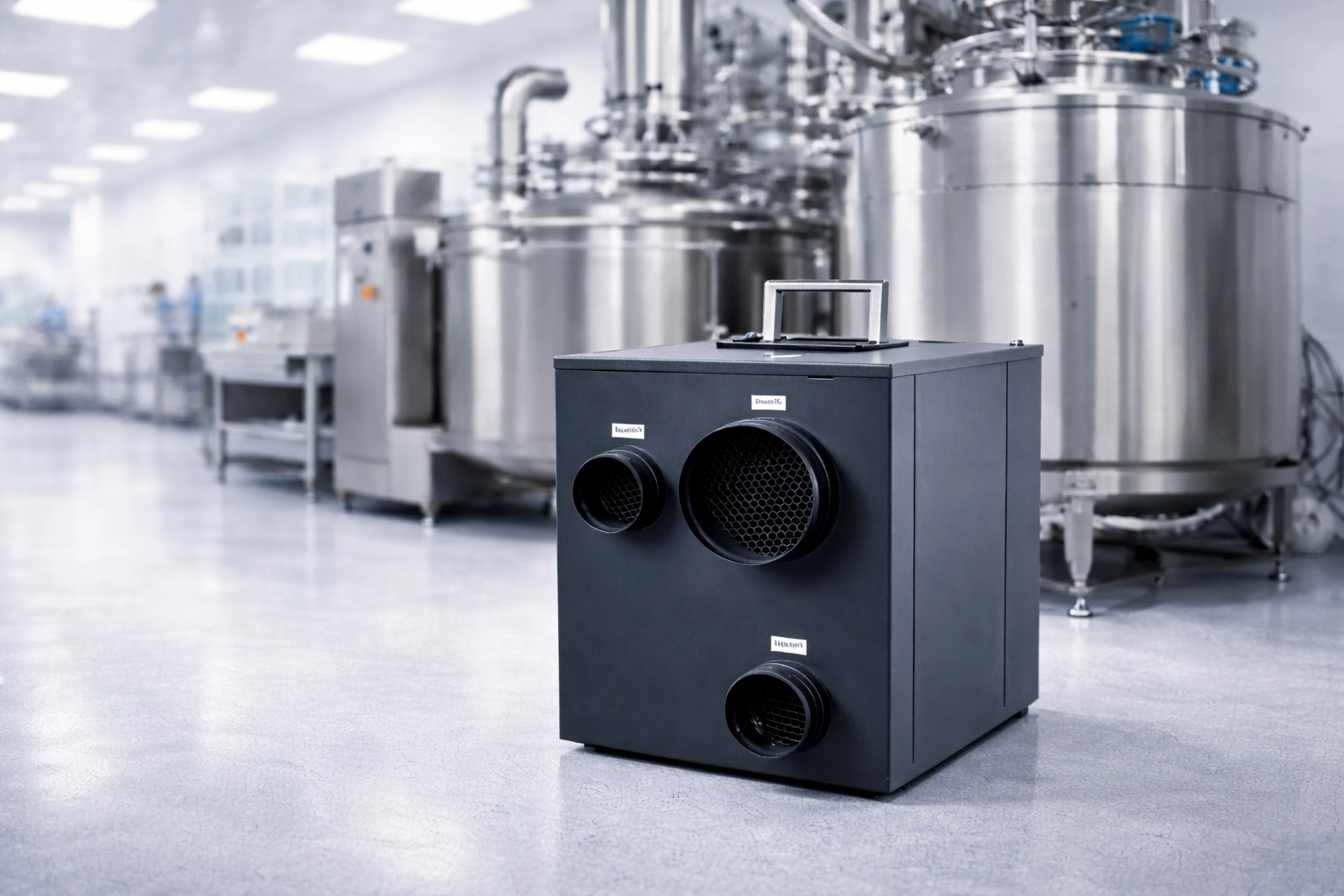
An effective system for distributing dried air should provide priority supply to the coldest surfaces (barrels, tanks, pipelines) to prevent condensation. Creating a slight positive pressure (+5...+15 Pa) prevents uncontrolled infiltration of moist outdoor air.
Significant energy savings can be achieved through recovery of reactivation heat from adsorption dehumidifiers for heating process water or supply air. Integration with refrigeration systems by using the refrigerant’s condensation heat for adsorbent reactivation can reduce energy consumption by 30-40%.
Typical design mistakes
The most common mistakes in dehumidification system design include:
- Incorrect selection of dehumidifier type (condensation instead of adsorption for cold cellars)
- Ignoring peak loads from equipment washing
- Installing expensive systems in leaky spaces
- Incorrect placement of humidity sensors (near the dehumidifier outlet rather than in the product storage zone)
- Lack of a CO₂ removal system for fermentation
- Underestimating capillary moisture suction through the floor
Economic justification
Losses from uncontrolled humidity can amount to 5-15% of product value due to cork spoilage, microbiological contamination, and equipment corrosion. The cost of a comprehensive solution for a typical wine cellar of 500-600 m² usually ranges from 15,000 to 25,000 euros, with a payback period of 2-4 years.
Frequently asked questions (FAQ)
Why are condensation dehumidifiers ineffective at low temperatures?
As air temperature drops, the amount of moisture that can be condensed decreases sharply. Below +10°C, the dehumidifier’s heat exchanger can frost over, stopping the dehumidification process.
What is the optimal dehumidification strategy for a wine cellar?
For a typical cellar at +12°C, an adsorption dehumidifier with a positive pressure system and sensors in critical zones is optimal.
How to prevent cork spoilage during long-term storage?
Maintain stable humidity of 60-70% RH, avoid temperature fluctuations, and store bottles horizontally to keep the cork moistened by the wine.
Why is positive pressure important in humidity-controlled rooms?
Positive pressure prevents infiltration of moist air from outside through gaps and openings, significantly reducing the load on the dehumidification system.
Conclusions
Humidity control in wine cellars and breweries is a complex engineering task that requires a systematic approach. Key success factors:
- Correct selection of dehumidification technology depending on temperature conditions
- Accurate calculation of all moisture sources, including peak loads
- Adsorption dehumidifiers as the optimal solution for low-temperature cellars
- Energy efficiency through heat recovery and integration with other systems
- Proper sensor placement and automation
Investments in professional humidity control systems not only protect products from spoilage, but also improve their quality, reduce operating costs, and create optimal conditions for long-term storage of alcoholic beverages.


