








































Author: Mycond Technical Department
High humidity at home is a problem many apartment and house owners face around the world. Condensation on windows, damp walls, unpleasant odors, and mold are all consequences of excessive humidity that not only reduce living comfort but can also pose a serious threat to residents' health and the integrity of the building. This issue is especially acute in humid climates, rooms with poor ventilation, new buildings, and basements.
When it comes to effectively tackling humidity, electric dehumidifiers far outperform traditional moisture absorbers. While a typical moisture absorber can collect only about 1 liter of water per month (often insufficient for residential spaces), a modern electric dehumidifier removes 16 to 25 liters of moisture per day. That’s the difference between a cosmetic fix and a real solution.
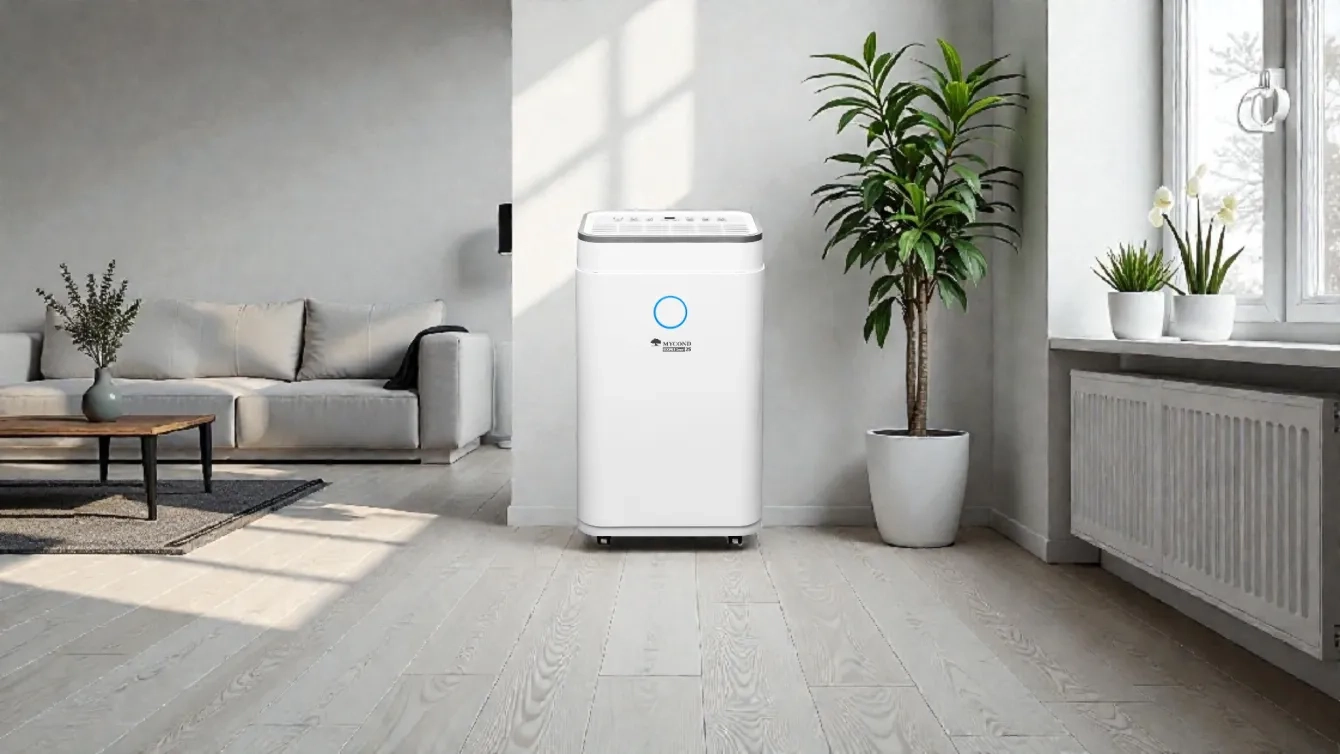
Mycond has developed a line of high-efficiency dehumidifiers that can meet the needs of any space. In this review, we cover three models, each the optimal solution for its specific task:
- Yugo Smart 16 – a compact and quiet dehumidifier for small rooms up to 35 m²
- Roomer Smart 25 – a powerful dehumidifier with a large tank for spacious areas up to 50 m²
- Roomer HEPA 25 – a dehumidifier with a HEPA filter for allergy sufferers and families who care about air quality
Each of these models has unique advantages, and in this article we’ll explain how to properly choose a dehumidifier for your specific case to solve the problem of excessive humidity at home once and for all.
Yugo Smart 16 for rooms up to 35 square meters
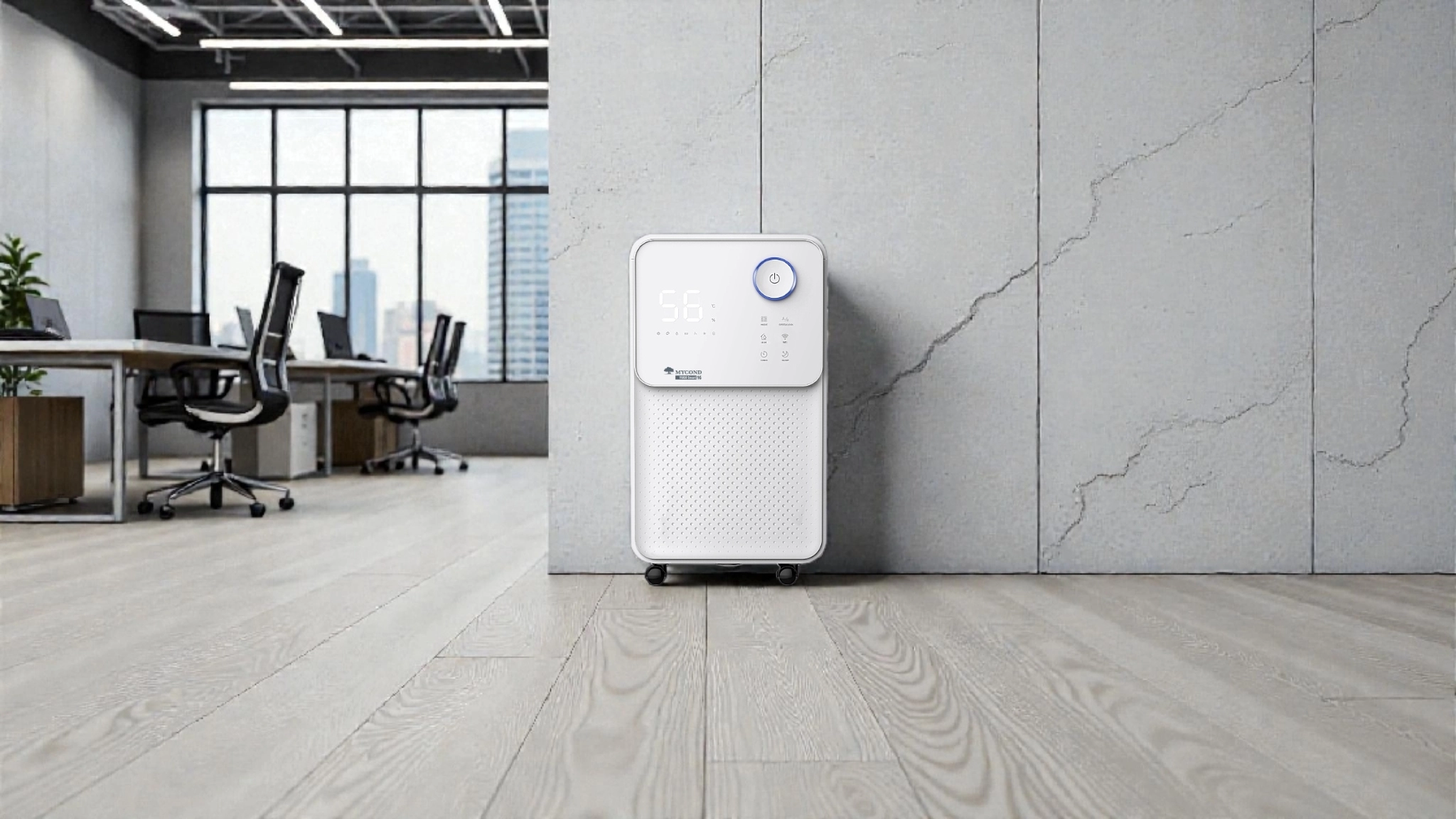
The Yugo Smart 16 dehumidifier is a compact yet powerful solution for small rooms where not only efficiency matters, but also low noise and energy efficiency.
Yugo Smart 16 specifications
The Yugo Smart 16 can remove up to 16 liters of moisture per day at 30°C and 80% relative humidity. To put that into perspective: it’s equivalent to 16 large bottles of water the unit literally "pulls" from the air. Power consumption is just 270 W, comparable to three standard incandescent bulbs.
The noise level deserves special attention—only up to 38 dBA, comparable to a soft whisper. This makes the Yugo Smart 16 ideal for bedrooms and children’s rooms where quiet is essential for rest. The water collection tank holds 2 liters, and the air exchange rate is 150 cubic meters per hour, ensuring effective dehumidification throughout the room.
The Yugo Smart 16 uses eco-friendly refrigerant R290 (65 grams), has compact dimensions of 280×201×505 mm and weighs 12 kg, making it easy to move between rooms when needed. Operating temperature range: 5 to 35°C, covering all typical conditions in residential spaces.
Smart features and extras
The Yugo Smart 16 isn’t just a dehumidifier—it’s a smart device with WiFi control, letting you manage it via smartphone from anywhere. You can switch it on before you get home or set a schedule for maximum convenience.
The built-in air ionization function provides additional purification by saturating the air with negative ions that attach to positively charged dust and allergen particles, making them heavier so they settle instead of entering your airways.
The carbon filter effectively removes unpleasant odors, smoke, and volatile organic compounds, creating a more pleasant indoor atmosphere.
Who the Yugo Smart 16 is ideal for
This dehumidifier is the perfect solution for:
- Studio apartments up to 35 m²
- One-bedroom and compact two-bedroom apartments
- Bedrooms where quiet is critical
- Spaces where Smart control via app matters
- Situations where energy efficiency is a priority
The Yugo Smart 16 is an ideal choice for compact spaces where quiet operation and energy efficiency are important while effectively keeping humidity under control.
Roomer Smart 25 for rooms up to 50 square meters
For larger apartments and private homes, you need a more powerful solution—and that’s where the Roomer Smart 25 comes in, capable of effectively combating humidity in spacious rooms.
Roomer Smart 25 specifications
The main advantage of this model is its high performance—up to 25 liters of moisture per day, which is 56% more than the Yugo Smart 16. At the same time, power consumption is only 380 W, indicating high energy efficiency.
The noise level up to 45 dBA is comparable to a quiet conversation—slightly louder than the Yugo Smart 16, yet comfortable for most living spaces. The tank volume deserves special attention—6.5 liters, the largest in the entire Mycond lineup. This means you’ll need to empty the tank only 3–4 times a day even at maximum performance.
The Roomer Smart 25 has an air exchange rate of 180 cubic meters per hour, ensuring effective circulation and dehumidification even in large rooms. It uses eco-friendly refrigerant R290 (75 grams) and measures 340×240×575 mm, weighing 14.5 kg.
Advantages of a large tank
A 6.5-liter tank is not just a spec—it’s real convenience in everyday use. At 25 liters per day, a standard 2–4 liter tank would need emptying up to 10 times a day, which is impractical. The Roomer Smart 25’s large tank reduces that to 3–4 times, saving your time and effort.
In addition, the model features a tank full indicator and automatic shutoff when the maximum water level is reached, ensuring safe operation even when you can’t constantly monitor the water level.
Who the Roomer Smart 25 is ideal for
The Roomer Smart 25 is indispensable for:
- Large apartments and private homes up to 50 m²
- Office spaces with high humidity
- Laundry rooms where clothes are dried
- Rooms after renovation or flooding where quick drying is needed
- Families who don’t want to empty the tank often
The Roomer Smart 25 is the ideal solution for large spaces that require maximum performance and ease of use without frequent tank emptying.
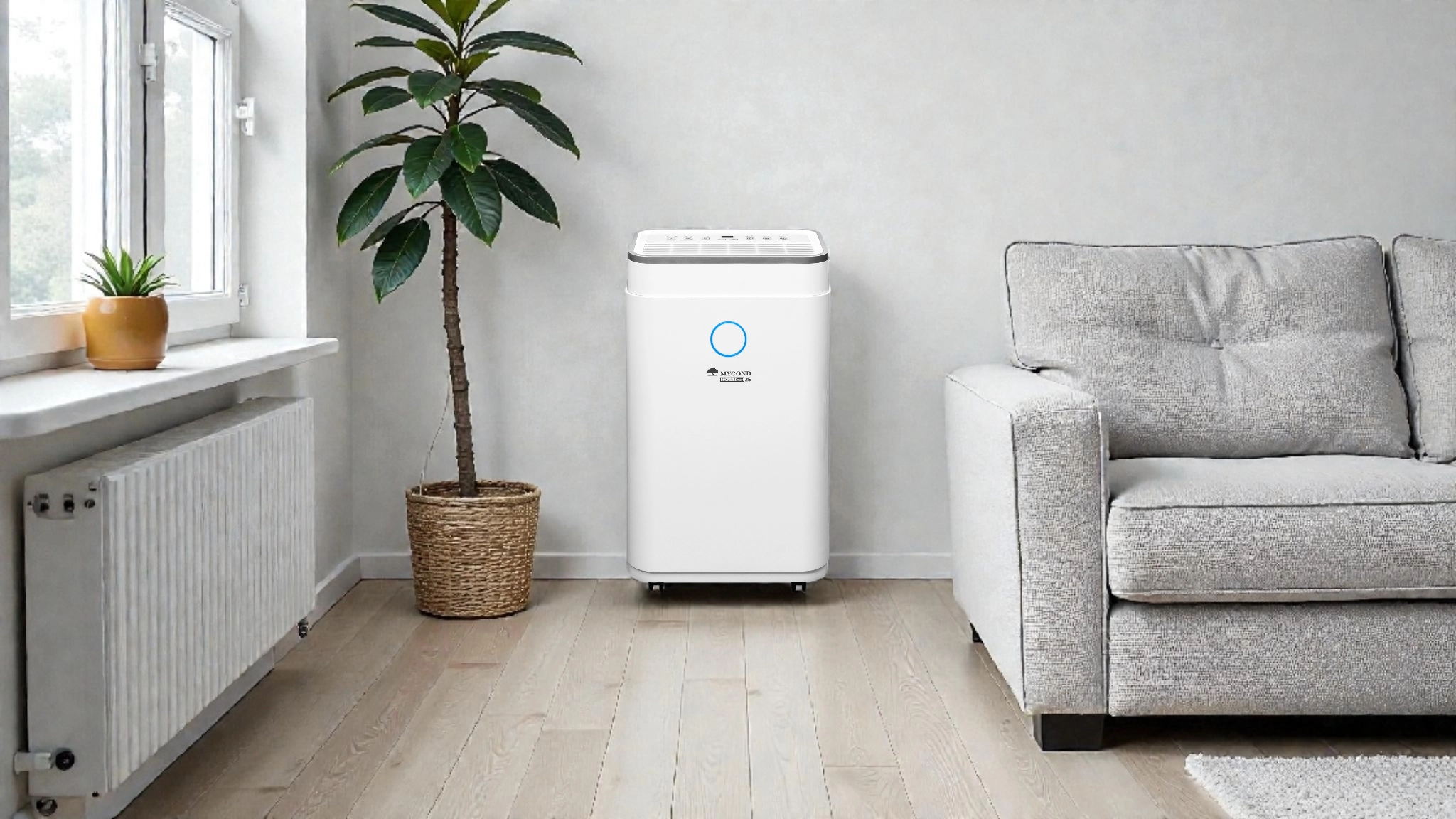
Roomer HEPA 25 for allergy sufferers and rooms up to 50 square meters
For families who care about health and air quality, Mycond offers a special model—the Roomer HEPA 25, which combines high-efficiency dehumidification with premium air purification.
Roomer HEPA 25 specifications
By its core parameters, the Roomer HEPA 25 is similar to the previous model: 25 liters per day performance, 370 W power consumption (slightly more economical than the Smart version), up to 45 dBA noise level, and 180 cubic meters per hour air exchange.
The tank volume is 4 liters, smaller than the Roomer Smart 25, but this is offset by the presence of a HEPA filter—the key feature of this model. Device dimensions: 350×235×578 mm; weight: 14.5 kg; refrigerant: R290 (70 grams).
HEPA filtration features and comparison with Roomer Smart 25
A HEPA (High Efficiency Particulate Air) filter is a special type of filter that captures 99.97% of particles as small as 0.3 microns. For comparison: a human hair is about 70 microns thick, and most bacteria are 0.3–5 microns in size. This means a HEPA filter effectively captures:
- Plant pollen that triggers seasonal allergies
- Mold spores that can provoke asthma and other respiratory issues
- Dust mites and their waste, the most common home allergen
- Pet dander and hair
- Many types of bacteria and viruses
Unlike the Roomer Smart 25, the HEPA model does not have a carbon filter to eliminate odors, but it offers significantly more effective air purification from allergens and microparticles. It’s a classic example of specialization: one model focuses on ease of use (large tank) and odor removal, the other on maximum air purification for health.
Who the Roomer HEPA 25 is ideal for
This model is the best choice for:
- People with allergies and asthma
- Families with small children where air quality is critical
- Pet owners, especially if someone in the household is allergic to fur/dander
- Rooms after mold remediation where it’s important to remove residual spores
- Those who want not only to dehumidify but also to purify the air
The Roomer HEPA 25 is the ideal solution for those who care about family health and need not only dehumidification but also air purification from allergens and harmful microparticles.
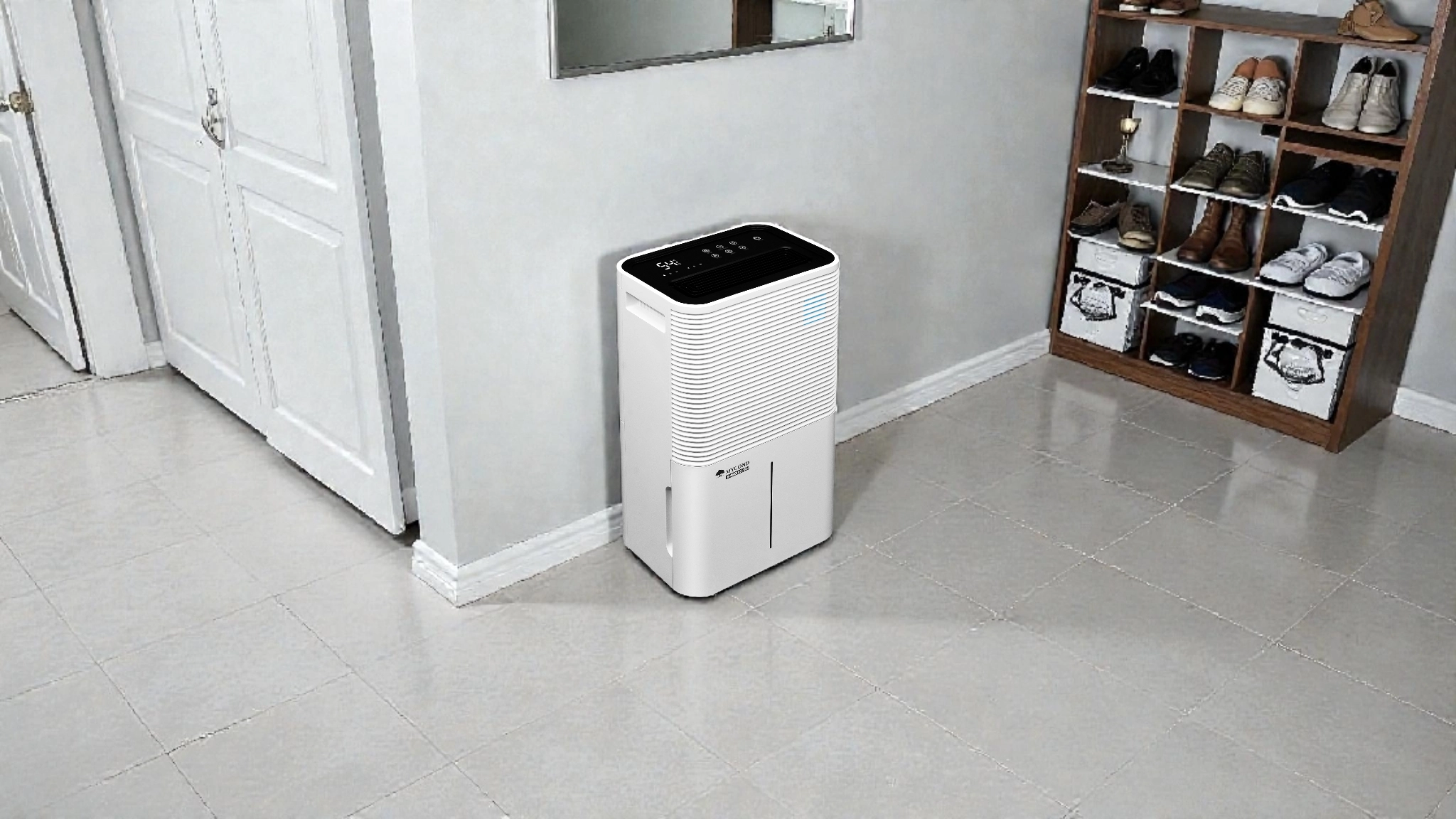
Dehumidifier energy consumption
One of the most common questions about dehumidifiers is how much electricity they use. Let’s dispel the myth of excessive energy consumption.
Comparative energy consumption table
| Model | Power (W) | Equivalent household appliances |
|---|---|---|
| Yugo Smart 16 | 270 | 3 incandescent bulbs |
| Roomer Smart 25 | 380 | 4 incandescent bulbs |
| Roomer HEPA 25 | 370 | 4 incandescent bulbs |
Cyclical operation and real consumption
It’s important to understand that a dehumidifier does not run at full power all the time. Like a refrigerator, it operates in cycles of 30–60 minutes, turning on and off depending on the room’s humidity level. On average, a dehumidifier actually runs about 40–60% of the time, which significantly reduces real energy consumption.
Estimated monthly consumption
With 12 hours of active operation per day (which corresponds to roughly 6–7 hours of actual compressor runtime), you can estimate monthly consumption:
- Yugo Smart 16: 270 W × 6 hours × 30 days = 48.6 kWh per month (taking cyclic operation into account, approximately 97 kWh)
- Roomer Smart 25: 380 W × 6 hours × 30 days = 68.4 kWh per month (taking cyclic operation into account, approximately 137 kWh)
- Roomer HEPA 25: 370 W × 6 hours × 30 days = 66.6 kWh per month (taking cyclic operation into account, approximately 133 kWh)
For comparison with other household appliances:
- Refrigerator: 100–150 kWh per month
- Air conditioner (summer): 200–300 kWh per month
- Washing machine: 20–30 kWh per month (for 10–15 wash cycles)
As you can see, a dehumidifier consumes about as much electricity as a regular refrigerator and significantly less than an air conditioner. At the same time, the cost of electricity for a dehumidifier is much lower than potential repair costs due to mold and moisture damage—not to mention the cost of treating health problems that can arise from high humidity.
Ways to fight humidity: what really works
Before choosing a method to combat humidity, it’s important to understand what options exist and how effective they are.
Three main approaches to combating humidity
1. Ventilation
Ventilation is the simplest and free way to remove moisture from a room. However, it has serious limitations:
- Effective only in winter when outside air is colder and drier than indoor air
- In summer and autumn, outside air is often more humid, and ventilation can make the problem worse
- Leads to heat loss in cold seasons and higher heating costs
- Does not work in rainy weather
2. Moisture absorbers
Moisture absorbers (absorption dehumidifiers) are passive devices that use calcium chloride or silica gel granules to absorb moisture from the air:
- Low-cost initial option
- No electricity consumption
- Very low performance—about 1 liter per month
- Suitable only for closets, pantries, and other small enclosed spaces
- Require regular replacement or regeneration
3. Electric dehumidifiers
Electric (condensation) dehumidifiers are the most effective way to deal with excess humidity:
- High performance—16 to 25 liters per day
- Effective year-round regardless of outdoor conditions
- Allow precise control of humidity levels
- Offer additional air purification and ionization functions
- Consume electricity, but are economically justified given their effectiveness
Comparative table of humidity control methods
| Method | How much water it removes | Best suited for |
|---|---|---|
| Ventilation | Depends on conditions, unpredictable | Short-term humidity reduction in winter |
| Moisture absorbers | About 1 liter per month | Closets, pantries, small enclosed spaces |
| Electric dehumidifiers | 16–25 liters per day | Living spaces, apartments, houses, offices |
For effectively combating humidity in living spaces, an electric dehumidifier is the ideal solution, and Mycond’s range offers models for any area and need. They not only remove moisture efficiently but also purify the air, improving the overall indoor climate.
Comparative table of the three Mycond models
For convenience, we’ve prepared a detailed comparison table of all three models:
| Criterion | Yugo Smart 16 | Roomer Smart 25 | Roomer HEPA 25 |
|---|---|---|---|
| Performance (liters per day) | 16 | 25 | 25 |
| Recommended area (m²) | up to 35 | up to 50 | up to 50 |
| Noise level (dBA) | up to 38 | up to 45 | up to 45 |
| Tank volume (liters) | 2 | 6.5 | 4 |
| WiFi control | Yes | Yes | Yes |
| HEPA filter | No | No | Yes |
| Carbon filter | Yes | Yes | No |
| Ionization | Yes | Yes | Yes |
| Power consumption (W) | 270 | 380 | 370 |
| Dimensions (mm) | 280×201×505 | 340×240×575 | 350×235×578 |
| Weight (kg) | 12 | 14.5 | 14.5 |
| Ideal for | Compact rooms, bedrooms where quiet matters | Large spaces where convenience and a big tank are valued | Allergy sufferers, families with children, rooms with mold issues |
Specific recommendations for typical situations
To make choosing a dehumidifier easier, let’s consider a few typical situations and the optimal solutions for them.
Situation 1: 30 m² studio apartment with a need for Smart control
For owners of compact 30 m² studio apartments—especially if you spend a lot of time away and value remote control—the Yugo Smart 16 is ideal. Its 16 liters per day performance is more than enough to dehumidify such a space, and the low noise level (38 dBA) won’t disturb comfort in a small area where the sleeping zone is often not separated from the living space. WiFi control lets you turn the dehumidifier on before returning home so you always walk into a comfortable environment.
Situation 2: 50 m² three-room apartment and a family with children without allergies
For a spacious three-room apartment with a family and children without allergy issues, the Roomer Smart 25 is the optimal solution. Its high 25 liters per day performance will dehumidify the entire apartment efficiently, while the large 6.5-liter tank significantly reduces emptying frequency—especially important for busy parents. The carbon filter helps remove unpleasant odors that often appear in large apartments, and WiFi control makes it easy to manage the device even when you’re busy caring for the kids.
Situation 3: 45 m² two-room apartment with an allergic child
For families with children who have allergies or asthma, the Roomer HEPA 25 is the best choice. This dehumidifier combines high performance with premium air purification thanks to its HEPA filter, which captures up to 99.97% of allergens. In a 45 m² two-room apartment, it will reduce not only humidity but also dust, pollen, mold spores, and other allergens, creating a healthy indoor climate for the whole family. HEPA filtration is critical for the health of an allergic child, making the Roomer HEPA 25 the ideal solution that combines dehumidification and air purification.
Situation 4: 40 m² office with high summer humidity
For a 40 m² office where humidity is elevated, especially in summer, we recommend the Roomer Smart 25. Its Smart features let you schedule operation so the unit turns on an hour before the workday, creating a comfortable climate before employees arrive. The large 6.5-liter tank means fewer interruptions to empty it—especially important in a work environment—and the carbon filter helps remove office odors, improving the overall atmosphere. The Roomer Smart 25 is the ideal solution for offices where you need performance, convenience, and Smart control.
Situation 5: Large 30 m² bedroom with sensitivity to noise
For a spacious bedroom where quiet is critical, especially during sleep, the Yugo Smart 16 is the best choice. At just 38 dBA—comparable to a whisper—this dehumidifier won’t disturb your sleep even when running all night. Its 16 liters per day performance is sufficient to effectively dehumidify a 30 m² bedroom. An added benefit is the ionization function, which promotes a healthier, fresher sleep. The Yugo Smart 16 is the ideal solution for bedrooms that demand both quiet and effective dehumidification.
Most common questions about dehumidifiers (FAQ)
What equipment is best for combating humidity at home?
An electric dehumidifier is the most effective equipment for combating humidity in residential spaces. Unlike moisture absorbers that collect only about 1 liter of water per month, modern Mycond dehumidifiers can remove 16–25 liters of moisture daily, making them the perfect solution for continuous climate control at home.
Do dehumidifiers consume a lot of electricity?
Mycond dehumidifiers are energy-efficient devices. With 12 hours of operation per day, the Yugo Smart 16 consumes about 97 kWh per month, and the Roomer models about 137 kWh—comparable to a regular refrigerator (100–150 kWh) and significantly less than an air conditioner (200–300 kWh).
Which air-drying methods really work?
There are three main ways: ventilation (works only in winter), moisture absorbers (effective only for closets and pantries), and electric dehumidifiers. Only electric dehumidifiers ensure a guaranteed result year-round, removing up to 25 liters of moisture daily. The Mycond lineup offers an ideal solution for any area and need.
Which is better to choose: Yugo Smart 16 or Roomer Smart 25?
The choice depends on room size and your priorities. The Yugo Smart 16 is ideal for spaces up to 35 m² and situations where quiet (38 dBA) matters. The Roomer Smart 25 suits areas up to 50 m² and cases where a large 6.5 L tank is important to reduce emptying frequency. Both models have WiFi control and ionization.
What’s better for an allergy sufferer: a regular dehumidifier or one with a HEPA filter?
For allergy sufferers, a dehumidifier with a HEPA filter is definitely better. The Roomer HEPA 25 captures 99.97% of allergens as small as 0.3 microns, including pollen, mold spores, and pet dander. It’s the ideal solution for people with allergies, asthma, and families with small children who are especially sensitive to air quality.
Do dehumidifiers need Smart features?
Smart features significantly enhance convenience. WiFi control lets you switch the device on remotely before returning home, set schedules, and monitor humidity via smartphone. All Mycond models (Yugo Smart 16, Roomer Smart 25, and Roomer HEPA 25) have this feature, making them ideal for a modern smart home.
Which dehumidifier is suitable for a 50 m² apartment?
For a 50 m² apartment, the Roomer Smart 25 or Roomer HEPA 25 with 25 liters per day performance is optimal. Choose based on additional needs: if a large 6.5 L tank and odor removal matter—Roomer Smart 25; if air purification from allergens is a priority—Roomer HEPA 25. Both models are ideal for spacious rooms.
Are dehumidifiers economical in terms of electricity?
Yes, modern Mycond dehumidifiers are energy-efficient. They operate cyclically (like a refrigerator), actually consuming energy 40–60% of the time. Monthly consumption is 97–137 kWh, comparable to a refrigerator. Meanwhile, savings on repairs due to moisture and mold damage far exceed electricity costs.
Can a dehumidifier be used in a bedroom?
Yes, you can and should use a dehumidifier in a bedroom, especially if humidity is high. For bedrooms, the Yugo Smart 16 with its low 38 dBA noise level is the best fit and won’t disrupt your sleep. This dehumidifier is ideal for creating a comfortable microclimate for healthy sleep.
How do Roomer Smart 25 and Roomer HEPA 25 differ?
Main differences: the Roomer Smart 25 has a larger tank (6.5 L vs. 4 L) and a carbon filter to remove odors, while the Roomer HEPA 25 has a HEPA filter to remove allergens. Both models have the same 25 L/day performance, WiFi control, and ionization. Choose based on your priorities: ease of use or air quality.
Conclusion and recommendations
High humidity at home is not just an inconvenience but a serious problem that needs an effective solution. Mycond offers three dehumidifier models, each an ideal fit for its specific task.
The choice depends on two main factors: the room area and residents’ specific needs. For compact spaces up to 35 m² with low-noise requirements—Yugo Smart 16. For spacious rooms up to 50 m² with an emphasis on ease of use—Roomer Smart 25 with a large tank. For families with allergy sufferers and higher air cleanliness requirements—Roomer HEPA 25.
Mycond has established itself as a leader in its segment for those seeking a comprehensive, modern, and energy-efficient microclimate solution without overpaying for a global-name brand. Each model offers an optimal balance of features and price:
- Yugo Smart 16 – the ideal solution for compact spaces where quiet operation and energy efficiency matter
- Roomer Smart 25 – the ideal solution for large spaces with maximum performance and ease of use
- Roomer HEPA 25 – the ideal solution for a healthy indoor climate free of allergens and harmful microparticles
Not sure what to choose for your situation? Call us or fill out the form at the bottom of the page for a free consultation. Our specialists will help you select the optimal solution to ensure a comfortable and healthy microclimate in your home.


