









































Author: Mycond Technical Department
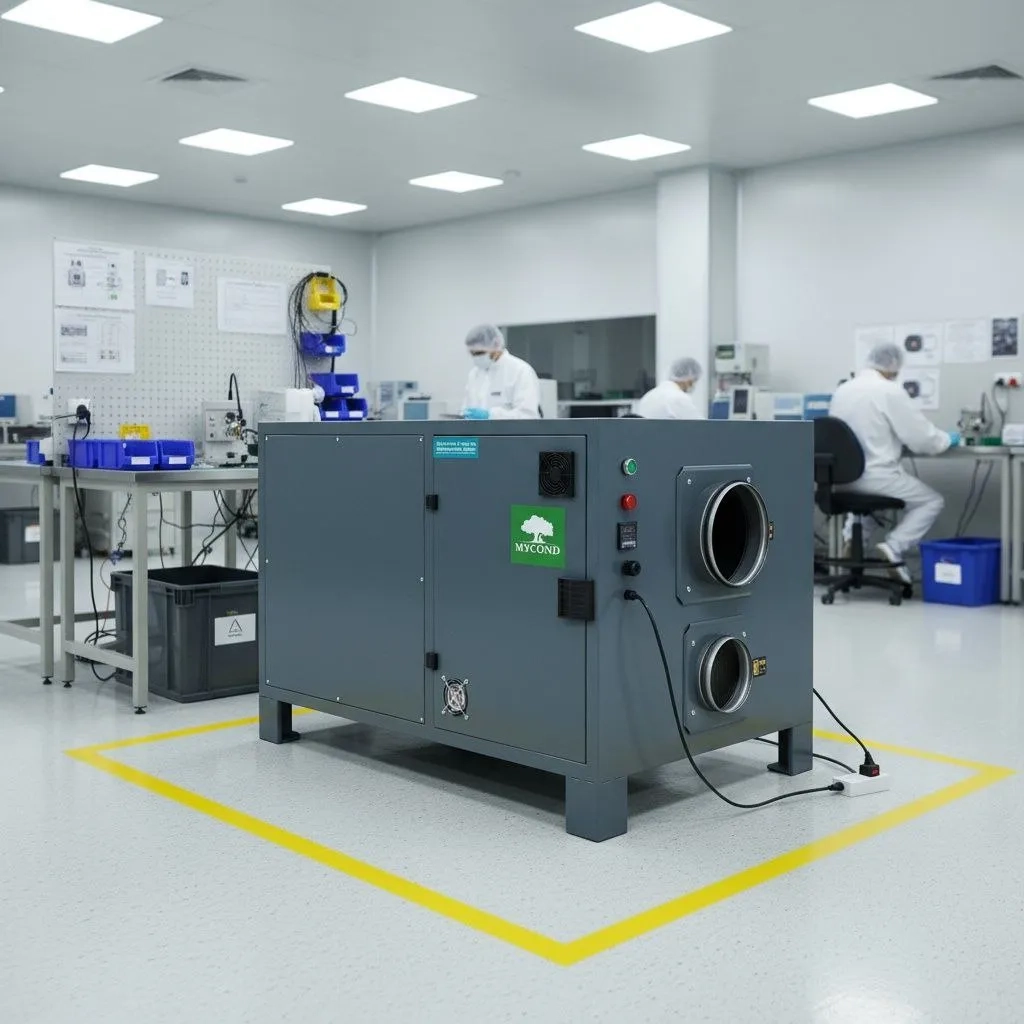
Effective air dehumidification in industrial and commercial spaces is not just about installing powerful equipment. The key to success is a properly designed control and automation system that maintains precise humidity setpoints and optimizes energy consumption. In this article, we examine engineering aspects of selecting, configuring, and operating dehumidifier control systems.
Why humidity control is a dynamic process
The moisture load in a space constantly changes: it fluctuates throughout the day and depends on the season, occupants, production processes, and many other factors. Particular attention should be paid to infiltration through doors and other openings—within one minute, more moisture can enter through an open door than a dehumidifier can remove in an hour of operation. That’s why the control system must respond to these changes promptly.
Humidity control devices perform four basic functions: measuring air humidity or the moisture content of materials, indicating measured values, recording readings (on a chart or in electronic memory), and controlling dehumidification equipment. It’s important to understand that each additional function increases not only the system’s cost but also the potential for errors. For many applications, for example a simple warehouse where you only need to keep humidity below 60%, a basic humidistat costing under $100 without extra indication and data logging is entirely sufficient.

Types of relative humidity sensors
The core of any dehumidification control system is the humidity sensor. Below are the main types of relative humidity sensors used in modern dehumidifier automation systems.
Mechanical hygrometers operate based on the change in length of natural or synthetic materials as they absorb moisture. Leonardo da Vinci noticed that a wool ball weighs more on a humid day. Modern mechanical hygrometers use human hair or polymer films that elongate as humidity increases. These instruments are simple but have limited accuracy.
Capacitive sensors measure the change in electrical capacitance of a polymer as it absorbs moisture. They show better sensitivity at low humidity (below 15% RH), making them ideal for dehumidification control in processes that require low relative humidity values.
Resistive sensors measure the change in electrical resistance of a polymer with quaternary ammonium salts. These sensors deliver higher accuracy at high humidity levels (over 90% RH) because they measure bulk rather than surface moisture absorption.
Psychrometers use a pair of thermometers—dry and water-wetted. The temperature difference between them is proportional to the rate of water evaporation and, accordingly, to the air’s relative humidity.
The typical accuracy of industrial humidistats is ±2% RH. It’s important to understand their limitations: if a device is calibrated at 24°C and 65% RH, it may produce significant errors when measuring humidity at 21°C and 10% RH due to the large difference in air moisture content.
Absolute humidity sensors
For more precise dehumidification control, absolute humidity sensors are often used. They measure actual moisture content in the air regardless of temperature.
Condensation hygrometers (dew point sensors) work by cooling a mirror surface until condensation appears. The temperature at which condensation forms equals the air’s dew point. This method has been used since 1751, when French naturalist Charles Le Roy added ice to a polished steel container to observe the phenomenon. Modern optical condensation hygrometers have a typical accuracy of ±1.5°C dew point and are considered the most accurate instruments for measuring humidity.
Aluminum oxide sensors offer a typical accuracy of ±3°C dew point and are optimized for very low humidity. They are used to measure a dew point of -40°C at air temperatures above 150°C, for example at the outlet of desiccant dehumidifiers used to dry plastic pellets. However, they have a significant drawback: aluminum oxide strongly binds water, so when switching from moist to dry air, the sensor response can take hours.
Lithium-chloride sensors operate by heating a salt layer until it dries. At a relative humidity of 11%, lithium chloride transitions from a liquid solution to a dry state, and the salt temperature at that moment is proportional to the air’s absolute humidity.
The concepts of accuracy and repeatability
When selecting humidity sensors for dehumidifier automation systems, it is critical to distinguish between the concepts of accuracy and repeatability of humidity measurements.
Accuracy is a device’s ability to display the true humidity value. Repeatability is the ability to return to a previous reading when previous humidity conditions are restored.
The key engineering principle is that a repeatable instrument can always be calibrated to be accurate, whereas a non-repeatable instrument will never be accurate, no matter how often it is calibrated. That’s why manufacturers of high-quality humidity control devices always specify repeatability in technical specifications, while cheap sensors are described only in terms of accuracy.
Choosing the controller type
The correct choice of controller type affects both the precision of maintaining the set parameters and the overall energy efficiency of the dehumidification system.
On-off control of the dehumidifier is sufficient when high control precision is not required. For example, for a refrigerated warehouse loading dock where the main task is to prevent floor icing, precision control with ±1% RH accuracy is impractical. The typical humidity swing range for condensing dehumidifiers with on-off control is about ±10% RH.
Modulating control is necessary for industries with tight humidity tolerances: pharmaceuticals, semiconductor manufacturing, drying confectionery. Desiccant dehumidifiers with power modulation provide humidity control accuracy of ±5% RH or better.
Let’s compare three types of controllers using the example of a loading dock at 4°C:
- Relative humidity controller set to 80% RH will turn on the dehumidifier when air moisture content exceeds 4 g/kg (provided the temperature is maintained at 4°C). This is the cheapest option with ±2% RH accuracy, but if the temperature differs from the design value, control will be inaccurate.
- Condensation controller on the floor or conveyor would be the ideal solution, as the dehumidifier would only run when moisture is actually condensing. However, such sensors are too fragile for floors with forklift traffic.
- Dew point controller set to 1°C is more accurate than a humidistat and independent of air temperature. It can be mounted on a wall rather than on the floor, simplifying operation.
Power modulation strategies
To optimize energy consumption and improve humidity control accuracy, various power modulation strategies are used in dehumidifiers.
Dehumidifier bypass control is used mainly for desiccant dehumidifiers. When the moisture load decreases, part of the air is directed around the desiccant rotor through a bypass, then mixed with the dried stream to raise the supply air humidity. It is critical to match the pressure drop of the bypass and the rotor using a fixed damper in the bypass duct—without this, modulation will be nonlinear and unstable.
Reactivation energy control is the most effective and least expensive way to save energy. A temperature controller at the outlet of the reactivation zone reduces heater power when the temperature exceeds 49°C (for systems with lithium-chloride desiccants). The physical principle is that when air absorbs moisture from the rotor in the reactivation zone, its temperature drops—similar to how air near a fountain feels cooler in summer. If the temperature remains high, it means there is little moisture, and reactivation energy can be reduced. Savings with this control typically amount to 25–50% of annual energy costs.
There are two levels of modulation:
- First level — reactivation load following control — reduces heater power as the moisture load decreases. This offers the best ratio of system cost to achieved savings.
- Second level — equipment reconfiguration (part-load control dehumidifier) — uses microprocessors and variable-frequency drives for fans and compressors. The cost is high and justified only for large industrial installations.
Sensor placement
Correct placement of humidity sensors is a critical success factor for the entire dehumidifier control and automation system.
Here is a real-world example: a corrosion protection system for steel structures was not working even though the dehumidifier was operating correctly. The reason turned out to be that the humidistat was installed near the dry air discharge, 23 meters away from the storage racks. As a result, the dehumidifier kept the air in the duct dry, but steel parts worth $50,000 were corroding.
The golden rule: the sensor must be placed close to the protected object, not next to the dehumidifier.
At low humidity (below 10% RH), the sensor placement problem becomes more acute. The difference between 50% and 55% RH at 21°C is about 0.85 g/kg, but the difference between a dew point of -29°C and -26°C is less than 0.01 g/kg—85 times less! This means the sensor must be much more sensitive, and humidity gradients in the room can be significant due to people breathing and local moisture sources.
Integration with BMS
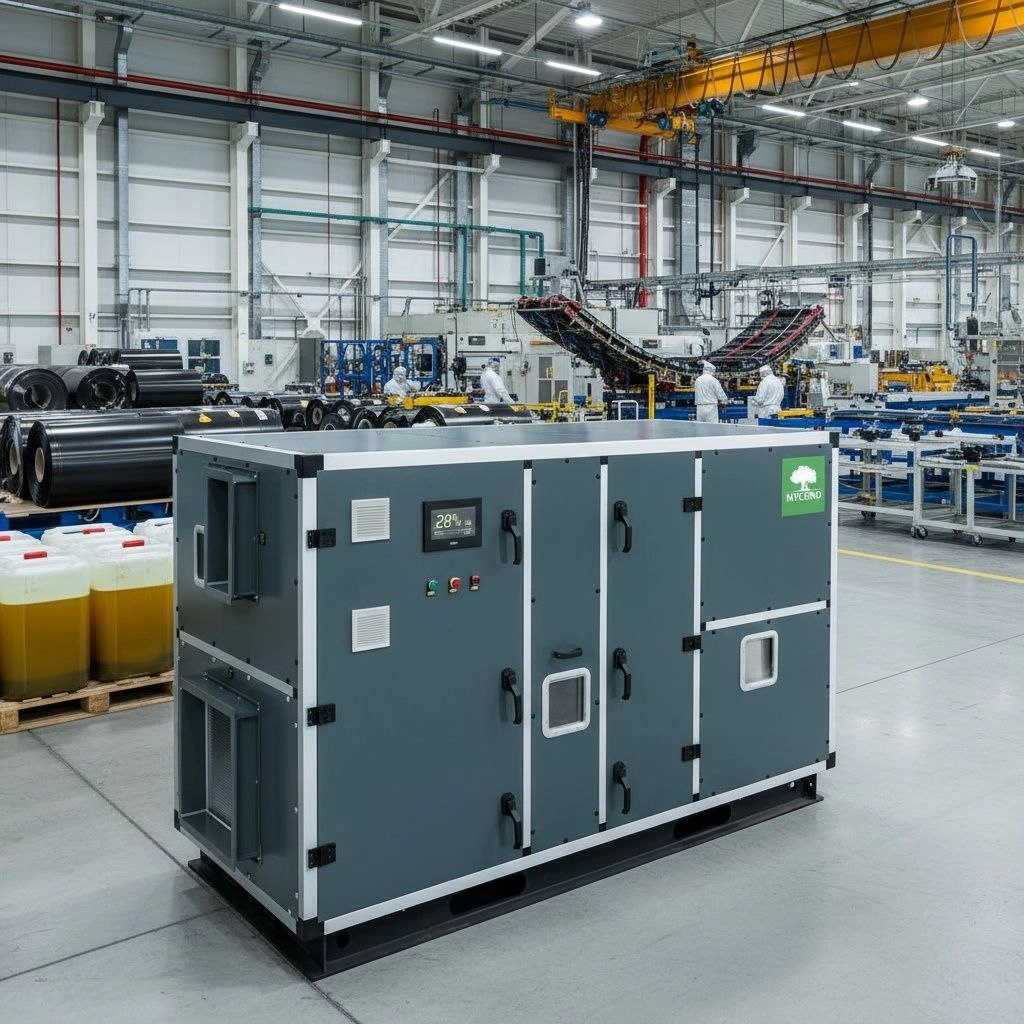
Modern industrial dehumidifiers are often integrated into the overall Building Management System (BMS), which provides centralized monitoring and control.
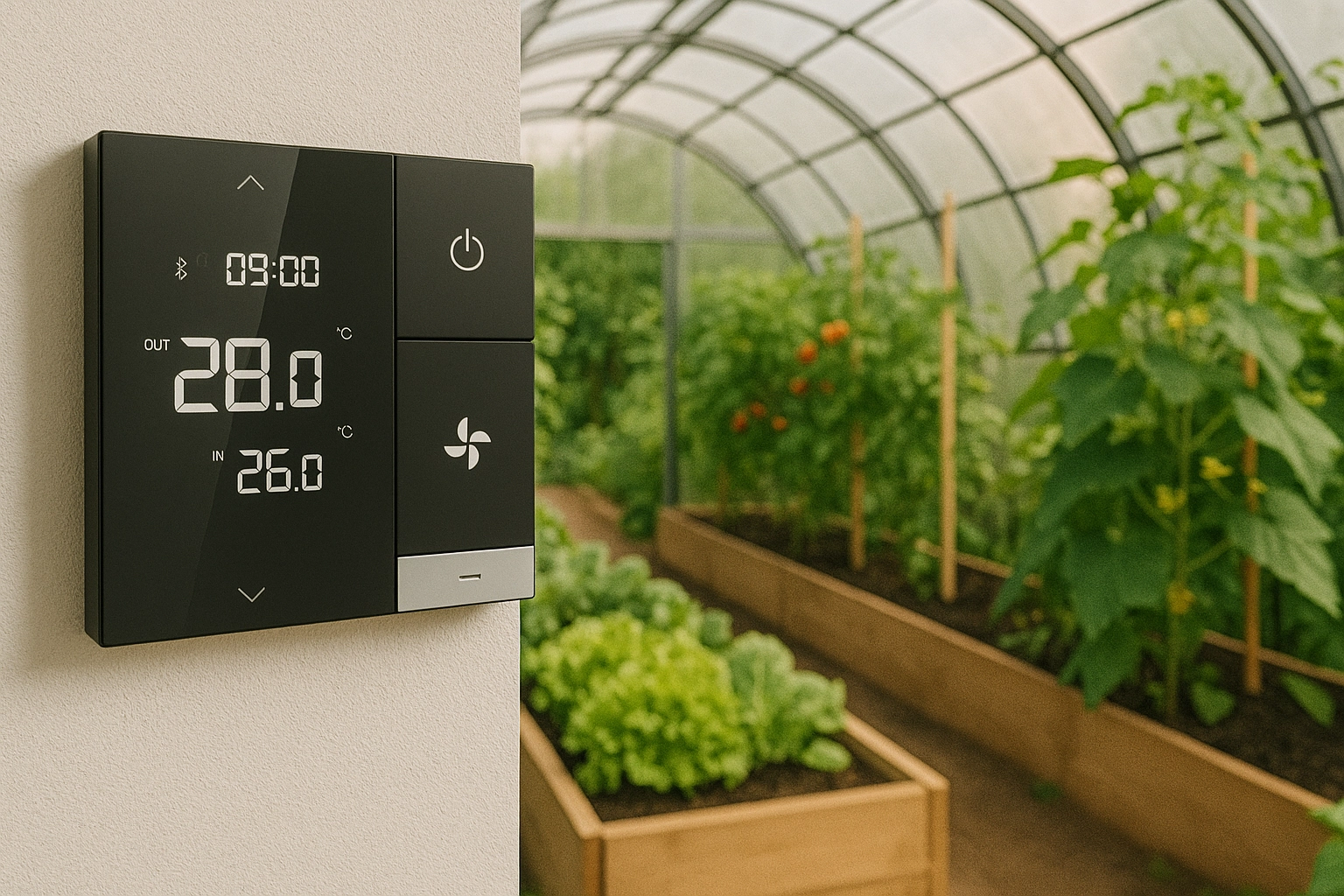
Most professional dehumidifiers are equipped with a Modbus RS485 interface for connection to BMS. Programmable logic controllers (PLCs) with touchscreens allow time schedules to be set and complex dehumidification algorithms to be implemented.
Remote monitoring via BMS ensures prompt response to deviations of humidity parameters from set values, which is especially important for critical applications such as pharmaceutical production or server rooms.
Common design mistakes
When designing dehumidifier control and automation systems, the following mistakes are common:
- Oversizing equipment with on-off control, causing large humidity swings. This is similar to a car that has an on/off switch instead of a gas pedal.
- No reactivation energy modulation, which wastes 25–50% of energy.
- Sensor calibration at temperatures and humidity levels different from operating conditions, leading to systemic errors.
- Locating the indicator and controller in different places, causing constant reading discrepancies, since no two sensors read exactly the same.
- Ignoring material drying time during commissioning. For example, corrugated cardboard at 80% RH contains 14% moisture, and at 35% RH—only 6%. After bringing in moist cardboard, the system may run at full capacity for days while the material releases moisture.
FAQ
1. What is the typical control accuracy for different types of dehumidifiers?
Condensing dehumidifiers with on-off control provide control accuracy within ±10% RH. Desiccant dehumidifiers with power modulation achieve ±5% RH or better. For precision applications with optical dew point sensors, accuracy of ±1–2% RH is possible.
2. How to choose between relative humidity control and dew point control?
Relative humidity control is cheaper and sufficient for most comfort and storage applications with an acceptable accuracy of ±3% RH. Dew point control is necessary when air temperature varies significantly or when high accuracy is required at low humidity (below 10% RH).
3. Why shouldn’t the sensor be placed near the dehumidifier outlet?
The air at the dehumidifier outlet is the driest in the system and does not reflect actual conditions in the protected area. The sensor must measure humidity where the outcome matters—near the protected object or process.
4. When is simple on-off control sufficient?
On-off control is sufficient for long-term storage warehouses with stable loads, for spaces where a wide humidity range (40–60% RH) is acceptable, and when annual energy costs are low compared to the cost of a modulation system.
5. How does reactivation energy modulation reduce operating costs?
The system reduces heater power when the moisture load is lower than design. Savings amount to 25–50% of annual energy costs, and the payback of a modulating controller is usually less than a year.
6. What is reactivation load following control?
This is the first level of modulation, where a temperature controller at the reactivation outlet automatically reduces heater power when the temperature rises above 49°C. It is the simplest and most effective way to save energy in desiccant dehumidifiers.
7. How do you integrate a dehumidifier into the building’s automation system?
Via the Modbus RS485 interface, the dehumidifier connects to the BMS, transmits humidity, temperature, and equipment status data, and receives commands to change setpoints and operating modes, enabling centralized monitoring and control of all building engineering systems.
Conclusions
The choice of dehumidifier control and automation system is determined by the required precision of humidity control and economic justification. For most commercial and industrial applications with an allowable deviation of ±5–10% RH, a humidistat with reactivation energy modulation is sufficient.
Precision industries such as pharmaceuticals or electronics require dew point control and full power modulation of the dehumidifier to achieve high humidity control accuracy.
It is important to remember that humidity sensor placement is often more important than its technical accuracy. The most accurate instrument installed in the wrong place will deliver worse results than a simple humidistat located directly next to the protected object.
Integration with BMS provides timely control of dehumidifier operation and documentation of humidity parameters for process validation, which is especially important for regulated industries.