










































Author: Mycond Technical Department
Designing humidity control systems is one of the most ambiguous tasks in creating HVAC systems. The main engineering challenge is that, unlike temperature parameters, there are no universal humidity requirements for different building types. Conflicting demands from processes, materials, equipment, and human comfort create design ambiguity that often leads to incorrect decisions with economic consequences.
The physics of air humidity
Air humidity characterizes the amount of water vapor in air. We distinguish absolute humidity (the amount of moisture in grams per cubic meter of air) and relative humidity (the percentage saturation of air with moisture at a given temperature). A key feature is that as air temperature rises, its capacity to hold moisture increases exponentially.
To illustrate the method for calculating dew point, consider: air at 25°C and 60% relative humidity has a dew point of about 16.7°C. This means that when surfaces are cooled below this temperature, condensate will begin to form on them. This calculation shows why condensation can occur in rooms with cold surfaces even when the air parameters seem normal.
Mechanisms by which humidity affects materials are diverse: hygroscopic materials (wood, paper, textiles) change their dimensions and physical properties; metals are subject to corrosion, especially with cyclic humidity changes; electronic equipment suffers from condensation and from static electricity at very low humidity.
Regulatory framework for humidity control
Modern humidity requirements in buildings are regulated by several key standards. According to EN 16798-1:2019, indoor environmental quality (IEQ) is classified into categories I to IV. For each category, ranges of relative humidity are specified to provide different levels of comfort and process needs.
The adaptive comfort concept recognizes that the human body adapts to seasonal changes. Lower RH values are acceptable in winter (due to the lower absolute moisture capacity of cold air), and higher ones in summer. To illustrate the effect of temperature on humidity: air at 50% RH at 20°C contains approximately 8.7 g/m³ of water vapor, and when heated to 25°C its relative humidity drops to 37%, although the absolute moisture content remains unchanged. This shows the importance of understanding absolute humidity when designing ventilation systems.
The methodology for design parameters is based on statistical approaches that account for the percentage of time limits are exceeded. According to ASHRAE Standard 55-2020, the comfortable relative humidity range for people is 30–60%, with the clarification that acceptable conditions depend on air temperature, air speed, and other environmental factors.
Humidity requirements in commercial buildings
In design practice for office spaces, relative humidity ranges of 30–60% are often considered. The exact limits are set by the designer depending on codes, equipment, and operating conditions. At low humidity (below 30%), occupants experience discomfort: dryness of mucous membranes, eye irritation, and an increased risk of electrostatic discharge that can damage electronics. At high humidity (above 60%), the risk of microbial and dust mite proliferation grows.
To illustrate the method for calculating moisture load, consider a notional 100 m² office with 10 employees. At moderate activity, each person emits about 50–70 g/h of moisture. At the same time, a ventilation system with 500 m³/h airflow and a 3 g/kg difference in humidity ratio between outdoor and indoor air can add up to 1,500 g/h of load. This example shows that in offices the dominant moisture load often comes from ventilation rather than internal sources.
Shopping malls are characterized by zonal differences: grocery sections require condensation control on refrigerated display cases, while areas with high visitor density have significant moisture generation. In hotels, particular attention is required for kitchens and restaurants with high process moisture emissions, and for conference halls with variable occupancy.
A typical mistake in commercial building design is applying a one-size-fits-all approach without accounting for zonal differences, leading to condensation or excessive dryness in different parts of the building.
Humidity control in industrial facilities
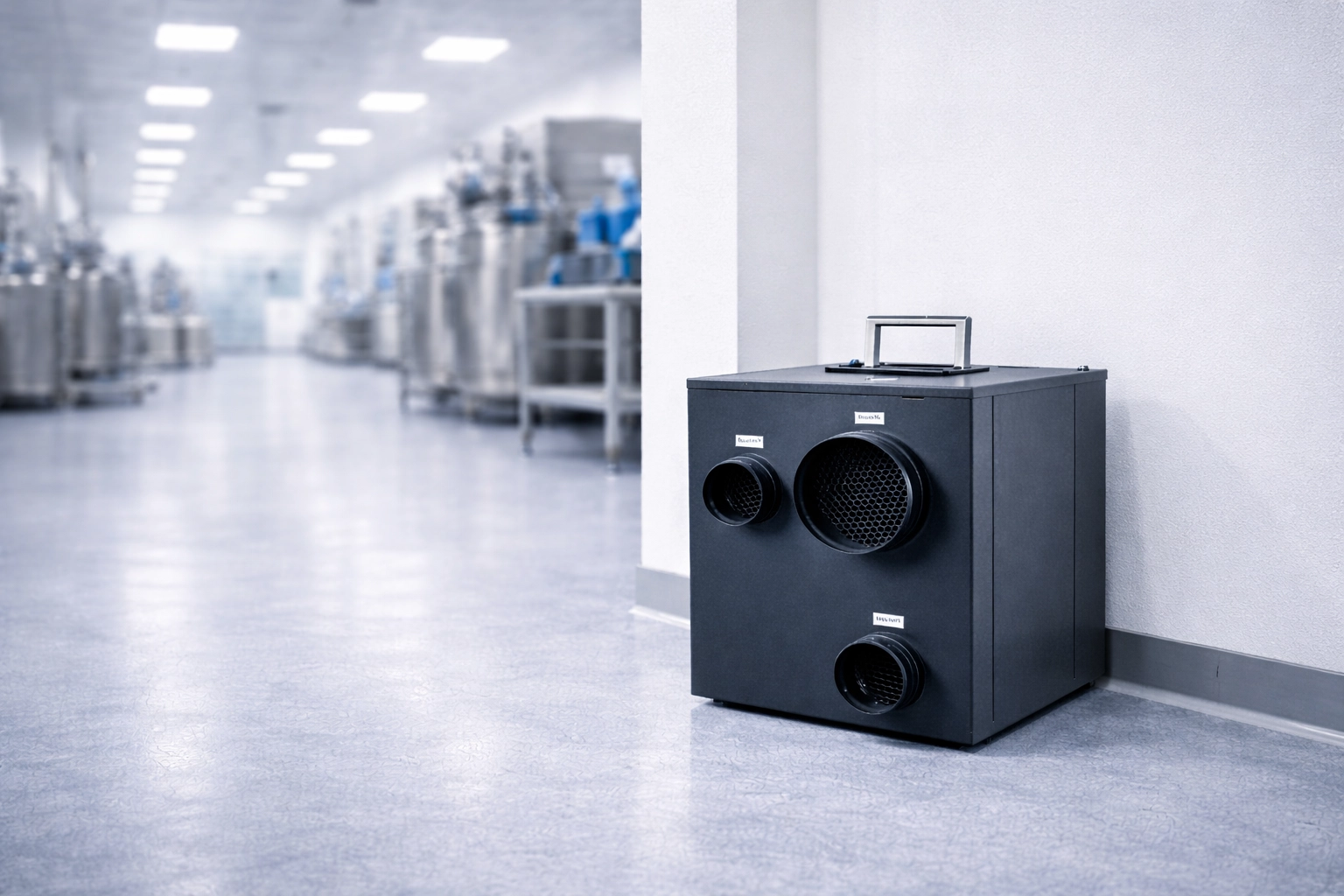
In pharmaceutical manufacturing, humidity requirements are particularly strict. According to GMP Annex 1:2020, for ISO 5 cleanrooms humidity control is a critical process parameter. In practice, such rooms often require maintaining relative humidity with ±5% accuracy. The specific setpoint is defined by the designer based on the process requirements.
The criticality of humidity control is explained by its impact on hygroscopic powders, which can change their properties when humidity deviates. To illustrate the methodology, consider a notional 50 m² cleanroom with 20 air changes per hour: if 40±5% RH must be maintained, the system must be able to both dehumidify and humidify the air depending on outdoor conditions and internal moisture generation. The calculation illustrates the approach; in a real project all data come from the technical specification.
In the food industry, humidity requirements depend on the process: drying lines need air with low absolute humidity for efficient moisture removal from the product; bakeries require controlled humidity to ensure dough and baking quality.
Warehouses require humidity control to prevent product spoilage; in cold rooms it is critical to prevent frost and ice formation. For the electronics industry, especially in microchip production and photolithography processes, humidity control directly affects product quality—deviations can lead to significant economic losses due to scrap.
In textile manufacturing, air humidity affects yarn breakage, and in woodworking it affects the equilibrium moisture content of timber, which determines final product quality.
Humidity requirements in institutional facilities
Hospital spaces, especially operating rooms, have specific humidity requirements. In hospital design practice, relative humidity ranges of 40–60% are used for general areas and 30–60% for operating rooms. Specific parameters are determined by the designer based on national codes and the types of procedures. The key is balancing the prevention of static electricity (which occurs at low humidity) and limiting microbial growth (which is promoted at high humidity).
To illustrate the methodology, consider a 40 m² operating room: an air change rate of 15–20 per hour creates the primary load on the humidity control system, and a surgical team of 5–7 people plus evaporation from the patient’s exposed surfaces add about 300–500 g/h of moisture. The system must compensate for these loads while maintaining parameters within the limits defined by medical standards.
In educational facilities, humidity directly affects comfort and the ability to concentrate. Fluctuations in relative humidity can influence perceptions of stuffy air and overall discomfort among students and teachers.
Museums and archives have particularly specific requirements. Conservation guidance indicates that for paper materials, paintings, textiles, and some woods, an optimal relative humidity level is 45–55% with minimal daily fluctuations. Different exhibit types may require different conditions, necessitating zoning of air-conditioning systems. Physical degradation mechanisms include cyclic material stresses due to humidity changes and mold growth at RH above 65% over prolonged periods.
Humidity control in sports facilities
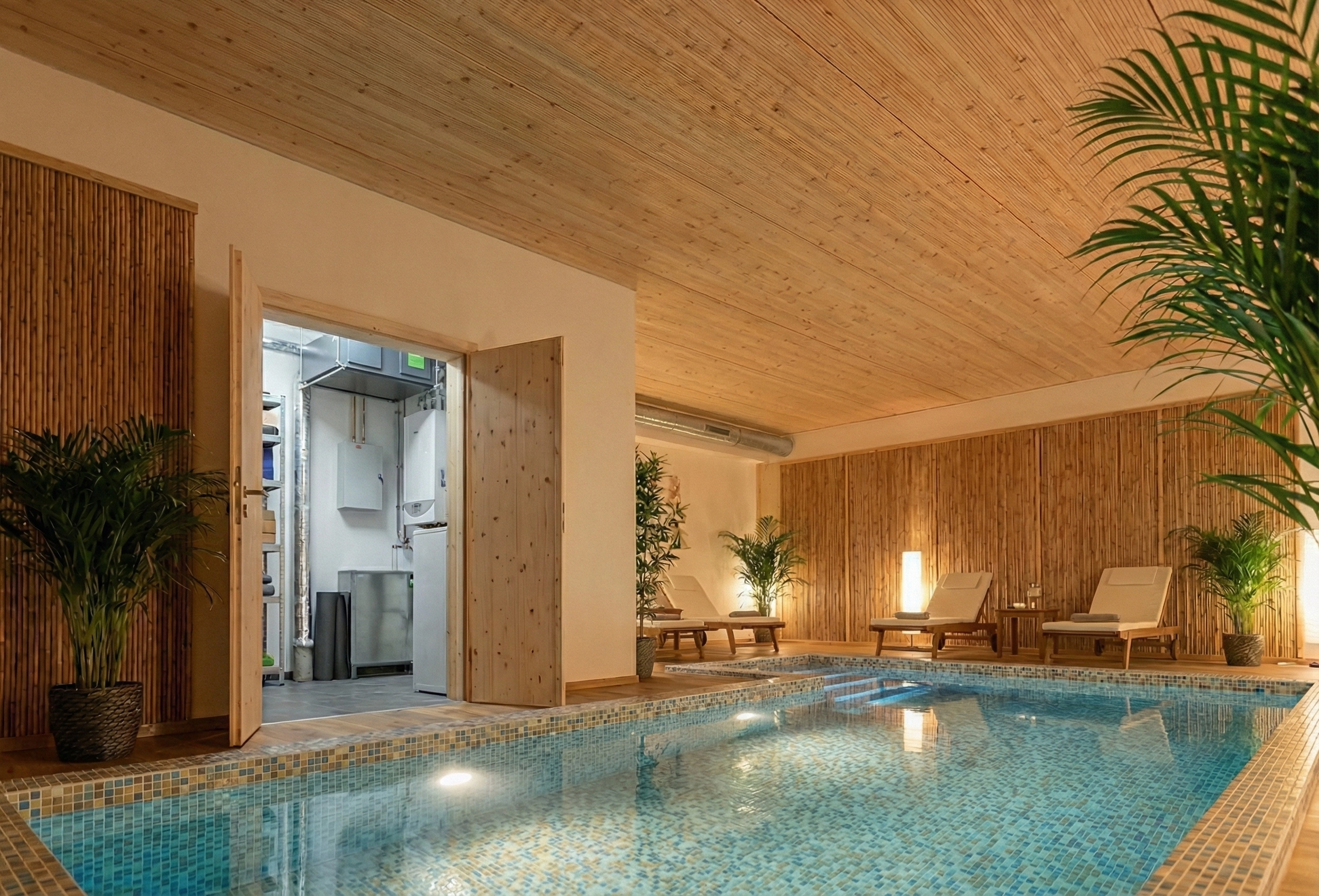
In the design of indoor pools, relative humidity ranges of 50–65% are commonly used. The exact values depend on equipment, national standards, and pool type. The main challenge is intense evaporation from the water surface, especially at elevated water temperatures.
To illustrate the method for calculating evaporation from a pool surface, consider a 25×10 m pool with water at 28°C and air at 30°C: under such conditions, evaporation may be about 30–40 kg/h with no activity and 60–80 kg/h during active use. The methodology is applied using the project’s actual inputs, considering bather activity, water surface area, and the difference between saturated water vapor pressure at the water surface and in the room air.
A key task of the humidity control system is preventing condensation on cold surfaces (windows, metal structures), which can lead to corrosion and deterioration of building components.
Gyms and spa complexes have different requirements across zones: dry and wet saunas, showers, and relaxation areas require a differentiated approach.
Ice arenas present a particular engineering challenge due to the need to maintain low absolute humidity to prevent fog over the ice and condensation on building structures.
Humidity requirements in data centers
According to ASHRAE TC 9.9 (2021), recommended relative humidity ranges for data centers are 20–80% for A1-class equipment. In practice, these ranges are often narrowed to provide additional reliability margins, especially for critical systems. Specific parameters depend on equipment manufacturers’ requirements.
The main risks are: at low humidity—static electricity that can damage electronic components; at high humidity—condensation on boards during localized cooling. The modern approach to data center design involves broadening allowable humidity ranges to improve energy efficiency, especially when using free cooling systems.
Humidity requirements in residential buildings
For residential buildings, relative humidity ranges of 30–60% are commonly considered. Exact values depend on national codes, climate zone, and season. In winter, lower values are typical due to the low absolute humidity of outdoor air introduced by ventilation and infiltration.
The impact of humidity on occupants’ health is significant: overly dry air leads to respiratory irritation, dry skin and eyes; high humidity promotes the growth of and mites, which can trigger allergic reactions.
The main household moisture sources are human respiration (about 40–50 g/h per person), cooking (500–1,500 g/h), laundry and indoor drying (300–500 g/h), houseplants, and showers. The physical causes of elevated humidity in dwellings are often related to insufficient ventilation, especially in moisture-generating rooms (bathrooms, kitchens).
Methodology for calculating moisture loads
Designing humidity control systems is based on a hierarchy of requirements: process needs first, then regulatory, and lastly comfort. Calculating moisture loads includes determining all sources of moisture addition and removal:
Sources of addition: outdoor air (depending on climate conditions), people, industrial processes, evaporation from open water surfaces, moisture released by materials.
Removal mechanisms: ventilation, condensation on cooling coils, adsorption dehumidification, absorption by materials.
Dehumidification system capacity is determined with safety factors that depend on the uncertainty of input data and the criticality of maintaining the set parameters. Typical safety factors are 1.1–1.3 for well-defined conditions and 1.5–2.0 for systems with high uncertainty or critical requirements.
Zoning of humidity control systems
The principle of zoning is to divide the building into zones with homogeneous humidity requirements and to separate rooms with sharply different requirements. This allows optimization of energy use and improved reliability of parameter maintenance.
Technical solutions include using local dehumidifiers or humidifiers for individual zones, air curtains between zones with different requirements, airlock vestibules for critical rooms, and cascade control of airflow from zones with stricter requirements to less demanding ones.
Typical mistakes in designing humidity control systems
The most common design mistakes are:
1. Application of universal approaches without considering the specifics of rooms and processes.
2. Underestimation of loads from outdoor air, especially in hot, humid climates.
3. Lack of proper zoning, leading to energy waste and inability to maintain parameters in critical zones.
4. Operational errors: improper control set-up, lack of regular system maintenance, failure to account for seasonal changes in operating modes.
5. Measurement errors: uncalibrated sensors, improper placement of humidity sensors, failure to account for the impact of temperature gradients on instrument readings.
Operational consequences of improper humidity control
Excess humidity leads to:
- Condensation on cold surfaces, causing staining, paint flaking, and wood rot.
- Corrosion of metal elements, especially with cyclic humidity changes.
- Growth of microorganisms, including mold and bacteria, degrading air quality and creating health risks.
Insufficient humidity causes:
- Discomfort due to dryness of mucous membranes, eye irritation, respiratory issues.
- Static electricity that can damage electronics and cause discomfort.
- Mechanical damage to materials due to shrinkage, cracking of wooden items, delamination in composite materials.
Economic consequences include increased repair costs, reduced service life of equipment and building structures, lower staff productivity, and higher energy consumption under suboptimal operating modes.
Humidity control systems
Effective humidity control requires reliable measurement and control systems. Relative humidity sensors differ by operating principle (capacitive, resistive, psychrometric) and have varying accuracy and stability. Critical applications require sensors with regular calibration.
The automation system must provide integrated control of air parameters, accounting for the interdependence of temperature, humidity, and ventilation. Modern solutions include predictive control that considers system inertia and the dynamics of changing outdoor conditions.
Energy efficiency of humidity control systems
Energy-efficient approaches to humidity control include:
1. Air recirculation to reduce the amount of outdoor air requiring treatment.
2. Use of rotary heat recovery wheels with moisture transfer to precondition outdoor air.
3. Use of adiabatic cooling in combination with adsorption dehumidifiers.
4. Cascade control with optimization of operating modes depending on outdoor conditions and internal loads.
Conclusions
Humidity control in buildings of various purposes is a complex engineering task that requires an individual approach accounting for building specifics, technological processes, climate conditions, and comfort requirements.
Key principles to consider in design:
1. Hierarchy of requirements: process > regulatory > comfort.
2. Need for zoning for rooms with different requirements.
3. Consideration of parameter dynamics, not only static values.
4. Selection of technical solutions with regard to energy efficiency and operating costs.
5. Provision of a reliable automation system with monitoring and data analytics.
By following these principles and having a deep understanding of the physical processes related to air humidity, it is possible to create effective, reliable, and economical systems that provide optimal conditions for people, processes, and materials in buildings of all types.


