









































Author: Mycond Technical Department.
Effective control of the indoor climate in hotel spaces is a key factor for ensuring guest comfort, preserving assets, and optimizing operating costs. Traditional hotel HVAC systems are designed for peak sensible loads, but overlook an important nuance: the moisture load remains constant due to continuous ventilation, while sensible load fluctuates sharply with guest check-in and check-out. This creates a situation where the compressor shuts off due to low sensible load, yet humidity continues to enter with ventilation air and accumulates indoors.
Excess humidity in hotels: shortcomings of traditional HVAC systems
Hotel spaces have a specific usage profile. When guests check in, the sensible load rises sharply due to human activity, electrical appliances, and lighting. When guests are absent, this load drops, forcing air-conditioning systems to cycle. However, fresh ventilation air continues to enter the building continuously, constantly adding a moisture load.
Traditional vapor-compression cooling systems are designed to quickly reduce temperature. When the desired room temperature is reached, the compressor switches off and stops removing moisture from the air. This leads to a gradual buildup of humidity in the room, especially when it is unoccupied.
The consequences of such moisture accumulation are serious: a musty odor appears, creating discomfort for guests; building structures and furniture are damaged; mold and mildew develop. Hotels and motels are often forced to regularly replace room furniture precisely because of these issues and the accelerated wear caused by excessive humidity.
Technical causes of humidity issues
Hotels experience significant fluctuations in sensible loads throughout the day, especially in conference rooms and guest rooms. These loads can change dramatically, but the moisture load remains fairly constant because the building continuously receives fresh air in accordance with ventilation requirements for occupied spaces.
Standard cooling systems have limited dehumidification capability at low sensible loads. Effective moisture condensation on cooling coils requires a sufficiently low coil surface temperature. When the sensible load decreases, the system simply turns off before removing excess moisture from the air.
Psychrometric analysis explains why this happens: air leaving cooling coils is typically nearly saturated (about 90–95% relative humidity). Such air cannot absorb excess moisture from the room—on the contrary, when room temperature rises, relative humidity may increase to uncomfortable levels.
Hotels with pools and spa areas create an additional challenge due to significant moisture loads. Through the shared ventilation system, this humid air can migrate to other hotel zones, exacerbating the over-humidity problem.
Consequences of insufficient humidity control for the hotel business
Excess humidity in hotel rooms causes serious furniture damage. Mold and mildew develop, wood warps, and metal hardware corrodes. All of this necessitates premature replacement of room furniture, leading to substantial capital expenditures that could otherwise be deferred for several years.
In practice, some hotel chains that implemented effective humidity control have extended furniture service life by 3–4 years (a typical engineering range according to design practice), significantly reducing capital expenses for room refurbishment.
Another problem is the proliferation of microorganisms in downstream ductwork from cooling coils and in condensate drain pans. These areas, where air remains saturated with moisture, create ideal conditions for mold and fungi growth, aligning with the “sick building syndrome” concept. This leads to degraded air quality and a musty odor that guests immediately notice.
Unsatisfied guests leave negative reviews about odors and discomfort, which reduces hotel ratings on booking platforms and undermines competitiveness in the hospitality market. In today’s world, where online reputation is critical, such issues can seriously impact business performance.
HVAC modernization concept: adding separate humidity control
Modernizing the existing HVAC system by adding separate humidity control is the optimal solution. The key principle is independent control of temperature and humidity, where temperature is regulated by the traditional cooling system, and humidity is controlled separately by a dehumidifier.
The concept of deep dehumidification of supply air is particularly effective. Dehumidifiers are used to pre-dry fresh ventilation air so it can act like a “sponge” that removes excess moisture from rooms even when the cooling system is off due to low sensible load.
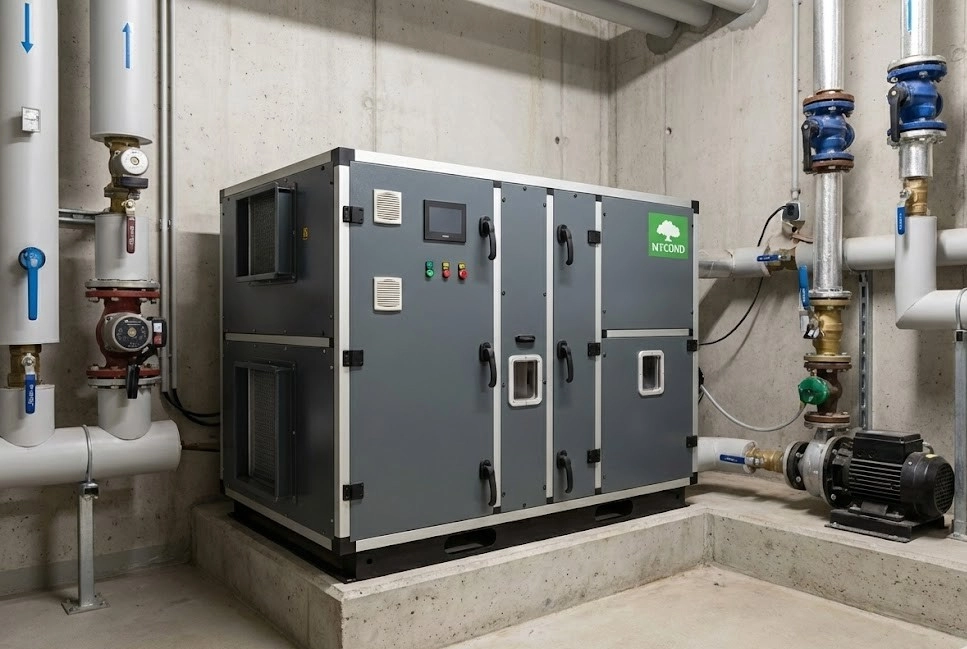
Depending on operating conditions and requirements, desiccant or condensing dehumidifiers can be integrated with the existing HVAC system. Desiccant dehumidifiers remove moisture through adsorption using hygroscopic materials, while condensing dehumidifiers cool air below its dew point and then reheat it.
The main advantage of modernization over full HVAC replacement lies in retaining functioning equipment and avoiding massive capital costs for a new installation. Adding dehumidifiers to the existing system is a cost-effective solution that addresses excess humidity without radical changes.
Specific technical solutions for modernization
The choice of dehumidifier type depends on climate, operating temperature range, and the required level of dehumidification. Condensing dehumidifiers are effective at temperatures above the typical operating range of heat exchangers (approximately 12–15°C, depending on equipment; exact limits are defined by the manufacturer’s technical documentation). They can reduce humidity to comfortable levels (typically 40–50% relative humidity for hotel spaces according to design practice; exact values depend on room use and local codes).
Desiccant systems operate at any temperature and can provide deeper drying if needed. They are especially effective when very low humidity levels must be maintained or when the system operates at low temperatures.
When integrating dehumidifiers into the system, two main options are considered: pre-drying the incoming fresh air before it mixes with return air, or dehumidifying air directly before the cooling coils to reduce the latent load on the cooling system.
The humidity load calculation for a hotel should account for ventilation air per air-change standards, infiltration through lobby doors and service entrances, moisture generation from occupants in rooms, corridors, and conference spaces, using typical per-person moisture emission values.
For hotels with pools and spa areas, separate specialized dehumidification systems must be provided, since the moisture load from open water surfaces is extremely high. It is important to properly integrate the pool system with the building’s general ventilation to prevent migration of moist air to other hotel zones.
The control and automation system should include humidity sensors placed in characteristic zones and algorithms for modulating dehumidifier capacity depending on current load to save energy. Recovered heat from the condensers of existing refrigeration systems or from cogeneration units can be used for desiccant regeneration, significantly reducing operating costs.
ROI calculation and economic efficiency of the project
The economic feasibility of modernizing a hotel’s HVAC system by adding dehumidification is determined by several factors. A key factor is lower operating costs due to extended furniture service life. By preventing mold and mildew, some hotel chains have managed to extend the service life of room furniture by several years, deferring capital expenditures on room refurbishment.
For illustration: for a 100-room hotel, a notional example of savings can reach tens or hundreds of thousands of euros depending on hotel class and furniture cost (this is an illustrative example, not a design value; specific figures are determined by financial analysis).
Deferring furniture replacement (typically by 3–4 years according to hotel industry practice) allows capital to be reallocated to other business needs, improving overall financial performance.
An important aspect is higher guest satisfaction due to the absence of musty odors and more comfortable conditions. This leads to better ratings on booking platforms, more repeat bookings, and an increase in the revenue per available room metric, which is a key measure in the hotel business.
Additional savings are achieved by reducing HVAC maintenance costs. Preventing microorganism proliferation in ductwork and condensate pans reduces the need for frequent cleaning and disinfection of these elements.
For hotels with pools, there is an additional economic effect from lower energy consumption for exhaust ventilation in pool areas. When specialized dehumidifiers are used, there is no need to exhaust such large volumes of air to the outside, saving energy on heating supply air in winter.
The typical payback period for mid-range hotels is 2–4 years (depending on the initial condition of systems and hotel usage intensity—this is not a guaranteed figure but an engineering guideline that must be confirmed by a detailed financial analysis of the specific property).
When comparing initial investments with long-term benefits (over a typical 20-year service life of dehumidification equipment based on operational experience), the cumulative effect may conditionally exceed initial costs by 10–15 times under favorable conditions (this is an illustrative estimate, not a design guarantee).
Practical recommendations for implementing the modernization project
Before starting modernization, it is necessary to survey the existing HVAC system to assess its latent removal capacity, check the condition of cooling coils, their surface temperatures, and performance.
An important step is to minimize moisture loads before installing equipment. This is achieved by sealing the building envelope, eliminating excessive air leakage through doors and windows, and optimizing ventilation to reduce fresh air quantity (where possible without violating codes).
When implementing the project, a phased strategy can be chosen: start with pilot zones such as one floor or wing to validate effectiveness and refine the approach, or immediately implement a comprehensive modernization across the entire hotel if the budget allows.
The selection of equipment installation points depends on the building configuration and existing system. Options include rooftop units for centralized supply-air dehumidification or placement in mechanical rooms near existing air-handling units.
Typical design mistakes include underestimating moisture loads from door openings, choosing the wrong dehumidifier type for specific conditions, and failing to integrate controls with the existing building automation system. Engaging qualified engineers with hotel-sector experience helps avoid these errors.
Frequently asked questions (FAQ)
Is it possible to add dehumidification without replacing existing chillers?
Yes, this is the main advantage of the proposed modernization approach. The principle of independent humidity control allows you to keep the existing cooling equipment and add a dehumidification system. Dehumidifiers can be integrated into the existing HVAC with minimal configuration changes, providing humidity control independent of cooling compressor operation.
How much does it cost to modernize a hotel HVAC system by adding dehumidification?
The cost of modernization depends on several key engineering factors: system size (number of rooms and hotel area), the type of equipment chosen (condensing or desiccant dehumidifiers), and the complexity of integration with the existing system. The exact cost can only be determined after a detailed technical survey of the property and engineering of the appropriate solution.
What is the typical payback period for a dehumidification system in a hotel?
Payback is calculated by comparing initial investments with the sum of savings from extending furniture service life, increased guest satisfaction (which affects occupancy), and lower maintenance costs. The typical payback period is 2–4 years, but this is a calculated value that depends on each hotel’s specific conditions.
What are the optimal humidity levels to maintain in hotel rooms?
For hotel rooms, the optimal range is 40–50% relative humidity (according to design practice). Specific values may vary depending on climate zone and comfort requirements. Maintaining humidity within this range ensures guest comfort and prevents mold and mildew growth.
Why are traditional HVAC systems insufficient for humidity control in hotels?
Traditional HVAC systems are designed for peak sensible loads and control humidity only as a byproduct of cooling. When the sensible load is low (e.g., in unoccupied rooms), the compressor turns off, but ventilation air continues bringing in moisture. Without specialized dehumidification equipment, this moisture accumulates indoors, creating conditions for mold growth and guest discomfort.
Conclusions
Modernizing hotel HVAC systems by adding independent humidity control is a technically sound solution that eliminates the fundamental problem of traditional systems—the inability to effectively dehumidify air at low sensible loads.
The optimal approach is to balance capital expenditures on modernization with long-term operational efficiency. Savings are achieved by extending furniture service life, increasing guest satisfaction, and reducing maintenance costs.
When selecting a technical solution, priority should be given to equipment reliability and ease of integration with existing systems, energy efficiency, and minimal maintenance requirements.
Humidity control becomes a competitive advantage for the hospitality industry, ensuring higher service quality and optimized operating costs over decades of operation. Investing in hotel HVAC modernization by adding dehumidification is technically justified and economically sound from an engineering perspective.


